Loading...
Al-Amin vs Alexios I Komnenos
Alexios I Komnenos leads by 38.5 pts · 2 figures compared
…

Al-Amin
Emperor · Medieval
39.9Total
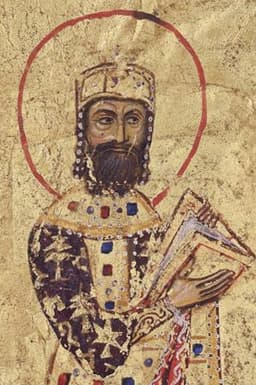
Alexios I Komnenos
Emperor · Medieval
78.4Total
Basic Information
Born
787
1048
Died
813
1118
Era
Medieval
Medieval
Nationality
Abbasid Caliphate
Byzantine Empire
Occupation
Emperor
Emperor
Civilization
Middle Eastern
Western
Score Comparison
Military (10%)
50.0
61.7
Political (20%)
30.7
78.0
Influence (20%)
47.9
88.0
Legacy (20%)
38.3
80.0
Leadership (15%)
33.6
78.0
Strategy (15%)
36.8
68.0
TOTAL
39.9
78.4
Al-Amin — Complete Timeline
811 AD
Fourth Fitna (Civil War)War
Al-Amin's reign was dominated by the Fourth Fitna, a civil war against his brother al-Mamun. The conflict began when al-Amin tried to remove al-Mamun from succession, leading to a devastating war that weakened the Abbasid Caliphate.
Impact: regionaldestructive
812 AD
Siege of BaghdadWar◆ Major
Al-Mamun's forces, led by Tahir ibn Husayn, besieged Baghdad in 812-813. The siege lasted over a year, causing widespread destruction and famine. Al-Amin was captured and executed in 813, ending his caliphate.
Impact: regionaltragic
813 AD
Execution of Al-AminPolitical Action◆ Major
After the fall of Baghdad, al-Amin was captured by Tahir's forces. He was executed on al-Mamun's orders, marking the end of the civil war and the beginning of al-Mamun's sole rule.
Impact: nationaltragic
Alexios I Komnenos — Complete Timeline
1081 AD
Battle of DyrrhachiumWar◆ Major
Alexios I Komnenos was defeated by the Norman army under Robert Guiscard at Dyrrhachium. The Byzantine forces were routed, and Alexios barely escaped. This loss allowed the Normans to occupy much of the western Balkans, though Alexios later recovered some territory.
Norman InvasionDefeatBalkans
Impact: regionaltragic
1090 AD
Reforms of the Byzantine Military and EconomyReform◆ Major
Alexios I implemented a series of reforms to restore Byzantine power. He reorganized the army by relying more on foreign mercenaries, reformed the currency (the hyperpyron), and granted tax exemptions to the Church. These measures stabilized the empire after decades of decline.
Military ReformEconomic ReformKomnenian Restoration
Impact: nationalconstructive
1095 AD
Appeal to the West: Council of PiacenzaPolitical Action
Alexios I sent envoys to Pope Urban II at the Council of Piacenza, requesting military aid against the Seljuk Turks. This appeal contributed to Urban's call for the First Crusade at the Council of Clermont later that year, initiating the Crusader movement.
First CrusadePope Urban IISeljuk Turks
Impact: global
1097 AD
First Crusade: Siege of NicaeaWar◆ Major
Alexios I cooperated with the Crusader army to besiege and capture Nicaea from the Seljuk Turks. The city was surrendered to Byzantine control, and Alexios used the Crusaders to recover key territories in Anatolia, though tensions later arose over land claims.
First CrusadeNicaeaByzantine-Crusader Relations
Impact: regionalconstructive
Expert Analysis
Alexios I Komnenos vs Al-Amin
# The Emperor and the Caliph: Two Paths Through the Medieval Storm
In the summer of 1081, a Byzantine emperor fled his own capital, his army shattered on the Albanian coast. Forty years later, in 813, an Abbasid caliph was dragged from a hiding place in Baghdad and executed by his own brother’s soldiers. Both men inherited crumbling empires, both faced civil war and foreign invasion, and both left their names to history. Yet one is remembered as a savior who reshaped the medieval world, the other as a cautionary tale of how quickly power can dissolve. What made the difference?
Origins
Alexios I Komnenos was born into a world of desperate improvisation. The Byzantine Empire in 1048 had lost Anatolia, its richest recruiting ground, to the Seljuk Turks after the catastrophe of Manzikert. The imperial treasury was empty, the army a shadow of its former self, and the court riven by factions. Alexios grew up in a military family—his father was a general, his mother a member of the powerful Doukas clan—and learned early that survival depended on alliances, not birthright. He was forty-one when he seized the throne in a coup, already a veteran of campaigns and court intrigues.
Al-Amin, by contrast, was born into the zenith of Abbasid power. His father, Harun al-Rashid, ruled a caliphate that stretched from North Africa to Central Asia, and the young prince grew up in the golden cage of Baghdad’s palaces. He was thirty-three when he inherited the throne in 809, but his education had been in poetry and pleasure, not war. His brother al-Mamun, governing the eastern provinces from Merv, had been schooled in the hard realities of frontier administration. The seeds of disaster were planted in their father’s decision to divide the succession.
Rise to Power
Alexios’s path to the throne was a masterclass in political calculation. In 1081, he and his brother Isaac led a rebellion against the unpopular Emperor Nikephoros III. But instead of marching directly on Constantinople, Alexios first secured the support of the powerful Doukas family by marrying their candidate, Irene Doukaina, against his own mother’s wishes. He then bribed the Varangian Guard, the emperor’s elite bodyguard, to open the gates. When he entered the capital, he was crowned not as a conqueror but as a restorer of order—a fiction that allowed him to claim legitimacy while purging his enemies.
Al-Amin’s rise was simpler and more fatal. He was his father’s designated heir, and when Harun al-Rashid died, he assumed the caliphate without opposition. But his father had also named al-Mamun as governor of the east, with a promise that he would succeed al-Amin. The young caliph, surrounded by flatterers who whispered that his brother was a rebel, made the catastrophic decision to demand al-Mamun’s submission. When al-Mamun refused, the Fourth Fitna began—a civil war that would destroy the unity of the Abbasid state.
Leadership & Governance
Alexios ruled for thirty-seven years, and his governance was a constant balancing act. He reformed the military by creating a new army of foreign mercenaries—Normans, Turks, and Franks—because he could no longer trust his own subjects to fight. He debased the currency to pay for these troops, then reformed the economy to restore value. He granted land to powerful nobles in exchange for military service, creating a system of feudal obligation that stabilized the empire for a century. His greatest political gamble was his appeal to the West in 1095, when he asked Pope Urban II for mercenaries against the Turks. That appeal triggered the First Crusade, a force he could neither control nor dismiss.
Al-Amin’s rule lasted only four years, and his governance was a study in self-destruction. He alienated the powerful military commanders who had served his father, replacing them with sycophants. He emptied the treasury on lavish building projects and entertainments. When his brother’s armies marched on Baghdad, he could not even trust his own generals: one after another, they defected to al-Mamun. The siege of Baghdad in 812-813 was a catastrophe of famine and disease, and when the city fell, al-Amin was found hiding in a garden, clutching a copy of the Quran. His execution was swift and undignified.
Triumph & Tragedy
Alexios’s greatest triumph was the recovery of Nicaea in 1097, the former Byzantine capital of Anatolia, which he took through a combination of Crusader siege and Byzantine diplomacy. He negotiated the city’s surrender to his own forces, not the Crusaders, and raised the imperial standard over its walls. It was a symbolic victory that restored Byzantine prestige and secured the empire’s western flank.
His greatest tragedy came at Dyrrhachium in 1081, just months after his coronation. He led his army against the Norman invader Robert Guiscard, but his troops panicked when the Norman cavalry charged. Alexios himself was wounded, his horse killed beneath him, and he barely escaped the battlefield. The defeat cost him Albania and exposed the empire to a Norman invasion that would take years to repel.
Al-Amin had no triumphs. His tragedy was not a single battle but the slow, grinding collapse of his world. The siege of Baghdad destroyed the city that had been the jewel of the Islamic world; its libraries were burned, its markets looted, its people starved. When al-Amin died, he left behind a caliphate that would never recover its unity.
Character & Destiny
Alexios was a survivor, not a visionary. He was cautious, patient, and ruthless when necessary. He could smile at a Norman knight while planning to betray him, and he could weep in public to win sympathy. His personality was shaped by constant crisis: he trusted no one completely and forgave no one fully. This suspicion saved his throne but poisoned his relationships with his own family and allies.
Al-Amin was a man of his time and place—a product of the Abbasid golden age, when caliphs were patrons of poets and scholars, not warriors. He was generous, impulsive, and incapable of imagining that his world could end. His character was his destiny: he believed that his birthright would protect him, and it did not.
Legacy
Alexios founded the Komnenian dynasty, which ruled Byzantium for a century and restored its power in the eastern Mediterranean. He also began the Crusades, a movement that would reshape the medieval world. Today, he is remembered as a competent emperor who held his empire together against overwhelming odds, a pragmatist who used enemies as tools and allies as shields.
Al-Amin is remembered as a footnote, a warning to rulers who take power for granted. His defeat ended the unity of the Abbasid caliphate and ushered in an era of fragmentation and civil war. In Baghdad, his name is spoken with a mixture of pity and contempt.
Conclusion
The difference between these two rulers was not intelligence or opportunity—it was the ability to adapt. Alexios understood that an emperor must be a chameleon, changing colors to match the threats around him. Al-Amin believed that a caliph’s power was absolute, a gift from God that no man could take away. One survived; the other did not. And in that simple contrast lies a truth about power that transcends centuries and civilizations: those who cling to it most tightly are often the first to lose it.
Rankings
🥇
Alexios I KomnenosLeader
Mil: 61.7Pol: 78.0Inf: 88.0
78.4
🥈
Al-Amin
Mil: 50.0Pol: 30.7Inf: 47.9
39.9
+38.5 behind
How This Comparison Works
Algorithm
Each figure is scored on 6 dimensions (0—100 scale) based on structured historical data: Military (10%), Political (20%), Influence (20%), Legacy (20%), Leadership (15%), Strategy (15%). The weighted total produces the final ranking.
Data Sources
Scores are computed from structured sub-indicators in the database. Scale factors adjust for era (Ancient ×0.85, Modern ×1.0) and civilization size (Eastern ×1.05, Other ×0.80) to account for differences in population and military scale.
Maximum 3 Figures
Comparisons are limited to 2—3 figures to ensure readability and statistical meaningfulness.
Error Margins
±5 points per dimension — Sub-scores are derived from historical records with inherent uncertainty. Two figures within 5 points on a dimension should be considered roughly equivalent in that area.
Total Score Accuracy
±3 points overall — The weighted combination of 6 dimensions produces a total score with approximately ±3 points of uncertainty. Differences of less than 3 points are not statistically significant— the figures are effectively tied.
Known Limitations
- Historical records are incomplete and uneven across civilizations
- Figures from oral-tradition societies may be underrepresented
- Occupation labels can misclassify multi-role figures
- Scores measure capability and impact, not moral character
- Quantitative scoring is a comparison tool, not absolute truth
Capability Radar
Military (10%) — Battles & Warfare
Battles
20
75
Win Rate
15
70
Expansion
5
60
Political (20%) — Governance & Reform
Reform
10
85
Diplomacy
10
90
Economy
15
70
Influence (20%) — Cultural & Global Reach
Cultural
15
70
Global
10
75
Legacy (20%) — Historical Impact
Historical
20
85
Longevity
10
80
Leadership (15%) — Power & Stability
Tenure
20
80
Stability
10
75
Strategy (15%) — Tactics & Innovation
Strategy
10
85
Tactics
15
80
Reform
5
75
Similar Comparisons
Comments & Discussion
CaliphCrusher996/16/2026
Alexios gets too much credit as a "savior" when he literally launched the Crusades by begging the Pope for help. That decision destabilized Byzantium for centuries and brought Latin warlords into the empire's heart. Meanwhile, Al-Amin at least tried to preserve Abbasid unity, even if he failed. Give me the caliph who died fighting for his legacy over the emperor who sold his sovereignty to the West.
御笔判官6/16/2026
说阿明是昏君纯粹是胜利者书写的历史——他哥哥马蒙那一边写的!阿明在位四年就被篡位,根本没时间改革。亚历克修斯可是统治了三十七年,还利用十字军打内线战。拿任期差十倍的人比较,根本是田忌赛马,不公平!
NomismaNerd6/16/2026
Stop romanticizing Alexios' "reforms." His debasement of the nomisma — the Byzantine solidus — dropped gold content to under 25 carats, triggering inflation that wrecked the peasant economy. Sure he stabilized the frontier, but at what cost? Al-Amin's fiscal policy was no worse; at least Baghdad's silver dirhams held their weight until the civil war.
塞外铁骑6/16/2026
从军事角度看,亚历克修斯比阿明强太多。1081年杜拉佐惨败后,他硬是靠外交手腕和游击战,把诺曼人和佩切涅格人逐个击破。阿明呢?面对马蒙的内战,连巴格达的城防都没准备好,最终被突厥佣兵背叛。统帅的能力不在于出身,而在于能不能让军队跟你走到最后。
PapyrusPundit6/16/2026
Both men inherited disasters, but Al-Amin's was self-inflicted. Harun al-Rashid explicitly divided the caliphate between his sons, knowing a civil war was likely. Alexios, though, took a corpse of an empire and breathed life into it through sheer pragmatism — giving tax breaks to pronoia holders, reforming the navy. One built a dynasty that lasted a century; the other got strangled in a bathhouse. The archives don't lie.