Loading...
Ajatashatru vs Chandragupta II
Chandragupta II leads by 16.1 pts · 2 figures compared
…

Ajatashatru
Emperor · Ancient
58.6Total
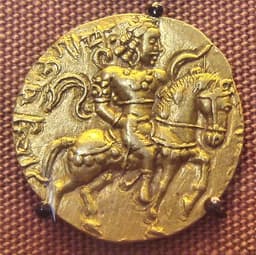
Chandragupta II
Emperor · Ancient
74.7Total
Basic Information
Born
-530
380
Died
-460
415
Era
Ancient
Ancient
Nationality
India
India
Occupation
Emperor
Emperor
Civilization
Indian
Indian
Score Comparison
Military (10%)
63.3
74.0
Political (20%)
68.0
78.0
Influence (20%)
55.0
88.0
Legacy (20%)
58.0
65.0
Leadership (15%)
53.2
72.0
Strategy (15%)
58.0
65.4
TOTAL
58.6
74.7
Ajatashatru — Complete Timeline
491 BC
Imprisoned His Father BimbisaraPolitical Action◆ Major
Ajatashatru overthrew his father Bimbisara, imprisoning him to seize the throne of Magadha. This act of patricide was condemned in Buddhist texts, but it secured Ajatashatru's rule and allowed him to pursue an expansionist policy.
Succession CrisisPatricide
Impact: nationaldestructive
485 BC
Fortified RajagrihaOther
Ajatashatru fortified the city of Rajagriha (modern Rajgir) with massive stone walls to protect Magadha's capital from attack. The fortifications included a new outer wall and strengthened defenses, making Rajagriha one of the strongest fortified cities in ancient India.
FortificationDefense
483 BC
Convened the First Buddhist CouncilCultural
Ajatashatru sponsored the First Buddhist Council at Rajagriha, held shortly after the Buddha's death. Under the monk Mahakashyapa's leadership, 500 arhats recited and codified the Buddha's teachings (Sutras) and monastic rules (Vinaya), preserving them orally.
BuddhismCouncilScripture
Impact: globalconstructive
480 BC
War with the Licchavis of VaishaliWar◆ Major
Ajatashatru waged a prolonged war against the Licchavi republic of Vaishali, eventually conquering it. He used new military technology including catapults and a siege engine. This victory expanded Magadha's territory and eliminated a rival power.
ConquestMagadha Expansion
Impact: regional
Chandragupta II — Complete Timeline
380 AD
Accession to the Gupta ThronePolitical Action
Chandragupta II succeeded his father Samudragupta as emperor of the Gupta Empire. He inherited a vast territory and continued the expansionist policies, further consolidating Gupta power in northern India.
Gupta EmpireSuccessionExpansion
Impact: regional
385 AD
Marriage Alliance with the VakatakasPolitical Action◆ Major
Chandragupta II married his daughter Prabhavatigupta to the Vakataka king Rudrasena II. After Rudrasena's death, Prabhavatigupta ruled as regent, effectively bringing the Vakataka kingdom under Gupta influence and securing the Deccan frontier.
VakatakaAllianceDeccan
Impact: regionalconstructive
395 AD
Conquest of the Western SatrapsWar◆ Major
Chandragupta II defeated the Western Kshatrapas (Saka rulers) in Gujarat and Malwa, annexing their territories. This conquest gave the Gupta Empire access to the Arabian Sea ports and control over lucrative trade routes with the Roman Empire.
Western SatrapsGujaratTrade
Impact: regional
400 AD
Patronage of the Golden Age of Gupta CultureCultural◆ Major
Chandragupta II's court included the poet Kalidasa, the astronomer Varahamihira, and other scholars. This period saw the flourishing of Sanskrit literature, art, and science, often considered the peak of classical Indian culture.
Golden AgeKalidasaSanskrit Literature
Impact: regionalconstructive
405 AD
Visit of the Chinese Pilgrim FaxianCultural
The Chinese Buddhist monk Faxian visited the Gupta Empire during Chandragupta II's reign. Faxian recorded the prosperity, religious tolerance, and efficient administration of the empire, providing valuable historical documentation.
FaxianChinese PilgrimBuddhism
Impact: regionalconstructive
Expert Analysis
Origins
Ajatashatru (c. 492–460 BCE) was born a prince of the Haryanka dynasty in Magadha, one of the sixteen Mahajanapadas of ancient India. His father was King Bimbisara, a powerful ruler who expanded Magadha through conquest and diplomacy. Ajatashatru's early life was marked by ambition and conflict; he reportedly conspired with Devadatta, a rival of the Buddha, to overthrow his father. He was educated in statecraft and military tactics, but his impatience for power led to patricide.
Chandragupta II (c. 380–415 CE) was the son of Samudragupta, the greatest conqueror of the Gupta dynasty. Born into a lineage that had already established a vast empire, he inherited a stable and prosperous kingdom. His mother was Dattadevi, and he grew up in a court that valued learning and the arts. Unlike Ajatashatru, Chandragupta II's path to power was smooth, as he succeeded his father without recorded conflict.
Rise to Power
Ajatashatru seized power by imprisoning and starving his father Bimbisara to death, an act condemned in Buddhist texts. This patricide, around 492 BCE, gave him the throne of Magadha, but it also created a reputation for ruthlessness. His early reign was consumed by war with the Licchavi republic of Vaishali, a powerful confederation. Ajatashatru employed new military technologies, including a catapult (mahashilakantaka) and a covered chariot with a mace (rathamushala), to break the Licchavi resistance. The war lasted 16 years, ending with Magadha's victory and annexation of Vaishali.
Chandragupta II's rise was more conventional. He acceded to the Gupta throne around 380 CE after his father Samudragupta's death. He faced no serious internal opposition and immediately continued his father's expansionist policies. His first major achievement was the conquest of the Western Kshatrapas (Saka rulers) in Gujarat and Malwa, which he completed around 395 CE. This victory gave the Gupta Empire access to the Arabian Sea trade routes, boosting its wealth.
Leadership & Governance
Ajatashatru ruled Magadha with an iron fist. He fortified Rajagriha with massive stone walls, creating a near-impregnable capital. He also patronized Buddhism, convening the First Buddhist Council at Rajagriha shortly after the Buddha's death (c. 483 BCE). This council, led by the monk Mahakashyapa, compiled the Buddha's teachings into the Sutta Pitaka and Vinaya Pitaka. However, Ajatashatru's governance was authoritarian; he maintained power through fear and military force.
Chandragupta II, by contrast, presided over a decentralized administration that allowed regional autonomy. He formed strategic marriage alliances, most notably marrying his daughter Prabhavatigupta to the Vakataka king Rudrasena II. After Rudrasena's death, Prabhavatigupta ruled as regent, effectively bringing the Vakataka kingdom under Gupta influence. Chandragupta II's court was a center of cultural patronage, with figures like the poet Kalidasa and astronomer Varahamihira. The Chinese pilgrim Faxian visited during his reign and recorded efficient governance, low taxes, and religious tolerance.
Triumph & Tragedy
Ajatashatru's greatest triumph was the conquest of Vaishali, which eliminated a major rival and expanded Magadha's territory. His sponsorship of the First Buddhist Council ensured the preservation of Buddhist scriptures, a lasting contribution to world religion. However, his greatest failure was his patricide, which tainted his legacy. Moreover, his aggressive wars drained resources and created enemies. He died around 460 BCE, possibly assassinated by his own son Udayabhadra, repeating the cycle of violence.
Chandragupta II's triumph was the conquest of the Western Satraps, which brought immense wealth and trade networks to the Gupta Empire. His patronage of arts and sciences during the Gupta Golden Age produced cultural masterpieces like Kalidasa's plays and the Ajanta cave paintings. However, his reign saw no major failures, though his successors struggled to maintain the empire's cohesion. The lack of a strong successor after his death led to gradual decline.
Character & Destiny
Ajatashatru was ambitious and ruthless, driven by a desire for power that led him to kill his own father. His character is often compared to that of a tyrant in Buddhist texts, yet his patronage of Buddhism shows a complex personality who sought legitimacy through religion. His destiny was shaped by his violent rise; he died as he lived, by treachery.
Chandragupta II was a skilled diplomat and patron, known as Vikramaditya (Sun of Valor) in tradition. He combined military prowess with cultural sophistication, and his reign is remembered as a golden age. His character was more balanced, and his destiny was to be remembered as one of India's greatest emperors.
Legacy
Ajatashatru's legacy is mixed. He is remembered as a parricide but also as the king who convened the First Buddhist Council, which helped preserve Buddhism. His fortifications at Rajagriha were influential, but his empire did not long outlast him. His total score of 58.6 reflects this limited impact.
Chandragupta II's legacy is immense. The Gupta Golden Age set standards for literature, science, and art that influenced India for centuries. His conquests expanded the empire to its greatest extent, and his administrative policies were models for later rulers. He scores 74.7 overall, reflecting his greater influence and leadership.
Conclusion
Chandragupta II had a significantly greater impact than Ajatashatru. With a total score of 74.7 versus 58.6, he outperformed in every category: military (74.0 vs 63.3), political (78.0 vs 68.0), influence (88.0 vs 55.0), leadership (72.0 vs 53.2), and strategy (65.4 vs 58.0). While Ajatashatru's convening of the First Buddhist Council was historically important, Chandragupta II's patronage of the Gupta Golden Age had a broader and more enduring effect on Indian civilization. The Gupta period's cultural achievements, including Sanskrit literature and scientific advances, shaped India's identity for millennia. Ajatashatru's legacy was more localized and morally ambiguous. Therefore, Chandragupta II stands as the more consequential ruler.
Rankings
🥇
Chandragupta IILeader
Mil: 74.0Pol: 78.0Inf: 88.0
74.7
🥈
Ajatashatru
Mil: 63.3Pol: 68.0Inf: 55.0
58.6
+16.1 behind
How This Comparison Works
Algorithm
Each figure is scored on 6 dimensions (0—100 scale) based on structured historical data: Military (10%), Political (20%), Influence (20%), Legacy (20%), Leadership (15%), Strategy (15%). The weighted total produces the final ranking.
Data Sources
Scores are computed from structured sub-indicators in the database. Scale factors adjust for era (Ancient ×0.85, Modern ×1.0) and civilization size (Eastern ×1.05, Other ×0.80) to account for differences in population and military scale.
Maximum 3 Figures
Comparisons are limited to 2—3 figures to ensure readability and statistical meaningfulness.
Error Margins
±5 points per dimension — Sub-scores are derived from historical records with inherent uncertainty. Two figures within 5 points on a dimension should be considered roughly equivalent in that area.
Total Score Accuracy
±3 points overall — The weighted combination of 6 dimensions produces a total score with approximately ±3 points of uncertainty. Differences of less than 3 points are not statistically significant— the figures are effectively tied.
Known Limitations
- Historical records are incomplete and uneven across civilizations
- Figures from oral-tradition societies may be underrepresented
- Occupation labels can misclassify multi-role figures
- Scores measure capability and impact, not moral character
- Quantitative scoring is a comparison tool, not absolute truth
Capability Radar
Military (10%) — Battles & Warfare
Battles
55
75
Win Rate
60
80
Expansion
75
80
Political (20%) — Governance & Reform
Reform
65
80
Diplomacy
60
75
Economy
55
90
Influence (20%) — Cultural & Global Reach
Cultural
70
95
Global
65
70
Legacy (20%) — Historical Impact
Historical
75
90
Longevity
70
85
Leadership (15%) — Power & Stability
Tenure
70
85
Stability
50
85
Strategy (15%) — Tactics & Innovation
Strategy
70
75
Tactics
65
70
Reform
60
65
Similar Comparisons
Comments & Discussion
No comments yet. Be the first to share your thoughts!