Loading...
This comparison has not been analyzed yet.
One-time AI generation (~1 minute). Scores and timeline are already available below.
Ahmed Suleiman Dafle vs Victoriano Huerta
Victoriano Huerta leads by 4.4 pts · 2 figures compared
…

Ahmed Suleiman Dafle
General · Modern
36.2Total
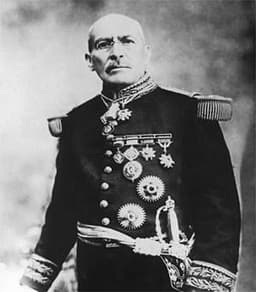
Victoriano Huerta
General · Modern
40.6Total
Basic Information
Born
1920
1850
Died
—
1916
Era
Modern
Modern
Nationality
Somalia
Mexico
Occupation
General
General
Civilization
Other
Western
Score Comparison
Military (10%)
10.2
10.0
Political (20%)
30.8
32.2
Influence (20%)
47.9
49.4
Legacy (20%)
35.8
40.8
Leadership (15%)
47.3
41.5
Strategy (15%)
25.0
60.0
TOTAL
36.2
40.6
Ahmed Suleiman Dafle — Complete Timeline
1969 AD
Appointed Police Chief under Siad BarrePolitical Action◆ Major
Ahmed Suleiman Dafle was appointed as the Chief of the Somali Police Force after Siad Barre's coup. He was a loyalist who helped enforce Barre's authoritarian rule and suppress dissent.
Police ChiefSiad BarreAuthoritarianism
Impact: nationaldestructive
1970 AD
Oversaw Repression of OppositionPolitical Action◆ Major
As police chief, Dafle oversaw the repression of political opponents, including the arrest and torture of dissidents. His tenure was marked by human rights abuses and the consolidation of Barre's dictatorship.
RepressionHuman RightsSomalia
Impact: nationaldestructive
1991 AD
Fled Somalia After Barre's FallPolitical Action
After the collapse of Siad Barre's government in 1991, Ahmed Suleiman Dafle fled Somalia. He went into exile, avoiding the civil war and the retribution of the victorious rebel factions.
ExileRegime CollapseSomalia
Impact: national
Victoriano Huerta — Complete Timeline
1913 AD
Coup d'état against Francisco I. MaderoPolitical Action
Huerta, as commander of the Mexican federal army, orchestrated a coup against President Francisco I. Madero during the Ten Tragic Days. Madero and Vice President Pino Su
CoupMexican RevolutionMadero
Impact: nationaldestructive
Presidency of MexicoPolitical Action◆ Major
Huerta served as President of Mexico from February 1913 to July 1914. His regime was characterized by authoritarian rule, suppression of opposition, and reliance on the federal army, but it faced widespread rebellion from revolutionary factions.
PresidencyDictatorshipMexican Revolution
Impact: nationaldestructive
Dissolution of CongressPolitical Action
Huerta dissolved the Mexican Congress in October 1913 after it refused to approve his policies. He ruled by decree, arresting or exiling many deputies, which further alienated moderate politicians and intensified opposition to his regime.
CongressAuthoritarianismRepression
Impact: nationaldestructive
1914 AD
Defeat by Constitutionalist ArmyWar
Huerta's federal forces were defeated by the Constitutionalist Army led by Venustiano Carranza,
Mexican RevolutionDefeatExile
Impact: nationaltragic
Exile and DeathPolitical Action
After his resignation, Huerta fled to Spain and later to the United States. He was arrested by U.S. authorities in 1915 for plotting to return to power and died in custody in El Paso, Texas, in 1916, ending his political ambitions.
ExileDeathEnd of Career
Impact: nationaltragic
This comparison has not been analyzed yet.
One-time AI generation (~1 minute). Scores and timeline are already available below.
Rankings
🥇
Victoriano HuertaLeader
Mil: 10.0Pol: 32.2Inf: 49.4
40.6
🥈
Ahmed Suleiman Dafle
Mil: 10.2Pol: 30.8Inf: 47.9
36.2
+4.4 behind
How This Comparison Works
Algorithm
Each figure is scored on 6 dimensions (0—100 scale) based on structured historical data: Military (10%), Political (20%), Influence (20%), Legacy (20%), Leadership (15%), Strategy (15%). The weighted total produces the final ranking.
Data Sources
Scores are computed from structured sub-indicators in the database. Scale factors adjust for era (Ancient ×0.85, Modern ×1.0) and civilization size (Eastern ×1.05, Other ×0.80) to account for differences in population and military scale.
Maximum 3 Figures
Comparisons are limited to 2—3 figures to ensure readability and statistical meaningfulness.
Error Margins
±5 points per dimension — Sub-scores are derived from historical records with inherent uncertainty. Two figures within 5 points on a dimension should be considered roughly equivalent in that area.
Total Score Accuracy
±3 points overall — The weighted combination of 6 dimensions produces a total score with approximately ±3 points of uncertainty. Differences of less than 3 points are not statistically significant— the figures are effectively tied.
Known Limitations
- Historical records are incomplete and uneven across civilizations
- Figures from oral-tradition societies may be underrepresented
- Occupation labels can misclassify multi-role figures
- Scores measure capability and impact, not moral character
- Quantitative scoring is a comparison tool, not absolute truth
Capability Radar
Military (10%) — Battles & Warfare
Battles
5
45
Win Rate
5
40
Expansion
5
25
Political (20%) — Governance & Reform
Reform
15
15
Diplomacy
20
20
Economy
10
15
Influence (20%) — Cultural & Global Reach
Cultural
10
15
Global
5
10
Legacy (20%) — Historical Impact
Historical
10
25
Longevity
5
10
Leadership (15%) — Power & Stability
Tenure
30
20
Stability
15
10
Strategy (15%) — Tactics & Innovation
Strategy
10
45
Tactics
10
50
Reform
15
30
Similar Comparisons
Comments & Discussion
No comments yet. Be the first to share your thoughts!