Loading...
Ahmed Sanjar vs King Seongdeok
Ahmed Sanjar leads by 2.1 pts · 2 figures compared
…
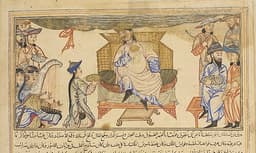
Ahmed Sanjar
Emperor · Medieval
61.0Total

King Seongdeok
Emperor · Medieval
58.9Total
Basic Information
Born
1085
691
Died
1157
737
Era
Medieval
Medieval
Nationality
Seljuk Empire
Korea
Occupation
Emperor
Emperor
Civilization
Middle Eastern
Eastern
Score Comparison
Military (10%)
64.4
50.0
Political (20%)
68.0
68.0
Influence (20%)
59.0
62.0
Legacy (20%)
49.2
52.0
Leadership (15%)
74.0
72.0
Strategy (15%)
62.5
43.7
TOTAL
61.0
58.9
Ahmed Sanjar — Complete Timeline
1141 AD
Battle of QatwanWar◆ Major
Ahmed Sanjar was defeated by the Kara Khitai at the Battle of Qatwan near Samarkand. This defeat ended Seljuk dominance in Transoxiana and led to the loss of Khorasan to the Kara Khitai, marking the beginning of the Seljuk decline.
BattleKara KhitaiSeljuk Decline
Impact: regionaltragic
1153 AD
Revolt of the Oghuz TurksWar◆ Major
Oghuz Turk tribes in Khorasan revolted against Sanjar's rule, capturing him in battle. Sanjar was held captive for three years, during which the Oghuz plundered Khorasan and destroyed Seljuk authority in the region.
RevoltOghuzCaptivity
Impact: regionaltragic
1156 AD
Restoration and DeathPolitical Action◆ Major
Sanjar escaped Oghuz captivity in 1156 and returned to Merv, but his authority was shattered. He died the following year, and his death marked the end of the Great Seljuk Empire, as his successors could not reunite the fragmented territories.
EscapeDeathEnd of Empire
Impact: regionaltragic
King Seongdeok — Complete Timeline
702 AD
Ascended to the Throne of SillaPolitical Action◆ Major
Seongdeok became king of Unified Silla. His reign is considered a golden age of Silla culture and Buddhism.
AccessionSillaKorea
Impact: regional
720 AD
Promoted Astronomy and ScienceCultural
Seongdeok supported scientific advancements, including the construction of the Cheomseongdae astronomical observatory. This reflected the kingdom's interest in science and calendar-making.
ScienceAstronomySilla
Impact: regionalconstructive
Expert Analysis
Origins
Ahmed Sanjar was born around 1086 into the Seljuk dynasty, the son of Sultan Malik Shah I. He grew up in the heart of the Seljuk Empire, receiving a princely education in statecraft and military command. At a young age, he was appointed governor of Khorasan, a critical province that would become his power base. His early years were marked by the empire's internal strife after Malik Shah's death, which taught Sanjar the art of political survival.
King Seongdeok was born around 690 in the Silla Kingdom of Korea, part of the Kim clan that had ruled for centuries. He ascended the throne in 702 as the 33rd monarch of Unified Silla. His upbringing was steeped in Buddhist teachings and Confucian statecraft, shaping his vision of a harmonious and culturally flourishing kingdom. Unlike Sanjar, Seongdeok inherited a relatively stable realm, allowing him to focus on cultural and scientific patronage.
Rise to Power
Sanjar's rise was gradual but decisive. After serving as governor of Khorasan, he consolidated power during the Seljuk civil wars of the early 12th century. By 1118, he became the de facto sultan of the eastern Seljuk domains, with his capital at Merv. His authority was recognized by the Abbasid caliph, though he faced constant challenges from rival brothers and Turkic commanders. A turning point was his victory at the Battle of Ghazni in 1117, which secured his eastern frontier.
Seongdeok's path to power was smoother. As the son of King Hyoso, he was groomed for kingship from birth. He ascended without major opposition in 702 and immediately set about strengthening Silla's institutions. His reign coincided with a period of peace with Tang China and Balhae, allowing him to allocate resources to grand projects. His political skill was evident in his ability to balance aristocratic factions, reflected in his political score of 68.0, tied with Sanjar.
Leadership & Governance
Sanjar's leadership style was autocratic but pragmatic. He maintained a vast empire through a combination of military force and diplomatic marriages. His governance relied on a Persian-style bureaucracy, but he struggled to control the nomadic Oghuz tribes within his realm. Sanjar's military score of 64.4 reflects his competence in battle, but his inability to integrate the Oghuz led to disaster. In contrast, Seongdeok's leadership (score 72.0) was more visionary and culturally oriented. He governed through a centralized bureaucracy that promoted Buddhism as a unifying force. His commission of Bulguksa Temple and Seokguram Grotto were not merely religious acts but political statements of Silla's identity. While Sanjar built through conquest, Seongdeok built through patronage.
Triumph & Tragedy
Sanjar's greatest triumph was his early career as a stabilizer of the eastern Seljuk realm. He successfully defended Khorasan against the Ghaznavids and the Qarakhanids, earning a reputation as a capable commander. However, his greatest failure was the Battle of Qatwan in 1141, where he was decisively defeated by the Kara Khitai. This loss cost him Transoxiana and shattered his invincibility. The subsequent revolt of the Oghuz Turks in 1153 led to his capture and three-year captivity. After escaping, he returned to a broken empire and died in 1157, his authority in ruins.
Seongdeok's triumphs were cultural and scientific. He oversaw the completion of Cheomseongdae, one of the world's earliest astronomical observatories, in 647 (actually built earlier, but his reign promoted such science). His greatest legacy is Bulguksa Temple and the Seokguram Grotto, both UNESCO World Heritage sites. These projects showcased Silla's engineering and artistic prowess. However, his reign saw no major military expansion; his military score of 50.0 reflects a lack of martial ambition. His failure, if any, was that his cultural splendor did not prevent Silla's eventual decline after his death.
Character & Destiny
Sanjar was a resilient but ultimately tragic figure. His character combined ambition with a fatal underestimation of the Oghuz threat. He was a skilled strategist (score 62.5) but poor at managing nomadic allies. His destiny was shaped by the very forces he tried to control: the Turkic tribes that were both his support and his undoing. Seongdeok, by contrast, was a wise patron who understood the power of culture. His character is reflected in the serene Buddha of Seokguram—calm, enduring, and detached from worldly strife. His destiny was to be remembered as a builder, not a conqueror.
Legacy
Sanjar's legacy is mixed. He is remembered as the last great Seljuk sultan, but his reign ended in collapse. His influence score of 59.0 and legacy score of 49.2 indicate a limited long-term impact. The Seljuk Empire fragmented after his death, and his name is mostly known among specialists. In contrast, Seongdeok's legacy is tangible and enduring. Bulguksa Temple and Seokguram Grotto remain major cultural landmarks, attracting millions of visitors. His promotion of Buddhism and science influenced Korean culture for centuries. His legacy score of 52.0, though modest, reflects his status as a cultural icon rather than a political titan.
Conclusion
While Ahmed Sanjar has a higher total score (61.0 vs 58.9), this margin is small and largely driven by military and strategic scores. However, impact is not solely measured by scores. Sanjar's rule ended in defeat and fragmentation, whereas Seongdeok's reign produced lasting monuments of human achievement. Seongdeok's cultural contributions—Bulguksa, Seokguram, Cheomseongdae—have outlasted Sanjar's empire by centuries. In terms of enduring influence on civilization, King Seongdeok had greater impact. His legacy is carved in stone and still inspires awe; Sanjar's legacy is dust.
Rankings
🥇
Ahmed SanjarLeader
Mil: 64.4Pol: 68.0Inf: 59.0
61.0
🥈
King Seongdeok
Mil: 50.0Pol: 68.0Inf: 62.0
58.9
+2.1 behind
How This Comparison Works
Algorithm
Each figure is scored on 6 dimensions (0—100 scale) based on structured historical data: Military (10%), Political (20%), Influence (20%), Legacy (20%), Leadership (15%), Strategy (15%). The weighted total produces the final ranking.
Data Sources
Scores are computed from structured sub-indicators in the database. Scale factors adjust for era (Ancient ×0.85, Modern ×1.0) and civilization size (Eastern ×1.05, Other ×0.80) to account for differences in population and military scale.
Maximum 3 Figures
Comparisons are limited to 2—3 figures to ensure readability and statistical meaningfulness.
Error Margins
±5 points per dimension — Sub-scores are derived from historical records with inherent uncertainty. Two figures within 5 points on a dimension should be considered roughly equivalent in that area.
Total Score Accuracy
±3 points overall — The weighted combination of 6 dimensions produces a total score with approximately ±3 points of uncertainty. Differences of less than 3 points are not statistically significant— the figures are effectively tied.
Known Limitations
- Historical records are incomplete and uneven across civilizations
- Figures from oral-tradition societies may be underrepresented
- Occupation labels can misclassify multi-role figures
- Scores measure capability and impact, not moral character
- Quantitative scoring is a comparison tool, not absolute truth
Capability Radar
Military (10%) — Battles & Warfare
Battles
75
20
Win Rate
70
25
Expansion
68
15
Political (20%) — Governance & Reform
Reform
55
55
Diplomacy
60
60
Economy
58
60
Influence (20%) — Cultural & Global Reach
Cultural
50
70
Global
45
40
Legacy (20%) — Historical Impact
Historical
55
65
Longevity
40
70
Leadership (15%) — Power & Stability
Tenure
65
65
Stability
45
65
Strategy (15%) — Tactics & Innovation
Strategy
74
20
Tactics
72
20
Reform
60
15
Similar Comparisons
Comments & Discussion
No comments yet. Be the first to share your thoughts!