Loading...
This comparison has not been analyzed yet.
One-time AI generation (~1 minute). Scores and timeline are already available below.
Adolphus Frederick VI vs Maximilian I of Mexico
Adolphus Frederick VI leads by 2.5 pts · 2 figures compared
…
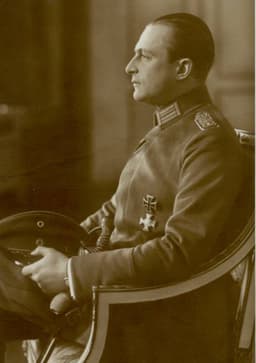
Adolphus Frederick VI
Emperor · Modern
39.4Total

Maximilian I of Mexico
Emperor · Modern
36.9Total
Basic Information
Born
1882
1832
Died
1918
1867
Era
Modern
Modern
Nationality
Mecklenburg-Strelitz
Mexico
Occupation
Emperor
Emperor
Civilization
Western
Western
Score Comparison
Military (10%)
46.7
14.9
Political (20%)
32.1
35.1
Influence (20%)
45.5
49.4
Legacy (20%)
33.3
38.3
Leadership (15%)
31.2
38.1
Strategy (15%)
55.5
25.0
TOTAL
39.4
36.9
Adolphus Frederick VI — Complete Timeline
1914 AD
Accession as Grand Duke of Mecklenburg-StrelitzPolitical Action◆ Major
Adolphus Frederick VI became Grand Duke of Mecklenburg-Strelitz on 11 June 1914, succeeding his father Adolphus Frederick V. His reign was brief and overshadowed by World War I.
Mecklenburg-StrelitzSuccession
Impact: national
1918 AD
Suicide during World War IOther
On 23 February 1918, Adolphus Frederick VI committed suicide at Neustrelitz. His death occurred during World War I, and he was the last grand duke of Mecklenburg-Strelitz, as the monarchy was abolished later that year.
SuicideEnd of monarchyMecklenburg-Strelitz
Impact: nationaltragic
Succession crisisPolitical Action◆ Major
Adolphus Frederick VI's suicide without a direct heir triggered a succession crisis in Mecklenburg-Strelitz. The grand duchy was eventually merged with Mecklenburg-Schwerin after the German Revolution.
Succession crisisMecklenburg-Strelitz
Impact: nationaldestructive
Maximilian I of Mexico — Complete Timeline
1863 AD
Accepted the Crown of MexicoPolitical Action◆ Major
Maximilian accepted the offer of the Mexican throne from a conservative delegation, with the backing of French Emperor Napoleon III. He arrived in Mexico in 1864 to establish the Second Mexican Empire.
Second Mexican EmpireMonarchyNapoleon III
Impact: national
1865 AD
Issued the Statute of the Mexican EmpireReform◆ Major
Maximilian issued a statute that established a constitutional monarchy, guaranteed civil liberties, and promoted land reform. He also ratified the liberal laws of the Reforma, alienating his conservative supporters.
ReformConstitutionLand Reform
Impact: nationalprogressive
1867 AD
Siege of QuerétaroWar◆ Major
Maximilian was besieged at Quer
SiegeQuerétaroRepublican Victory
Impact: nationaltragic
Executed by Firing SquadPolitical Action
Maximilian was executed by firing squad on the Cerro de las Campanas in Quer
ExecutionEnd of EmpireRepublic Restored
Impact: nationaltragic
This comparison has not been analyzed yet.
One-time AI generation (~1 minute). Scores and timeline are already available below.
Rankings
🥇
Adolphus Frederick VILeader
Mil: 46.7Pol: 32.1Inf: 45.5
39.4
🥈
Maximilian I of Mexico
Mil: 14.9Pol: 35.1Inf: 49.4
36.9
+2.5 behind
How This Comparison Works
Algorithm
Each figure is scored on 6 dimensions (0—100 scale) based on structured historical data: Military (10%), Political (20%), Influence (20%), Legacy (20%), Leadership (15%), Strategy (15%). The weighted total produces the final ranking.
Data Sources
Scores are computed from structured sub-indicators in the database. Scale factors adjust for era (Ancient ×0.85, Modern ×1.0) and civilization size (Eastern ×1.05, Other ×0.80) to account for differences in population and military scale.
Maximum 3 Figures
Comparisons are limited to 2—3 figures to ensure readability and statistical meaningfulness.
Error Margins
±5 points per dimension — Sub-scores are derived from historical records with inherent uncertainty. Two figures within 5 points on a dimension should be considered roughly equivalent in that area.
Total Score Accuracy
±3 points overall — The weighted combination of 6 dimensions produces a total score with approximately ±3 points of uncertainty. Differences of less than 3 points are not statistically significant— the figures are effectively tied.
Known Limitations
- Historical records are incomplete and uneven across civilizations
- Figures from oral-tradition societies may be underrepresented
- Occupation labels can misclassify multi-role figures
- Scores measure capability and impact, not moral character
- Quantitative scoring is a comparison tool, not absolute truth
Capability Radar
Military (10%) — Battles & Warfare
Battles
27
10
Win Rate
24
5
Expansion
31
5
Political (20%) — Governance & Reform
Reform
5
25
Diplomacy
5
20
Economy
5
15
Influence (20%) — Cultural & Global Reach
Cultural
5
20
Global
5
15
Legacy (20%) — Historical Impact
Historical
5
25
Longevity
5
15
Leadership (15%) — Power & Stability
Tenure
10
20
Stability
5
5
Strategy (15%) — Tactics & Innovation
Strategy
33
10
Tactics
37
10
Reform
38
15
Similar Comparisons
Comments & Discussion
No comments yet. Be the first to share your thoughts!