Loading...
Adolphus Frederick VI vs Julius Caesar
Julius Caesar leads by 43.4 pts · 2 figures compared
…
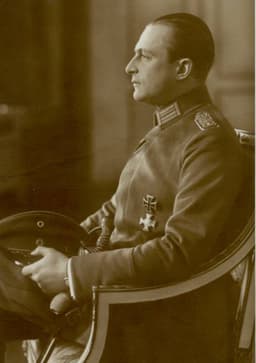
Adolphus Frederick VI
Emperor · Modern
39.4Total

Julius Caesar
General · Ancient
82.8Total
Basic Information
Born
1882
-100
Died
1918
-44
Era
Modern
Ancient
Nationality
Mecklenburg-Strelitz
Roman Republic
Occupation
Emperor
General
Civilization
Western
Western
Score Comparison
Military (10%)
46.7
88.0
Political (20%)
32.1
78.0
Influence (20%)
45.5
85.0
Legacy (20%)
33.3
82.0
Leadership (15%)
31.2
80.0
Strategy (15%)
55.5
85.0
TOTAL
39.4
82.8
Adolphus Frederick VI — Complete Timeline
1914 AD
Accession as Grand Duke of Mecklenburg-StrelitzPolitical Action◆ Major
Adolphus Frederick VI became Grand Duke of Mecklenburg-Strelitz on 11 June 1914, succeeding his father Adolphus Frederick V. His reign was brief and overshadowed by World War I.
Mecklenburg-StrelitzSuccession
Impact: national
1918 AD
Suicide during World War IOther
On 23 February 1918, Adolphus Frederick VI committed suicide at Neustrelitz. His death occurred during World War I, and he was the last grand duke of Mecklenburg-Strelitz, as the monarchy was abolished later that year.
SuicideEnd of monarchyMecklenburg-Strelitz
Impact: nationaltragic
Succession crisisPolitical Action◆ Major
Adolphus Frederick VI's suicide without a direct heir triggered a succession crisis in Mecklenburg-Strelitz. The grand duchy was eventually merged with Mecklenburg-Schwerin after the German Revolution.
Succession crisisMecklenburg-Strelitz
Impact: nationaldestructive
Julius Caesar — Complete Timeline
58 BC
Gallic WarsWar◆ Major
Caesar, as proconsul of Gaul, launched a series of campaigns that conquered all of Gaul (modern France, Belgium, and parts of Switzerland). He fought numerous battles, including against the Helvetii, the Belgae, and the Gallic chieftain Vercingetorix. The wars brought immense wealth and a loyal army to Caesar.
Gallic WarsConquestRoman Expansion
Impact: regional
49 BC
Crossing the RubiconPolitical Action◆ Major
Caesar led Legio XIII across the Rubicon River into Italy, defying the Roman Senate's order to disband his army. This act triggered a civil war against Pompey and the Optimates, ultimately leading to Caesar's dictatorship and the end of the Roman Republic.
Roman Civil WarEnd of RepublicPower Struggle
Impact: global
48 BC
Battle of PharsalusWar◆ Major
Caesar's outnumbered army defeated the larger forces of Pompey the Great at Pharsalus in Greece. Caesar's tactical use of a reserve line to counter Pompey's cavalry charge proved decisive. Pompey fled to Egypt, where he was assassinated, leaving Caesar as the undisputed master of the Roman world.
Roman Civil WarBattleDecisive Victory
Impact: regional
44 BC
Appointment as Dictator for LifePolitical Action◆ Major
The Roman Senate appointed Caesar dictator perpetuo (dictator for life), granting him unprecedented personal power. This move concentrated military, legislative, and judicial authority in one person, effectively ending the Roman Republic's traditional system of checks and balances and alarming many senators.
DictatorshipEnd of RepublicPower Consolidation
Impact: regionaldestructive
Assassination on the Ides of MarchPolitical Action◆ Major
A group of Roman senators, led by Marcus Junius Brutus and Gaius Cassius Longinus, stabbed Caesar to death at a meeting of the Senate in the Theatre of Pompey. The assassination was intended to restore the Republic, but instead triggered another civil war that led to the rise of the Roman Empire.
AssassinationRoman PoliticsEnd of Republic
Impact: globaldestructive
Expert Analysis
adolphus-frederick-vi-vs-julius-caesar
# The Ides of March and the Silence of Neustrelitz
On a gray February morning in 1918, a minor German prince named Adolphus Frederick VI put a gun to his head in a castle at Neustrelitz. The Great War raged across Europe, empires were crumbling, and no one outside his tiny duchy would long remember his name. Thirty-six years earlier, on the Ides of March in 44 BCE, a mob of Roman senators surrounded Gaius Julius Caesar in the Theatre of Pompey and stabbed him twenty-three times. The world shook. Two men, both rulers, both dead by violence—yet the gulf between their fates is not merely a matter of centuries. It is a chasm carved by the very nature of history itself.
Origins
Caesar was born into the patrician Julian clan, a family that claimed descent from the goddess Venus. But the Rome of his youth was a republic in convulsion—corrupt, faction-ridden, and hungry for a strong hand. His father died when he was sixteen, leaving him to navigate a world where survival meant cunning and ambition meant everything. He learned early that in a city of marble and blood, a man must either seize greatness or be crushed by those who do.
Adolphus Frederick VI was born into the House of Mecklenburg-Strelitz, a minor German dynasty that had survived for centuries by staying small, staying quiet, and staying loyal to larger powers. His world was one of ceremonial duties, hunting parties, and the slow, polite decay of aristocratic privilege. The German Empire of Kaiser Wilhelm II was modernizing at a furious pace, but the grand duchy of Mecklenburg-Strelitz remained a feudal backwater. The young prince was shaped not by the Forum's roar but by the silence of provincial courts.
Rise to Power
Caesar’s path to power was a masterclass in political audacity. He was captured by pirates as a young man—and laughed at their ransom demand, insisting they ask for more. He returned, raised a fleet, and crucified them. He climbed the republican ladder with breathtaking speed: quaestor, aedile, pontifex maximus, praetor, consul. Each step was a gamble, each victory a debt to be repaid in loyalty or fear. In 58 BCE, he took command of the legions in Gaul and began a war of conquest that would make him the richest and most dangerous man in Rome.
Adolphus Frederick VI became Grand Duke of Mecklenburg-Strelitz on 11 June 1914—just weeks before the assassination of Archduke Franz Ferdinand plunged Europe into war. He inherited a tiny state with no army to speak of, no economic heft, and no voice in the councils of Berlin. His "rise" was an accident of birth, not a conquest. He was a placeholder in a system that was already beginning to collapse around him.
Leadership & Governance
Caesar governed through sheer force of personality and military genius. He reorganized the calendar, reformed debt laws, extended citizenship to provincials, and launched massive public works. His Commentaries on the Gallic Wars are still studied as models of clarity and propaganda. He understood that power in Rome rested on three pillars: the legions, the people, and the Senate. He mastered the first two and broke the third.
Adolphus Frederick VI governed as a constitutional monarch in a state that had almost nothing to govern. Mecklenburg-Strelitz had a parliament, but real power lay with the Kaiser and the Prussian military machine. The Grand Duke's main duty during the war was to manage the home front—food shortages, conscription, and the endless reports of dead young men. His political score of 38.0 reflects not incompetence but irrelevance. He was a figurehead in a storm he could not steer.
Triumph & Tragedy
Caesar’s greatest triumph was the conquest of Gaul—a campaign that added a vast territory to the Roman sphere and made him the undisputed master of the Western world. His greatest tragedy was his own success. By crossing the Rubicon in 49 BCE, he started a civil war that he won—only to discover that a republic cannot survive a king who refuses to call himself one. His assassination on the Ides of March was a desperate act by men who thought they were saving Rome. Instead, they ensured its destruction.
Adolphus Frederick VI had no triumphs. His life was a tragedy of smallness. In February 1918, with the war grinding toward its bloody end and the German monarchy teetering, he shot himself at Neustrelitz. He left no heir, plunging his duchy into a succession crisis that would be resolved only by its dissolution. His death was a footnote in a war of millions of casualties. The world barely paused.
Character & Destiny
Caesar was reckless, brilliant, and utterly convinced of his own destiny. He pardoned his enemies, seduced his allies’ wives, and wrote his own history. He knew that in Rome, a man could be a god or a corpse—and he chose to reach for the heavens. His assassination was not a failure of ambition but a miscalculation of hatred. He understood power but underestimated the rage of those he had humiliated.
Adolphus Frederick VI was a man out of time. He lived in an age of empires and mass armies, yet ruled a territory smaller than many counties. His suicide was not a political act but a personal one—the despair of a man who saw no future for himself or his world. Where Caesar died because he was too great, Adolphus Frederick died because he was too small.
Legacy
Caesar’s legacy is the Roman Empire itself. His name became a title—Caesar, Kaiser, Tsar. His reforms shaped Western governance for two millennia. His life is a story that still resonates in every debate about power, ambition, and the price of greatness.
Adolphus Frederick VI is remembered, if at all, as the last Grand Duke of Mecklenburg-Strelitz. His duchy was abolished after the war, absorbed into the Weimar Republic. His palace became a museum. His name appears in genealogical tables and footnotes. His legacy score of 45.3 is generous.
Conclusion
History is not a meritocracy. It does not reward effort or intention—only impact. Caesar and Adolphus Frederick VI were both rulers, both dead by violence, both products of their eras. But one lived at the hinge of history, when a single man could bend the world to his will. The other lived at its fringes, when a prince was little more than a decoration on a collapsing building. The difference between them is not talent or courage—it is the cruel arithmetic of timing and scale. Caesar changed the world because he had a world to change. Adolphus Frederick VI had only a quiet room and a loaded pistol.
Rankings
🥇
Julius CaesarLeader
Mil: 88.0Pol: 78.0Inf: 85.0
82.8
🥈
Adolphus Frederick VI
Mil: 46.7Pol: 32.1Inf: 45.5
39.4
+43.4 behind
How This Comparison Works
Algorithm
Each figure is scored on 6 dimensions (0—100 scale) based on structured historical data: Military (10%), Political (20%), Influence (20%), Legacy (20%), Leadership (15%), Strategy (15%). The weighted total produces the final ranking.
Data Sources
Scores are computed from structured sub-indicators in the database. Scale factors adjust for era (Ancient ×0.85, Modern ×1.0) and civilization size (Eastern ×1.05, Other ×0.80) to account for differences in population and military scale.
Maximum 3 Figures
Comparisons are limited to 2—3 figures to ensure readability and statistical meaningfulness.
Error Margins
±5 points per dimension — Sub-scores are derived from historical records with inherent uncertainty. Two figures within 5 points on a dimension should be considered roughly equivalent in that area.
Total Score Accuracy
±3 points overall — The weighted combination of 6 dimensions produces a total score with approximately ±3 points of uncertainty. Differences of less than 3 points are not statistically significant— the figures are effectively tied.
Known Limitations
- Historical records are incomplete and uneven across civilizations
- Figures from oral-tradition societies may be underrepresented
- Occupation labels can misclassify multi-role figures
- Scores measure capability and impact, not moral character
- Quantitative scoring is a comparison tool, not absolute truth
Capability Radar
Military (10%) — Battles & Warfare
Battles
27
95
Win Rate
24
92
Expansion
31
97
Political (20%) — Governance & Reform
Reform
5
90
Diplomacy
5
85
Economy
5
82
Influence (20%) — Cultural & Global Reach
Cultural
5
88
Global
5
94
Legacy (20%) — Historical Impact
Historical
5
95
Longevity
5
96
Leadership (15%) — Power & Stability
Tenure
10
75
Stability
5
60
Strategy (15%) — Tactics & Innovation
Strategy
33
94
Tactics
37
96
Reform
38
88
Similar Comparisons
Comments & Discussion
SpartanSword6/17/2026
Comparing Caesar to a minor duke is like comparing Zeus to a doorman. Caesar didn't just die—he changed the world *by dying*: his assassination triggered a civil war that birthed the Roman Empire, while Adolphus Frederick's suicide was a footnote in a collapsing Reich. The Ides of March reshaped Western civilization; Neustrelitz barely made the local gazette. One man's death was a seismic event, the other's a whimper.
历史侦探6/17/2026
你拿翻了个神像跟踩死只蚂蚁放一起比,简直搞笑。凯撒遇刺时,元老院刺杀者在庞培剧场里刀刀见血,血流了五百年的帝国脉络——阿道夫斯·弗雷德里克呢?1918年他举枪时,连国境外的农民都不晓得Mecklenburg-Strelitz在哪。历史把一个人捧上神坛,另一个人写成脚注,这不是巧合,是权力和影响的残酷筛选。
古典派6/17/2026
Caesar是神人,不是人。他的死是罗马神话的翻版——元老们刺了二十三刀,刀刀都被赋予了“永恒帝国”的重量;阿道夫斯六世不过是个被时代碾压的可怜虫,他的死连象形文字都懒得多写一句。想想吧,Caesar的死催生了奥古斯都的黄金时代,而后者的死只让Strelitz宫里的窗帘晃了一下。史诗与烟尘,别混为一谈。
Historian1536/17/2026
Oh, let's not romanticize Caesar's death as some grand tragedy. He was a dictator who ended the Roman Republic and got what was coming from senators who feared his ambition. Meanwhile, Adolphus Frederick VI—a minor prince with no real power—died by his own hand in a world that had already forgotten him. Caesar's assassination was political theater; Frederick's was personal despair. Both men died violently, but one death was a spectacle, the other a sigh.
Chronicler43936/17/2026
Let's talk numbers: Caesar conquered Gaul (modern France/Belgium) in ~8 years, annexing 800 cities and fighting 3 million men. Adolphus Frederick VI ruled a duchy of ~100,000 people who didn't even care he existed. Caesar's death bankrolled a 14-year civil war; Frederick's suicide was a blip in WWI's 17 million deaths. One statistic outweighs the other by orders of magnitude. History isn't fair—it's arithmetic.