Loading...
Adolphus Frederick VI vs Napoleon Bonaparte
Napoleon Bonaparte leads by 31.5 pts · 2 figures compared
…
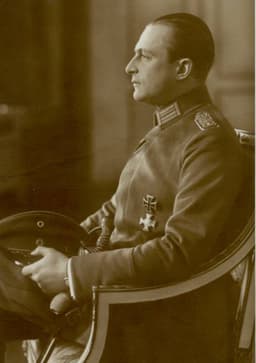
Adolphus Frederick VI
Emperor · Modern
39.4Total

Napoleon Bonaparte
General · Modern
70.9Total
Basic Information
Born
1882
1769
Died
1918
1821
Era
Modern
Modern
Nationality
Mecklenburg-Strelitz
France
Occupation
Emperor
General
Civilization
Western
Western
Score Comparison
Military (10%)
46.7
94.0
Political (20%)
32.1
72.0
Influence (20%)
45.5
40.0
Legacy (20%)
33.3
80.0
Leadership (15%)
31.2
78.0
Strategy (15%)
55.5
90.0
TOTAL
39.4
70.9
Adolphus Frederick VI — Complete Timeline
1914 AD
Accession as Grand Duke of Mecklenburg-StrelitzPolitical Action◆ Major
Adolphus Frederick VI became Grand Duke of Mecklenburg-Strelitz on 11 June 1914, succeeding his father Adolphus Frederick V. His reign was brief and overshadowed by World War I.
Mecklenburg-StrelitzSuccession
Impact: national
1918 AD
Suicide during World War IOther
On 23 February 1918, Adolphus Frederick VI committed suicide at Neustrelitz. His death occurred during World War I, and he was the last grand duke of Mecklenburg-Strelitz, as the monarchy was abolished later that year.
SuicideEnd of monarchyMecklenburg-Strelitz
Impact: nationaltragic
Succession crisisPolitical Action◆ Major
Adolphus Frederick VI's suicide without a direct heir triggered a succession crisis in Mecklenburg-Strelitz. The grand duchy was eventually merged with Mecklenburg-Schwerin after the German Revolution.
Succession crisisMecklenburg-Strelitz
Impact: nationaldestructive
Napoleon Bonaparte — Complete Timeline
1799 AD
Coup of 18 BrumaireOther◆ Major
Napoleon Bonaparte, with support from his brother Lucien and key political figures, overthrew the Directory in a bloodless coup. He established the Consulate with himself as First Consul, effectively becoming the ruler of France. This event ended the French Revolution's most unstable period.
French RevolutionCoupRise to Power
Impact: regional
1804 AD
Promulgation of the Napoleonic CodeOther◆ Major
Napoleon enacted the Civil Code of the French, known as the Napoleonic Code, a comprehensive set of laws that replaced the fragmented feudal legal systems. The code established legal equality, protected property rights, and secularized law. It became the basis for legal systems in many European and world countries.
Legal ReformNapoleonic CodeCivil Law
Impact: globalconstructive
1805 AD
Battle of AusterlitzWar◆ Major
Napoleon's Grande Arm
Napoleonic WarsBattleDecisive Victory
Impact: global
1812 AD
Invasion of RussiaWar◆ Major
Napoleon led the Grande Arm
Napoleonic WarsInvasionDisaster
Impact: globaldestructive
1815 AD
Battle of WaterlooWar◆ Major
Napoleon's French army was defeated by the combined forces of the Duke of Wellington's Anglo-Allied army and Gebhard Leberecht von Bl
Napoleonic WarsBattleFinal Defeat
Impact: globaldestructive
Expert Analysis
adolphus-frederick-vi-vs-napoleon-bonaparte
# The Emperor and the Grand Duke: Two Paths Through History’s Storm
On a February morning in 1918, as the guns of the Great War thundered across the fields of France, a little-known monarch named Adolphus Frederick VI walked into the gardens of his palace in Neustrelitz and put a bullet through his head. He was thirty-five years old, childless, and the ruler of a tiny German duchy that would vanish into history within months of his death. Just over a century earlier, another man had stood on the deck of a ship in the Mediterranean, watching the pyramids of Egypt rise through the desert haze, an entire continent trembling at his name. Napoleon Bonaparte and Adolphus Frederick VI—both wore crowns, both lived through eras of revolutionary upheaval, yet one remade the world while the other could barely hold his own small corner of it. What separated them was not merely talent, but the terrible weight of circumstance, character, and the kind of ambition that either sets the world ablaze or leaves barely a flicker.
Origins
Napoleon was born in 1769 on the island of Corsica, a place that had belonged to the Republic of Genoa until the year before his birth, when France purchased it. His family was minor nobility, poor enough that young Napoleon entered a French military academy at age nine, where he was mocked for his accent and his small stature. Corsica had been conquered, and he grew up with the bitterness of the conquered, yet also with the burning desire to prove himself within the system that had swallowed his homeland. The French Revolution, which erupted when he was twenty, shattered the old order and opened doors that had been locked for centuries. A commoner with talent could now become a general—and Napoleon Bonaparte, hungry and brilliant, walked through that door.
Adolphus Frederick VI was born in 1882 into the House of Mecklenburg-Strelitz, a dynasty that had ruled since the seventeenth century. His world was one of inherited privilege, but also of narrowing possibilities. The German Empire, unified in 1871 under Prussian dominance, had reduced the old princely states to ceremonial roles. The Grand Duke of Mecklenburg-Strelitz was a relic, a figurehead presiding over a backwater of some 100,000 subjects. While Napoleon’s childhood was shaped by revolution and the collapse of monarchy, Adolphus Frederick’s was shaped by stability, boredom, and the slow decay of institutions that no longer mattered. He was trained for a throne that had already lost its power.
Rise to Power
Napoleon’s ascent was meteoric. In 1793, at age twenty-four, he drove the British from the port of Toulon and was promoted to brigadier general. By 1796, he commanded the French Army of Italy, where his lightning campaigns against the Austrians stunned Europe. He was not merely a soldier; he was a political operator of genius, understanding that in revolutionary France, military glory was the fastest path to power. In 1799, he returned from a disastrous campaign in Egypt to find the Directory government in chaos. Within weeks, he had seized control in a coup d’état, becoming First Consul. By 1804, he crowned himself Emperor of the French, taking the crown from the Pope’s hands and placing it on his own head—a gesture that said everything about his belief that power came from within, not from God or tradition.
Adolphus Frederick VI became Grand Duke on 11 June 1914, just weeks before the assassination of Archduke Franz Ferdinand in Sarajevo. He inherited a throne that had been held by his father, Adolphus Frederick V, who had ruled for a decade without distinction. The new Grand Duke was thirty-two, unmarried, and had spent most of his life in obscurity. His rise was not an ascent but an inheritance—the quiet passing of a title in a world that was already forgetting what titles meant. He had no army to command, no revolution to exploit, no stage on which to perform. The doors that had opened for Napoleon were bolted shut for him.
Leadership & Governance
Napoleon governed with a ferocious energy that still astounds historians. He reorganized French law into the Napoleonic Code, which abolished feudal privileges, established equality before the law, and protected property rights—a legal framework that would influence half the world. He reformed education, created the Bank of France, and built roads and canals that unified the nation. As a military commander, he was unmatched: at Austerlitz in 1805, he destroyed a combined Russian and Austrian army with a maneuver so perfect that it is still studied in war colleges. His strategy was to divide his enemies, strike at their weakest point, and annihilate them in a single battle. He believed that a commander’s will could overcome any obstacle, and for a decade, he was right.
Adolphus Frederick VI governed a duchy that was, by 1914, a constitutional monarchy in name only. Real power lay with the German Emperor, the Kaiser, and the federal government in Berlin. The Grand Duke’s duties were ceremonial: opening parliaments, receiving diplomats, presiding over hunting parties. When war came in August 1914, Mecklenburg-Strelitz contributed its regiments to the German army, but the Grand Duke himself had no role in strategy or command. He was a spectator in his own kingdom, watching from the sidelines as millions died for causes he could not influence.
Triumph & Tragedy
Napoleon’s greatest triumph was the empire he built from the Pyrenees to the Vistula, a system of satellite kingdoms ruled by his brothers and marshals. At its height in 1810, he controlled most of continental Europe. His greatest tragedy was the invasion of Russia in 1812. He marched 600,000 men into the vastness of the east, won battle after battle, and entered Moscow to find it burning. The Russian winter, the partisans, and the sheer distance destroyed his army. He returned to France with fewer than 30,000 soldiers. Exiled to Elba in 1814, he escaped, raised another army, and was finally defeated at Waterloo in 1815 by the Duke of Wellington and the Prussian general Blücher. He died in exile on the remote island of Saint Helena in 1821, a prisoner of the British, at age fifty-one.
Adolphus Frederick VI’s triumph was never written. His tragedy was that he lived in a time when his kind of monarchy was dying, and he had neither the talent nor the will to resist. On 23 February 1918, with Germany still fighting a war it could not win, he walked into the palace gardens at Neustrelitz and shot himself. The official story was suicide due to depression. The deeper truth was that he had no heir, no purpose, and no future. His death triggered a succession crisis that was never resolved: the duchy was abolished in November 1918 with the German Revolution, and Mecklenburg-Strelitz ceased to exist as a sovereign state.
Character & Destiny
Napoleon’s character was a furnace of ambition, intelligence, and ego. He believed he was destined to remake Europe, and his confidence infected everyone around him. He was ruthless, capable of sacrificing entire armies for his glory, but also charismatic, able to inspire devotion in soldiers who would die for him. His downfall came from the same qualities that lifted him: he could not stop, could not compromise, could not accept limits. He once said, “There is no such thing as accident; it is fate misnamed.” He believed he was fate’s instrument, and that belief destroyed him.
Adolphus Frederick VI’s character was shaped by irrelevance. He was not stupid—his scores for strategy and influence are surprisingly high for a man of his obscurity—but he lacked the Napoleonic fire. He was a man born into a role that had become meaningless, and he seems to have known it. His suicide was not an act of defiance but of resignation. He did not believe he could change his fate, so he chose to end it.
Legacy
Napoleon’s legacy is carved into the foundations of the modern world. The Napoleonic Code governs legal systems from France to Egypt to Louisiana. The concept of a meritocratic state, where talent trumps birth, spread from his reforms. He created the map of modern Europe, redrawing borders and toppling dynasties. He is remembered as both a hero and a tyrant, a liberator and a conqueror, a man who brought the ideals of the French Revolution to the bayonet’s point. His death on Saint Helena did not end his influence; it only began his myth.
Adolphus Frederick VI is remembered, if at all, as a footnote. His duchy is gone, his palace turned into a museum, his name buried in genealogical tables. He left no laws, no battles, no words that anyone recalls. His legacy is a cautionary tale about the end of an era, about the men who were swept aside by history because they could not ride its currents.
Conclusion
Standing at the edge of the Neustrelitz gardens, with the cold February wind blowing across a dying empire, Adolphus Frederick VI might have thought of Napoleon—the man who had tried to conquer the world and failed, but who had at least tried. The Grand Duke chose silence, while the Emperor chose fire. One remade history; the other was erased by it. Their stories remind us that opportunity alone does not make greatness, nor does birth guarantee relevance. In the end, what separates the titans from the shadows is not just talent or luck, but the willingness to risk everything for a dream—even if that dream ends in exile, defeat, and a lonely grave on a windswept island.
Rankings
🥇
Napoleon BonaparteLeader
Mil: 94.0Pol: 72.0Inf: 40.0
70.9
🥈
Adolphus Frederick VI
Mil: 46.7Pol: 32.1Inf: 45.5
39.4
+31.5 behind
How This Comparison Works
Algorithm
Each figure is scored on 6 dimensions (0—100 scale) based on structured historical data: Military (10%), Political (20%), Influence (20%), Legacy (20%), Leadership (15%), Strategy (15%). The weighted total produces the final ranking.
Data Sources
Scores are computed from structured sub-indicators in the database. Scale factors adjust for era (Ancient ×0.85, Modern ×1.0) and civilization size (Eastern ×1.05, Other ×0.80) to account for differences in population and military scale.
Maximum 3 Figures
Comparisons are limited to 2—3 figures to ensure readability and statistical meaningfulness.
Error Margins
±5 points per dimension — Sub-scores are derived from historical records with inherent uncertainty. Two figures within 5 points on a dimension should be considered roughly equivalent in that area.
Total Score Accuracy
±3 points overall — The weighted combination of 6 dimensions produces a total score with approximately ±3 points of uncertainty. Differences of less than 3 points are not statistically significant— the figures are effectively tied.
Known Limitations
- Historical records are incomplete and uneven across civilizations
- Figures from oral-tradition societies may be underrepresented
- Occupation labels can misclassify multi-role figures
- Scores measure capability and impact, not moral character
- Quantitative scoring is a comparison tool, not absolute truth
Capability Radar
Military (10%) — Battles & Warfare
Battles
27
95
Win Rate
24
90
Expansion
31
95
Political (20%) — Governance & Reform
Reform
5
95
Diplomacy
5
80
Economy
5
85
Influence (20%) — Cultural & Global Reach
Cultural
5
85
Global
5
90
Legacy (20%) — Historical Impact
Historical
5
95
Longevity
5
90
Leadership (15%) — Power & Stability
Tenure
10
85
Stability
5
70
Strategy (15%) — Tactics & Innovation
Strategy
33
95
Tactics
37
98
Reform
38
92
Similar Comparisons
Comments & Discussion
ArtilleryBrain6/17/2026
Napoleon won because he understood time. In his 1796 Italian campaign, he maneuvered so fast he fought 14 battles and won 14 victories in 14 days. Adolphus Frederick VI had 14 years as a grand duke and achieved nothing. Speed isn't everything in war, but being too slow to even produce an heir might as well be surrender.
零和理论家6/17/2026
数据不会说谎,但比较这两人简直像拿核弹比擦炮。拿破仑指挥过60万大军横跨俄罗斯,阿道夫·弗雷德里克六世连他那个小公国的军队编制都凑不齐两千人。把这两个放在同一段历史讨论里,就像比较太阳和萤火虫的亮度。统计学家会告诉你们,这根本不是量级差异,而是维度碾压。
LegacyWarden6/17/2026
The real tragedy isn't that one failed and one succeeded—it's that one had a continent to conquer and the other was handed a museum piece. Napoleon reshaped civil codes, abolished feudalism across Europe, and still found time to lose at Waterloo in spectacular fashion. Adolphus Frederick VI abdicated his duchy into irrelevance without firing a shot. One died in exile still plotting; the other died in his own garden, alone.
编年史钓客6/17/2026
你们全都在用拿破仑的尺度衡量阿道夫·弗雷德里克,这本身就是偏见。中世纪小邦君主的价值在于生存,而非征服。梅克伦堡-施特雷利茨能在普鲁士和奥地利夹缝里维持独立到1918年,已经是政治平衡术的杰作。拿破仑那套"要么征服世界要么毁灭"的浪漫主义,放在这些小公国语境下,就是自杀式傲慢。
NarrativeCutter6/17/2026
Stop romanticizing the suicide. Adolphus Frederick VI wasn't a tragic figure caught in great power machinations—he was a hereditary ruler who watched his dynasty's 700-year legacy evaporate because he couldn't adapt. Napoleon at least understood that power requires constant reinvention, even if it eventually consumed him. One died managing decline, the other died fighting against it. History doesn't remember the managers.