Loading...
Abeid Karume vs Napoleon Bonaparte
Napoleon Bonaparte leads by 25.9 pts · 2 figures compared
…
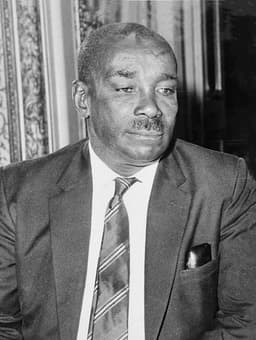
Abeid Karume
Politician · Modern
45.0Total

Napoleon Bonaparte
General · Modern
70.9Total
Basic Information
Born
1905
1769
Died
1972
1821
Era
Modern
Modern
Nationality
Tanzania
France
Occupation
Politician
General
Civilization
Other
Western
Score Comparison
Military (10%)
20.0
94.0
Political (20%)
35.1
72.0
Influence (20%)
51.8
40.0
Legacy (20%)
42.5
80.0
Leadership (15%)
58.8
78.0
Strategy (15%)
53.8
90.0
TOTAL
45.0
70.9
Abeid Karume — Complete Timeline
1964 AD
Zanzibar RevolutionPolitical Action
Karume led the Zanzibar Revolution in January 1964, overthrowing the Sultanate and establishing the People's Republic of Zanzibar. The revolution resulted in the overthrow of the Arab-dominated government and the installation of an Afro-Shirazi Party regime, leading to significant social and political changes.
RevolutionZanzibarOverthrow
Impact: regionaldestructive
First President of ZanzibarPolitical Action◆ Major
Following the revolution, Karume became the first President of Zanzibar in 1964. He led the government until his assassination in 1972, implementing policies of nationalization and land redistribution, while also consolidating power through authoritarian means.
PresidencyZanzibarLeadership
Impact: regional
Union with TanganyikaPolitical Action◆ Major
In April 1964, Karume negotiated the union of Zanzibar with Tanganyika to form the United Republic of Tanzania. This act created a single sovereign state, though Zanzibar retained significant autonomy, including its own president and government.
UnionTanzaniaZanzibar
Impact: regionalconstructive
1972 AD
Assassination of Abeid KarumePolitical Action◆ Major
Karume was assassinated in April 1972 by four gunmen while playing chess at the Afro-Shirazi Party headquarters in Zanzibar City. His death led to a period of political instability and a crackdown on opposition, with his successor Aboud Jumbe taking power.
AssassinationZanzibarPolitical Violence
Impact: regionaltragic
Napoleon Bonaparte — Complete Timeline
1799 AD
Coup of 18 BrumaireOther◆ Major
Napoleon Bonaparte, with support from his brother Lucien and key political figures, overthrew the Directory in a bloodless coup. He established the Consulate with himself as First Consul, effectively becoming the ruler of France. This event ended the French Revolution's most unstable period.
French RevolutionCoupRise to Power
Impact: regional
1804 AD
Promulgation of the Napoleonic CodeOther◆ Major
Napoleon enacted the Civil Code of the French, known as the Napoleonic Code, a comprehensive set of laws that replaced the fragmented feudal legal systems. The code established legal equality, protected property rights, and secularized law. It became the basis for legal systems in many European and world countries.
Legal ReformNapoleonic CodeCivil Law
Impact: globalconstructive
1805 AD
Battle of AusterlitzWar◆ Major
Napoleon's Grande Arm
Napoleonic WarsBattleDecisive Victory
Impact: global
1812 AD
Invasion of RussiaWar◆ Major
Napoleon led the Grande Arm
Napoleonic WarsInvasionDisaster
Impact: globaldestructive
1815 AD
Battle of WaterlooWar◆ Major
Napoleon's French army was defeated by the combined forces of the Duke of Wellington's Anglo-Allied army and Gebhard Leberecht von Bl
Napoleonic WarsBattleFinal Defeat
Impact: globaldestructive
Expert Analysis
abeid-karume-vs-napoleon-bonaparte
# The Island and the Empire
On an April evening in 1972, Abeid Karume sat playing chess at the Afro-Shirazi Party headquarters in Zanzibar City. Outside, the Indian Ocean lapped against the ancient coral walls of Stone Town. Inside, four gunmen stepped through the door. Karume, the fisherman's son who had become president, never saw the bullets coming. Eleven thousand miles away and a century and a half earlier, Napoleon Bonaparte had died on a remote Atlantic island, a prisoner of the British, his dreams of a global empire reduced to a scrap of rock. Both men rose from modest beginnings. Both seized history by the throat. Yet one reshaped the Western world, while the other remains a footnote in African history. The difference was not merely in ambition, but in the worlds they inhabited.
Origins
Napoleon was born in 1769 on Corsica, a Mediterranean island that France had purchased from Genoa just a year earlier. His family were minor Italian nobility, poor but proud. As a boy, he spoke Corsican, not French, and was mocked at military academy for his accent and small stature. He devoured books on military history and the Enlightenment, particularly Rousseau. The French Revolution, erupting when he was twenty, shattered the old order and opened paths that birth alone could never have granted.
Abeid Karume was born in 1905 on Zanzibar, an island off East Africa then ruled by the Omani Sultanate. His father was a poor fisherman, his mother a slave of Arab descent. Karume received almost no formal education. He worked as a sailor, a carpenter, a dockworker. He learned Swahili and Arabic, but never became fluent in English, the language of power. Where Napoleon had the printing press, the salon, the academy, Karume had the dhow, the wharf, the oral tradition of the mosque. Their starting points were not merely different; they were different centuries.
Rise to Power
Napoleon’s rise was meteoric, propelled by the chaos of revolutionary France. In 1793, at twenty-four, he drove the British out of Toulon and was promoted to brigadier general. In 1795, he saved the revolutionary government from a royalist mob with a "whiff of grapeshot." By 1796, he commanded the Army of Italy and won a string of stunning victories against the Austrians. He was not merely lucky; he was a master of speed, deception, and artillery tactics. He turned battle into science.
Karume’s path was slower, more brutal. In 1957, he co-founded the Afro-Shirazi Party, demanding independence from the Arab-dominated Sultanate. He was imprisoned, exiled, beaten. He spoke not of glory but of land rights, wages, and the end of racial hierarchy. The Zanzibar Revolution of January 1964 was not a campaign of maneuver but a bloody uprising: Arab elites were massacred, the Sultan fled, and Karume emerged as president of the People's Republic. He had not conquered an army; he had ridden a wave of popular rage.
Leadership & Governance
Napoleon governed as he fought: with relentless energy and total control. As First Consul after 1799, he centralized the state, created the Bank of France, and codified French law into the Napoleonic Code, which abolished feudal privileges and established legal equality. He built roads, canals, and lycées. He made peace with the Catholic Church through the Concordat of 1801. He was a reformer, but also a tyrant: he censored the press, reestablished slavery in the colonies, and crowned himself Emperor in 1804. His military genius—rated 94 by historians—was matched by political skill, but not by wisdom. He believed he could conquer Europe, then Russia, then the world.
Karume ruled Zanzibar with a different logic. He nationalized land and clove plantations, redistributing wealth to the African majority. He built schools and hospitals. But he also established a one-party state, suppressed dissent, and ruled by decree. His political score of 74.6 reflects a leader who achieved real change but through authoritarian means. His military score of 50.8 suggests he was no general; his strategy score of 56.0 indicates limited tactical thinking. Yet his greatest act—the union with Tanganyika in April 1964 to form Tanzania—was a stroke of political genius. It prevented Zanzibar from becoming a Cold War pawn, and gave the island stability it had never known.
Triumph & Tragedy
Napoleon’s greatest moment was Austerlitz, December 2, 1805. He lured the combined Russian and Austrian armies into a trap, smashed their center, and destroyed the Third Coalition. It was a masterpiece of deception and timing. His greatest failure was the invasion of Russia in 1812. He marched 600,000 men into the vastness, lost them to cold and hunger, and returned with barely 40,000. Exiled to Elba in 1814, he escaped, raised another army, and was finally defeated at Waterloo on June 18, 1815. He died in 1821 on Saint Helena, a prisoner, still dreaming of glory.
Karume’s triumph was the union itself. By merging Zanzibar with Julius Nyerere’s Tanganyika, he created a nation that has endured for over sixty years. His tragedy was his isolation and paranoia. He distrusted intellectuals, exiled rivals, and ruled through a network of loyalists. On April 7, 1972, four gunmen—soldiers loyal to a former minister—ended his life. He was sixty-six. No trial, no exile, just a chess game interrupted by bullets.
Character & Destiny
Napoleon was driven by an insatiable will. "Impossible," he once said, "is a word to be found only in the dictionary of fools." He believed he could bend reality to his ambition. That belief made him master of Europe—and then its prisoner. His character was his destiny: brilliant, arrogant, relentless, and ultimately self-destructive.
Karume was more cautious, more pragmatic. He had seen the horrors of revolution and wanted order. "We must build a nation," he said, "not a battlefield." He was not a visionary like Nyerere, nor a conqueror like Napoleon. He was a survivor who became a ruler, and then a target. His character—suspicious, stubborn, determined—shaped a small island’s fate, but not the world’s.
Legacy
Napoleon’s legacy is immense. The Napoleonic Code influenced legal systems across Europe and the Americas. His military tactics are studied in war colleges. His name is synonymous with ambition, genius, and hubris. His influence score of 82 and legacy score of 78 reflect a man who changed the course of Western history.
Karume’s legacy is quieter. He is remembered as the father of Zanzibar’s revolution and the co-founder of Tanzania. But his authoritarian rule and the violence of the revolution remain controversial. His influence score of 68.2 and legacy score of 55.6 suggest a leader who mattered deeply to his nation, but barely registers globally. In Zanzibar, his portrait still hangs in government offices. Elsewhere, he is unknown.
Conclusion
The difference between Napoleon and Karume is not simply one of scale. It is one of world-historical context. Napoleon inherited the Enlightenment, the Revolution, and the resources of a continental power. Karume inherited a tiny island, a colonial wound, and the Cold War. Napoleon could dream of Europe because Europe existed to be conquered. Karume could only dream of survival, because survival was the highest ambition his world allowed. One became a legend; the other became a footnote. Both were men of their time, and their times were not the same.
Rankings
🥇
Napoleon BonaparteLeader
Mil: 94.0Pol: 72.0Inf: 40.0
70.9
🥈
Abeid Karume
Mil: 20.0Pol: 35.1Inf: 51.8
45.0
+25.9 behind
How This Comparison Works
Algorithm
Each figure is scored on 6 dimensions (0—100 scale) based on structured historical data: Military (10%), Political (20%), Influence (20%), Legacy (20%), Leadership (15%), Strategy (15%). The weighted total produces the final ranking.
Data Sources
Scores are computed from structured sub-indicators in the database. Scale factors adjust for era (Ancient ×0.85, Modern ×1.0) and civilization size (Eastern ×1.05, Other ×0.80) to account for differences in population and military scale.
Maximum 3 Figures
Comparisons are limited to 2—3 figures to ensure readability and statistical meaningfulness.
Error Margins
±5 points per dimension — Sub-scores are derived from historical records with inherent uncertainty. Two figures within 5 points on a dimension should be considered roughly equivalent in that area.
Total Score Accuracy
±3 points overall — The weighted combination of 6 dimensions produces a total score with approximately ±3 points of uncertainty. Differences of less than 3 points are not statistically significant— the figures are effectively tied.
Known Limitations
- Historical records are incomplete and uneven across civilizations
- Figures from oral-tradition societies may be underrepresented
- Occupation labels can misclassify multi-role figures
- Scores measure capability and impact, not moral character
- Quantitative scoring is a comparison tool, not absolute truth
Capability Radar
Military (10%) — Battles & Warfare
Battles
15
95
Win Rate
20
90
Expansion
10
95
Political (20%) — Governance & Reform
Reform
30
95
Diplomacy
25
80
Economy
20
85
Influence (20%) — Cultural & Global Reach
Cultural
30
85
Global
20
90
Legacy (20%) — Historical Impact
Historical
35
95
Longevity
20
90
Leadership (15%) — Power & Stability
Tenure
40
85
Stability
15
70
Strategy (15%) — Tactics & Innovation
Strategy
15
95
Tactics
10
98
Reform
10
92
Similar Comparisons
Comments & Discussion
Shipwrecked Emperor6/17/2026
Comparing Karume to Napoleon is like comparing a canoe to a dreadnought. Sure, both rose from modest origins, but Napoleon reshaped the legal and political foundations of Europe with the Napoleonic Code, which still influences civil law across 70+ nations today. Karume? He executed political rivals and banned opposition parties in Zanzibar. One built an empire of ideas; the other built a cult of personality on a spice island. Context matters, but so do results.
Chessboard Assassin6/17/2026
拿拿破仑和卡鲁姆比,简直是把狮子跟鬣狗并列。拿破仑在奥斯特里茨三皇会战中,以七万兵力击溃九万俄奥联军,一战封神;卡鲁姆在桑给巴尔搞“革命”后,直接取缔所有政党,建立一党专政,还纵容民兵屠杀上千阿拉伯裔平民。一个用战略改变欧洲地图,一个用暴力统治海岛。历史不是比谁出身更惨,是比谁让世界变得更好。卡鲁姆的名字只配出现在脚注里。
Corinthian Reformer6/17/2026
The Napoleonic Code is the ghost of modern civil law from Louisiana to Lebanon, but Zanzibar under Karume saw the forced merger with Tanganyika in 1964, effectively erasing its sovereignty within two years of independence. Napoleon conquered half of Europe; Karume couldn't even keep his own country intact. One wrote legal systems that outlasted his downfall; the other traded autonomy for a footnote in Tanzanian textbooks. The scale gap is laughable.
石城棋局6/17/2026
两人都爱下棋:拿破仑在圣赫勒拿岛用棋子复盘滑铁卢,卡鲁姆在总理府下棋时被乱枪打死。一个囚徒活在回忆里,一个总统死在棋局中。拿破仑虽败犹荣,他重建了法国教育体系,创立了荣誉军团勋章;卡鲁姆的“功绩”是把桑给巴尔变成苏联卫星国的试验田,还强推“革命法庭”随意判刑。一个流芳百世,一个连雕像都被推倒。历史的选择从不偏心——它只记录有分量的名字。