Loading...
Abdoulaye Wade vs Mario Soares
Mario Soares leads by 12.0 pts · 2 figures compared
…

Abdoulaye Wade
Politician · Modern
51.8Total
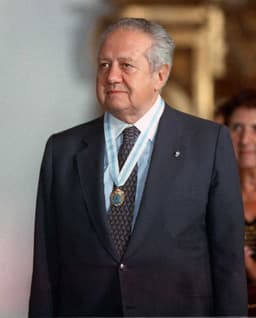
Mario Soares
Politician · Modern
63.8Total
Basic Information
Born
1926
1924
Died
—
—
Era
Modern
Modern
Nationality
Senegal
Portugal
Occupation
Politician
Politician
Civilization
Other
Western
Score Comparison
Military (10%)
19.6
14.6
Political (20%)
68.0
84.0
Influence (20%)
56.4
68.0
Legacy (20%)
43.3
68.0
Leadership (15%)
68.0
78.0
Strategy (15%)
44.8
40.8
TOTAL
51.8
63.8
Abdoulaye Wade — Complete Timeline
2000 AD
Elected President of SenegalPolitical Action
Abdoulaye Wade won the presidential election, defeating incumbent Abdou Diouf. His victory marked the first peaceful transfer of power in Senegal's history and was hailed as a democratic milestone.
ElectionDemocracy
Impact: nationalconstructive
2007 AD
Re-elected for a Second TermPolitical Action◆ Major
Wade was re-elected in the first round with 55.9% of the vote. The election was criticized by opposition for irregularities, but Wade's victory was confirmed by the Constitutional Council.
Re-electionControversy
Impact: national
2011 AD
Attempted to Change Constitution for Third TermPolitical Action◆ Major
Wade proposed a constitutional amendment to allow a third term, sparking massive protests. The move was seen as a power grab and led to violent clashes, damaging his democratic legacy.
Constitutional CrisisProtests
Impact: nationaldestructive
2012 AD
Defeated in Presidential ElectionPolitical Action◆ Major
Wade lost the presidential election to Macky Sall in a runoff. He conceded defeat, marking a peaceful transition of power despite the earlier tensions over his third-term bid.
Election DefeatTransition
Impact: national
Mario Soares — Complete Timeline
1973 AD
Founding of the Portuguese Socialist PartyPolitical Action◆ Major
Soares co-founded the Portuguese Socialist Party (PS) in West Germany, in exile from the Estado Novo regime. The party became a key force in the democratic transition after the Carnation Revolution.
Political PartyDemocracyExile
Impact: nationalconstructive
1974 AD
Return from Exile after Carnation RevolutionPolitical Action◆ Major
After the Carnation Revolution overthrew the Estado Novo, Soares returned from exile to Portugal. He was greeted by large crowds and immediately entered the political negotiations for the new democratic regime.
Carnation RevolutionDemocracyReturn
Impact: nationalconstructive
1976 AD
Election as Prime MinisterPolitical Action◆ Major
Soares became the first democratically elected Prime Minister of Portugal after the Carnation Revolution, leading a minority Socialist government. His election marked the consolidation of democratic institutions.
ElectionDemocracyGovernment
Impact: nationalconstructive
1985 AD
Negotiation of Portugal's Accession to the EECPolitical Action◆ Major
As Prime Minister, Soares led the negotiations for Portugal's accession to the European Economic Community (EEC). The treaty was signed in 1985, integrating Portugal into the European project and modernizing its economy.
European UnionIntegrationTreaty
Impact: regionalconstructive
1986 AD
Election as President of PortugalPolitical Action◆ Major
Soares was elected President of the Republic, becoming the first civilian president since the Carnation Revolution. He served two five-year terms, providing stability and continuity during Portugal's consolidation of democracy.
PresidencyDemocracyElection
Impact: nationalconstructive
Expert Analysis
Origins
Abdoulaye Wade was born in 1926 in Kébémer, Senegal, into a Muslim family. He studied law in France, earning a doctorate, and returned to Senegal to practice as a lawyer. His early career included teaching at the University of Dakar and involvement in opposition politics against President Léopold Sédar Senghor. Wade founded the Senegalese Democratic Party (PDS) in 1974, advocating for multiparty democracy.
Mário Soares was born in 1924 in Lisbon, Portugal, to a republican family. His father was a priest and teacher. Soares studied history and law at the University of Lisbon, becoming a lawyer. He was an early opponent of the Estado Novo regime, joining the Communist Party briefly before co-founding the Portuguese Socialist Party (PS) in 1973 while in exile in West Germany. His activism led to imprisonment and exile.
Rise to Power
Wade rose to prominence as a persistent opposition leader. He ran for president multiple times: first in 1978 (won 17.4%), then 1983 (14.7%), 1988 (25.8%), and 1993 (32.0%). In 2000, he defeated incumbent Abdou Diouf in a runoff with 58.5% of the vote, marking Senegal's first peaceful transfer of power. His victory was a turning point for African democracy.
Soares returned from exile on April 30, 1974, after the Carnation Revolution overthrew the Estado Novo. He was greeted by 200,000 people in Lisbon. He became Prime Minister in 1976 after his PS won 36.1% of the vote in the first democratic elections. His rise was rapid, leveraging his international connections and anti-fascist credentials.
Leadership & Governance
Wade's leadership was characterized by ambitious infrastructure projects like the toll highway and the Monument of the African Renaissance, but also by growing authoritarianism. He scored 68.0 in political leadership and 44.8 in strategy. His governance style was confrontational; he frequently clashed with opposition and civil society. He attempted to change the constitution for a third term in 2011, sparking violent protests. His economic policies led to growth but also increased inequality.
Soares, scoring 84.0 in politics and 78.0 in leadership, governed with a focus on consolidating democracy and integrating Portugal into Europe. He led minority governments, relying on coalitions. He negotiated Portugal's accession to the EEC in 1985, securing structural funds that modernized the economy. His governance was pragmatic, though he faced economic crises and austerity measures.
Triumph & Tragedy
Wade's greatest triumph was the peaceful transfer of power in 2000 and again in 2012 when he conceded defeat to Macky Sall. His tragedy was the attempt to extend his rule, which tarnished his legacy and led to violent crackdowns that killed at least six people. His support for the International Criminal Court and African Union initiatives were positive, but his domestic record was mixed.
Soares's triumph was overseeing Portugal's transition to democracy and EU integration. He also served as President (1986-1996), stabilizing the country. His tragedy was the failure to prevent the 1975 leftist coup attempt that nearly derailed democracy, and his economic policies struggled with high unemployment and inflation. He was criticized for being too moderate.
Character & Destiny
Wade was a charismatic lawyer and orator, but his character became increasingly autocratic. He believed in his own indispensability, leading to the third-term debacle. His destiny was to be a transitional figure who opened democracy but overstayed his welcome.
Soares was a pragmatic socialist, committed to democratic institutions. His character combined idealism with realism, allowing him to navigate turbulent post-revolution politics. His destiny was to be the 'father of Portuguese democracy,' a role he embraced with dignity.
Legacy
Wade's legacy in Senegal is complex: he is credited with ending 40 years of Socialist Party rule and establishing democratic alternation, but his later actions damaged his reputation. The Monument of the African Renaissance stands as a controversial symbol. His political score of 68.0 and legacy score of 43.3 reflect this mixed record.
Soares is universally revered in Portugal. The PS remains a major party, and Portugal's EU membership is his enduring achievement. His legacy score of 68.0 and influence of 68.0 highlight his lasting impact. He is remembered as a statesman who guided Portugal from dictatorship to democracy.
Conclusion
Mário Soares had the greater impact overall, with a total score of 63.8 compared to Wade's 51.8. Soares's role in founding Portuguese democracy and integrating his country into Europe was transformative on a national and continental scale. Wade's contribution to African democracy was significant but marred by his later power grab. While Wade's peaceful transitions were important, Soares's deeper institutional legacy and higher scores in politics, leadership, and legacy make him the more consequential figure.
Rankings
🥇
Mario SoaresLeader
Mil: 14.6Pol: 84.0Inf: 68.0
63.8
🥈
Abdoulaye Wade
Mil: 19.6Pol: 68.0Inf: 56.4
51.8
+12.0 behind
How This Comparison Works
Algorithm
Each figure is scored on 6 dimensions (0—100 scale) based on structured historical data: Military (10%), Political (20%), Influence (20%), Legacy (20%), Leadership (15%), Strategy (15%). The weighted total produces the final ranking.
Data Sources
Scores are computed from structured sub-indicators in the database. Scale factors adjust for era (Ancient ×0.85, Modern ×1.0) and civilization size (Eastern ×1.05, Other ×0.80) to account for differences in population and military scale.
Maximum 3 Figures
Comparisons are limited to 2—3 figures to ensure readability and statistical meaningfulness.
Error Margins
±5 points per dimension — Sub-scores are derived from historical records with inherent uncertainty. Two figures within 5 points on a dimension should be considered roughly equivalent in that area.
Total Score Accuracy
±3 points overall — The weighted combination of 6 dimensions produces a total score with approximately ±3 points of uncertainty. Differences of less than 3 points are not statistically significant— the figures are effectively tied.
Known Limitations
- Historical records are incomplete and uneven across civilizations
- Figures from oral-tradition societies may be underrepresented
- Occupation labels can misclassify multi-role figures
- Scores measure capability and impact, not moral character
- Quantitative scoring is a comparison tool, not absolute truth
Capability Radar
Military (10%) — Battles & Warfare
Battles
25
21
Win Rate
29
24
Expansion
32
26
Political (20%) — Governance & Reform
Reform
55
95
Diplomacy
60
90
Economy
50
70
Influence (20%) — Cultural & Global Reach
Cultural
40
70
Global
40
65
Legacy (20%) — Historical Impact
Historical
40
85
Longevity
30
75
Leadership (15%) — Power & Stability
Tenure
60
85
Stability
45
75
Strategy (15%) — Tactics & Innovation
Strategy
35
33
Tactics
37
35
Reform
41
35
Similar Comparisons
Comments & Discussion
No comments yet. Be the first to share your thoughts!