Loading...
Abd al-Karim Qasim vs Efrain Rios Montt
Abd al-Karim Qasim leads by 18.3 pts · 2 figures compared
…

Abd al-Karim Qasim
General · Modern
56.3Total
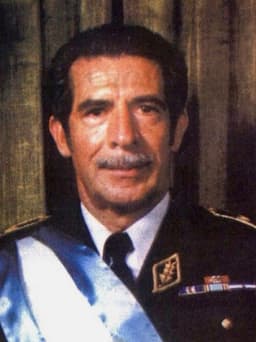
Efrain Rios Montt
General · Modern
38.0Total
Basic Information
Born
1914
1926
Died
1963
—
Era
Modern
Modern
Nationality
Iraq
Guatemala
Occupation
General
General
Civilization
Middle Eastern
Western
Score Comparison
Military (10%)
45.0
25.9
Political (20%)
68.0
25.0
Influence (20%)
56.4
47.9
Legacy (20%)
46.7
38.3
Leadership (15%)
65.7
47.3
Strategy (15%)
60.0
30.3
TOTAL
56.3
38.0
Abd al-Karim Qasim — Complete Timeline
1958 AD
14 July RevolutionPolitical Action
Qasim, leading the Free Officers movement, orchestrated a military coup that overthrew King Faisal II and the Hashemite monarchy. The royal family was executed, and Iraq was declared a republic with Qasim as Prime Minister.
CoupRepublicIraq
Impact: national
1959 AD
Withdrawal from the Baghdad PactPolitical Action◆ Major
Qasim withdrew Iraq from the Baghdad Pact, shifting the country's foreign policy away from Western alignment. He pursued a neutralist stance and improved relations with the Soviet Union, altering the regional balance of power.
Foreign PolicyCold WarNeutralism
Impact: regional
1961 AD
Kuwait crisisPolitical Action◆ Major
Qasim claimed sovereignty over Kuwait shortly after its independence from Britain, leading to a military standoff. British forces intervened to protect Kuwait, and Qasim's claim was widely condemned, isolating Iraq diplomatically.
Territorial DisputeKuwaitIsolation
Impact: regionaldestructive
1963 AD
Overthrow and executionPolitical Action
Qasim was overthrown in a Ba'athist coup led by Abdul Salam Arif and Ahmed Hassan al-Bakr. After a brief trial, he was executed by firing squad. His death ended the first republican government of Iraq and ushered in Ba'athist rule.
CoupExecutionBa'ath Party
Impact: nationaltragic
Efrain Rios Montt — Complete Timeline
1982 AD
Scorched earth campaign against Maya communitiesWar◆ Major
Under Ríos Montt's 'Beans and Bullets' policy, the Guatemalan army conducted a scorched earth campaign in the highlands, destroying hundreds of Maya villages, killing thousands, and displacing tens of thousands. The campaign aimed to eliminate support for leftist guerrillas.
Scorched EarthCounterinsurgencyMaya Genocide
Impact: nationaldestructive
Coup d'état and assumption of powerPolitical Action◆ Major
Ríos Montt led a military coup that overthrew President Fernando Romeo Lucas García. He assumed power as head of a military junta, suspending the constitution and dissolving Congress. His rule marked the bloodiest period of Guatemala's 36-year civil war.
CoupMilitary RuleCivil War
Impact: nationaldestructive
2013 AD
Conviction for genocide against Maya IxilPolitical Action
Ríos Montt was convicted of genocide and crimes against humanity for the massacre of over 1,700 Maya Ixil people during his 1982-83 rule. He was sentenced to 80 years in prison, but the conviction was later overturned on procedural grounds by the Constitutional Court.
GenocideHuman RightsMayaTrial
Impact: globaldestructive
Expert Analysis
Origins
Abd al-Karim Qasim was born in 1914 in Baghdad, Iraq, into a lower-middle-class Sunni family. His father was a carpenter, and his mother was a Shia. He attended military school and graduated from the Iraqi Military Academy in 1934. Qasim rose through the ranks, influenced by Arab nationalism and anti-imperialism. Efrain Rios Montt was born in 1926 in Huehuetenango, Guatemala, into a middle-class family. He attended the Guatemalan Military Academy and later studied at the School of the Americas. His early career was shaped by Cold War anti-communist ideology.
Rise to Power
Qasim led the 14 July Revolution in 1958, a military coup that overthrew King Faisal II and the Hashemite monarchy. He became Prime Minister and de facto ruler. His rise was swift, backed by the Free Officers movement. Rios Montt came to power in a 1982 coup that ousted President Fernando Romeo Lucas Garcia. He assumed leadership of a military junta, suspending the constitution and dissolving Congress. His ascent capitalized on the Guatemalan Civil War's chaos.
Leadership & Governance
Qasim pursued a neutralist foreign policy, withdrawing Iraq from the Baghdad Pact in 1959 and improving relations with the Soviet Union. Domestically, he implemented land reforms and supported women's rights, including the Personal Status Law of 1959. However, his rule was autocratic, suppressing political opposition. Rios Montt governed under a state of siege, employing a 'Beans and Bullets' policy that combined food aid with military repression. He launched a scorched earth campaign against Maya communities, destroying hundreds of villages. His governance was marked by human rights abuses, scoring 25.0 in political effectiveness compared to Qasim's 68.0.
Triumph & Tragedy
Qasim's greatest triumph was overthrowing the monarchy and establishing a republic, achieving a political score of 68.0. He also successfully nationalized oil resources. His tragedy was his inability to consolidate power, leading to his overthrow in 1963 by Ba'athist forces and subsequent execution. Rios Montt's triumph was temporarily stabilizing the country through brutal counterinsurgency, earning a legacy score of 38.3. His tragedy was his conviction for genocide and crimes against humanity in 2013 for the massacre of over 1,700 Maya Ixil people, though the conviction was later overturned on technicalities.
Character & Destiny
Qasim was cautious and indecisive, often alienating allies. His leadership score of 65.7 reflects his ability to inspire loyalty initially but his failure to maintain it. His destiny was sealed by his isolation and reliance on a narrow base. Rios Montt was ruthless and ideologically rigid, with a military strategy score of 30.3. His character led to widespread atrocities, and his eventual conviction marked a rare instance of accountability. His total score of 38.0 reflects his catastrophic legacy.
Legacy
Qasim is remembered as a nationalist reformer who ended the monarchy in Iraq but failed to build a stable state. His influence score of 56.4 is moderate. Rios Montt's legacy is one of genocide and impunity, with a legacy score of 38.3. He became a symbol of state terror in Latin America. Both left mixed legacies, but Qasim's impact on Iraqi history is more significant in terms of structural change.
Conclusion
Abd al-Karim Qasim had a greater impact than Efrain Rios Montt, as reflected in his total score of 56.3 versus 38.0. Qasim's overthrow of the monarchy and neutralist policies shaped Iraq for decades, while Rios Montt's brutal regime ended in international condemnation. Qasim's reforms, though flawed, were more substantive. Rios Montt's legacy is primarily one of destruction. Data supports Qasim as the more consequential figure.
Rankings
🥇
Abd al-Karim QasimLeader
Mil: 45.0Pol: 68.0Inf: 56.4
56.3
🥈
Efrain Rios Montt
Mil: 25.9Pol: 25.0Inf: 47.9
38.0
+18.3 behind
How This Comparison Works
Algorithm
Each figure is scored on 6 dimensions (0—100 scale) based on structured historical data: Military (10%), Political (20%), Influence (20%), Legacy (20%), Leadership (15%), Strategy (15%). The weighted total produces the final ranking.
Data Sources
Scores are computed from structured sub-indicators in the database. Scale factors adjust for era (Ancient ×0.85, Modern ×1.0) and civilization size (Eastern ×1.05, Other ×0.80) to account for differences in population and military scale.
Maximum 3 Figures
Comparisons are limited to 2—3 figures to ensure readability and statistical meaningfulness.
Error Margins
±5 points per dimension — Sub-scores are derived from historical records with inherent uncertainty. Two figures within 5 points on a dimension should be considered roughly equivalent in that area.
Total Score Accuracy
±3 points overall — The weighted combination of 6 dimensions produces a total score with approximately ±3 points of uncertainty. Differences of less than 3 points are not statistically significant— the figures are effectively tied.
Known Limitations
- Historical records are incomplete and uneven across civilizations
- Figures from oral-tradition societies may be underrepresented
- Occupation labels can misclassify multi-role figures
- Scores measure capability and impact, not moral character
- Quantitative scoring is a comparison tool, not absolute truth
Capability Radar
Military (10%) — Battles & Warfare
Battles
30
15
Win Rate
35
10
Expansion
10
5
Political (20%) — Governance & Reform
Reform
60
5
Diplomacy
40
10
Economy
50
10
Influence (20%) — Cultural & Global Reach
Cultural
30
5
Global
20
20
Legacy (20%) — Historical Impact
Historical
45
30
Longevity
25
10
Leadership (15%) — Power & Stability
Tenure
45
40
Stability
20
5
Strategy (15%) — Tactics & Innovation
Strategy
30
15
Tactics
25
20
Reform
40
5
Similar Comparisons
Comments & Discussion
No comments yet. Be the first to share your thoughts!