Loading...
Efrain Rios Montt vs Napoleon Bonaparte
Napoleon Bonaparte leads by 32.9 pts · 2 figures compared
…
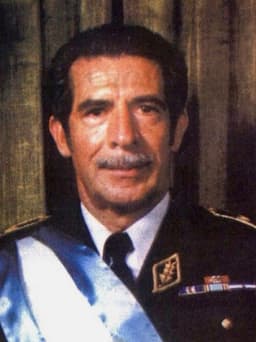
Efrain Rios Montt
General · Modern
38.0Total

Napoleon Bonaparte
General · Modern
70.9Total
Basic Information
Born
1926
1769
Died
—
1821
Era
Modern
Modern
Nationality
Guatemala
France
Occupation
General
General
Civilization
Western
Western
Score Comparison
Military (10%)
25.9
94.0
Political (20%)
25.0
72.0
Influence (20%)
47.9
40.0
Legacy (20%)
38.3
80.0
Leadership (15%)
47.3
78.0
Strategy (15%)
30.3
90.0
TOTAL
38.0
70.9
Efrain Rios Montt — Complete Timeline
1982 AD
Scorched earth campaign against Maya communitiesWar◆ Major
Under Ríos Montt's 'Beans and Bullets' policy, the Guatemalan army conducted a scorched earth campaign in the highlands, destroying hundreds of Maya villages, killing thousands, and displacing tens of thousands. The campaign aimed to eliminate support for leftist guerrillas.
Scorched EarthCounterinsurgencyMaya Genocide
Impact: nationaldestructive
Coup d'état and assumption of powerPolitical Action◆ Major
Ríos Montt led a military coup that overthrew President Fernando Romeo Lucas García. He assumed power as head of a military junta, suspending the constitution and dissolving Congress. His rule marked the bloodiest period of Guatemala's 36-year civil war.
CoupMilitary RuleCivil War
Impact: nationaldestructive
2013 AD
Conviction for genocide against Maya IxilPolitical Action
Ríos Montt was convicted of genocide and crimes against humanity for the massacre of over 1,700 Maya Ixil people during his 1982-83 rule. He was sentenced to 80 years in prison, but the conviction was later overturned on procedural grounds by the Constitutional Court.
GenocideHuman RightsMayaTrial
Impact: globaldestructive
Napoleon Bonaparte — Complete Timeline
1799 AD
Coup of 18 BrumaireOther◆ Major
Napoleon Bonaparte, with support from his brother Lucien and key political figures, overthrew the Directory in a bloodless coup. He established the Consulate with himself as First Consul, effectively becoming the ruler of France. This event ended the French Revolution's most unstable period.
French RevolutionCoupRise to Power
Impact: regional
1804 AD
Promulgation of the Napoleonic CodeOther◆ Major
Napoleon enacted the Civil Code of the French, known as the Napoleonic Code, a comprehensive set of laws that replaced the fragmented feudal legal systems. The code established legal equality, protected property rights, and secularized law. It became the basis for legal systems in many European and world countries.
Legal ReformNapoleonic CodeCivil Law
Impact: globalconstructive
1805 AD
Battle of AusterlitzWar◆ Major
Napoleon's Grande Arm
Napoleonic WarsBattleDecisive Victory
Impact: global
1812 AD
Invasion of RussiaWar◆ Major
Napoleon led the Grande Arm
Napoleonic WarsInvasionDisaster
Impact: globaldestructive
1815 AD
Battle of WaterlooWar◆ Major
Napoleon's French army was defeated by the combined forces of the Duke of Wellington's Anglo-Allied army and Gebhard Leberecht von Bl
Napoleonic WarsBattleFinal Defeat
Impact: globaldestructive
Expert Analysis
efrain-rios-montt-vs-napoleon-bonaparte
# The General's Two Faces: Napoleon and Ríos Montt
On a June morning in 1815, Napoleon Bonaparte stood on a muddy field near Waterloo, watching his Imperial Guard march into the maw of British cannons. He knew, even as the drums beat, that this was the end. One hundred and sixty-seven years later, in a Guatemalan courtroom, another general sat stone-faced as a judge read a verdict: genocide. Efraín Ríos Montt, who had once ruled a country with the same absolute certainty as Napoleon, was now a convicted criminal. Two generals, two centuries, two utterly different legacies—yet both rose from the same instinct: the belief that a man with an army could reshape the world.
Origins
Napoleon Bonaparte was born in 1769 on the island of Corsica, a wild Mediterranean rock that had only recently become French. His family was minor nobility, poor enough that young Napoleon wore patched uniforms to military school. The French Revolution erupted when he was twenty, and it shattered the old order. For a brilliant artillery officer of modest birth, that chaos was opportunity. He devoured history and mathematics, spoke with a thick Corsican accent, and burned with an ambition that matched the revolutionary fervor around him.
Efraín Ríos Montt was born in 1926 in Huehuetenango, Guatemala, a highland region where indigenous Maya villages clung to mountainsides. His father was a coffee farmer, his family part of the Ladino minority that dominated Guatemalan society. He entered military school at fifteen, a time when Guatemala was still a feudal estate owned by a handful of families and the United Fruit Company. The Cold War was brewing, and the Guatemalan army saw itself as the last bulwark against communism. Ríos Montt learned to obey orders, and to give them.
Rise to Power
Napoleon’s ascent was meteoric. In 1796, at twenty-six, he took command of the French army in Italy and won six battles in a month. He marched on Egypt, seized Malta, and shot down a rebellion with what he called a "whiff of grapeshot." By 1799, he staged a coup and made himself First Consul. He was thirty. His path was forged by personal brilliance—he read terrain like a map, moved troops faster than anyone thought possible, and inspired men to die for him.
Ríos Montt’s rise was institutional. He climbed the ranks of the Guatemalan army through loyalty and competence, serving as director of the military academy and later as chief of staff. In 1974, he ran for president and lost—or believed he was cheated of victory. He retreated, waiting. On March 23, 1982, junior officers staged a coup against the corrupt government of Fernando Romeo Lucas García. They called Ríos Montt to lead. He accepted, and within weeks had consolidated power, purged rivals, and declared himself head of state. He was fifty-five, and his moment had come.
Leadership & Governance
Napoleon governed with the energy of a conqueror. He rewrote French law in the Napoleonic Code, establishing equality before the law, religious tolerance, and merit-based advancement. He built roads, schools, and a banking system. He made peace with the Catholic Church and crowned himself emperor in 1804, taking the crown from the Pope’s hands to place it on his own head. His military genius was strategic: he destroyed Austrian armies at Austerlitz in 1805, crushed Prussia at Jena in 1806, and dominated Europe from Madrid to Moscow.
Ríos Montt governed with the efficiency of a drill sergeant. He launched a "Beans and Bullets" policy: beans for those who submitted, bullets for those who resisted. His regime targeted the Maya Ixil people, accusing them of supporting leftist guerrillas. The army burned villages, killed civilians, and forced survivors into "model villages" under military control. Over 1,700 Maya Ixil were slaughtered. Ríos Montt saw this as counterinsurgency; the world later called it genocide. His military strategy was not brilliance but brutality—a scorched earth campaign that left entire regions empty.
Triumph & Tragedy
Napoleon’s greatest triumph was Austerlitz, where he lured the combined Russian and Austrian armies into a trap and destroyed them. His greatest tragedy was the invasion of Russia in 1812. He marched 600,000 men into the vastness of the steppes, and returned with fewer than 100,000. The Grand Army dissolved in snow and starvation. Exiled to Elba, he escaped, raised another army, and was finally defeated at Waterloo in 1815. He spent his last six years imprisoned on the remote island of Saint Helena, dictating memoirs and dying of stomach cancer at fifty-one.
Ríos Montt’s triumph was seizing power in a chaotic country and imposing order—at a terrible price. His tragedy was that the order he imposed was a crime. He was overthrown by his own minister of defense in 1983, after just seventeen months in power. He fled into obscurity, then into politics, serving in Congress. In 2013, at eighty-six, he was convicted of genocide and crimes against humanity. The verdict was overturned on a technicality, but the stain remained. He died under house arrest, unrepentant, the last of his kind.
Character & Destiny
Napoleon was a man of immense will, intelligence, and ego. He believed he was destiny’s instrument, and for a time, he was right. But his arrogance blinded him. He invaded Russia because he could not stop, because he believed his star would never fall. His character drove him to conquer Europe, and it also drove him to ruin.
Ríos Montt was a man of rigid discipline and cold certainty. He saw the world in black and white: order versus chaos, civilization versus barbarism. The Maya were, in his view, obstacles to progress. He never apologized, never wavered. His character made him a efficient commander and a bureaucratic killer.
Legacy
Napoleon’s legacy is monumental. He reshaped Europe’s borders, spread the ideals of the French Revolution, and inspired nationalism from Germany to Italy. The Napoleonic Code influences legal systems across the globe. He is remembered as a military genius, a reformer, and a tyrant—a man who liberated and enslaved in equal measure.
Ríos Montt’s legacy is a scar. He is remembered for genocide, for the thousands of Maya dead, for the villages burned and the children orphaned. His name is a symbol of the Cold War’s brutality in Latin America, of what happens when order is valued above humanity. In Guatemala, his trial was a landmark—the first time a former head of state was convicted of genocide by his own country’s courts. But the conviction did not hold, and the wounds remain.
Conclusion
Two generals, two worlds. Napoleon conquered a continent and changed history; Ríos Montt conquered a small country and left a graveyard. One died in exile, the other under house arrest. Both believed in the power of the sword, in the right of the strong to command the weak. But Napoleon’s sword carried ideas—flawed, contradictory, but ideas nonetheless. Ríos Montt’s sword carried nothing but death. In the end, the difference is not in the ambition, but in what that ambition served. Napoleon sought glory; Ríos Montt sought control. One built a code; the other burned a village. History remembers both, but for very different reasons.
Rankings
🥇
Napoleon BonaparteLeader
Mil: 94.0Pol: 72.0Inf: 40.0
70.9
🥈
Efrain Rios Montt
Mil: 25.9Pol: 25.0Inf: 47.9
38.0
+32.9 behind
How This Comparison Works
Algorithm
Each figure is scored on 6 dimensions (0—100 scale) based on structured historical data: Military (10%), Political (20%), Influence (20%), Legacy (20%), Leadership (15%), Strategy (15%). The weighted total produces the final ranking.
Data Sources
Scores are computed from structured sub-indicators in the database. Scale factors adjust for era (Ancient ×0.85, Modern ×1.0) and civilization size (Eastern ×1.05, Other ×0.80) to account for differences in population and military scale.
Maximum 3 Figures
Comparisons are limited to 2—3 figures to ensure readability and statistical meaningfulness.
Error Margins
±5 points per dimension — Sub-scores are derived from historical records with inherent uncertainty. Two figures within 5 points on a dimension should be considered roughly equivalent in that area.
Total Score Accuracy
±3 points overall — The weighted combination of 6 dimensions produces a total score with approximately ±3 points of uncertainty. Differences of less than 3 points are not statistically significant— the figures are effectively tied.
Known Limitations
- Historical records are incomplete and uneven across civilizations
- Figures from oral-tradition societies may be underrepresented
- Occupation labels can misclassify multi-role figures
- Scores measure capability and impact, not moral character
- Quantitative scoring is a comparison tool, not absolute truth
Capability Radar
Military (10%) — Battles & Warfare
Battles
15
95
Win Rate
10
90
Expansion
5
95
Political (20%) — Governance & Reform
Reform
5
95
Diplomacy
10
80
Economy
10
85
Influence (20%) — Cultural & Global Reach
Cultural
5
85
Global
20
90
Legacy (20%) — Historical Impact
Historical
30
95
Longevity
10
90
Leadership (15%) — Power & Stability
Tenure
40
85
Stability
5
70
Strategy (15%) — Tactics & Innovation
Strategy
15
95
Tactics
20
98
Reform
5
92
Similar Comparisons
Comments & Discussion
Waterloo's Ghost6/17/2026
Comparing a tactical genius to a butchering autocrat is a false equivalence. Napoleon rewrote European law with the Napoleonic Code, introduced meritocracy, and modernized warfare. Ríos Montt burned Maya villages and called it anti-communism. The only similarity is they both wore epaulettes. One shaped civilization; the other slaughtered peasants.
法典叛徒6/17/2026
别拿科西嘉矮子和种族灭绝犯比。拿破仑好歹颁布了《拿破仑法典》,废除了封建残余,哪怕滑铁卢输得惨,也算改变了欧洲。里奥斯·蒙特呢?1982年烧了至少626个玛雅村庄,屠杀数万人,用“焦土政策”掩盖种族清洗。一个留下法律遗产,一个留下万人坑。这不是类比,是侮辱历史。
Stats Scrapper6/17/2026
The comparison ignores scale. Napoleon’s wars killed millions across a continent and reshaped global borders. Ríos Montt’s 1982 coup and scorched-earth campaign targeted around 200,000 indigenous civilians in a single country. Different orders of magnitude. The analysis inflates the Guatemalan general’s impact by framing him as Napoleon’s equal. No, the little Corsican actually conquered empires.
玛雅记忆6/17/2026
我家老人说起1982年,军队进村时,大家以为只是来巡逻。结果呢?焚烧、强奸、割喉,连婴儿都不放过。拿破仑再残暴,至少没搞系统性种族灭绝。那是18个月,17.5万到20万人被杀,多数是玛雅土著。你们在争论战术天才,我们只记住死人的名字。别用“两个将军”的叙事粉饰暴君。