Loading...
Analysis will be generated on first visit.
Scores and timeline are available below. The page will refresh automatically when ready.
Catherine the Great vs Napoleon Bonaparte
Napoleon Bonaparte leads by 9.3 pts · 2 figures compared
…
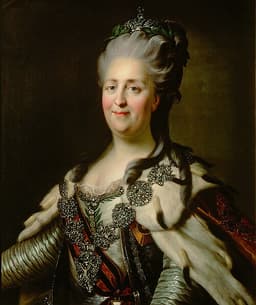
Catherine the Great
Emperor · Modern
73.1Total

Napoleon Bonaparte
General · Modern
82.4Total
Basic Information
Born
1729
1769
Died
1796
1821
Era
Modern
Modern
Nationality
Russia
France
Occupation
Emperor
General
Civilization
Western
Western
Score Comparison
Military (10%)
65.0
94.0
Political (20%)
82.0
75.0
Influence (20%)
70.0
82.0
Legacy (20%)
72.0
78.0
Leadership (15%)
80.0
80.0
Strategy (15%)
65.0
93.0
TOTAL
73.1
82.4
Analysis will be generated on first visit.
Scores and timeline are available below. The page will refresh automatically when ready.
Rankings
🥇
Napoleon BonaparteLeader
Mil: 94.0Pol: 75.0Inf: 82.0
82.4
🥈
Catherine the Great
Mil: 65.0Pol: 82.0Inf: 70.0
73.1
+9.3 behind
How This Comparison Works
Algorithm
Each figure is scored on 6 dimensions (0—100 scale) based on structured historical data: Military (10%), Political (20%), Influence (20%), Legacy (20%), Leadership (15%), Strategy (15%). The weighted total produces the final ranking.
Data Sources
Scores are computed from structured sub-indicators in the database. Scale factors adjust for era (Ancient ×0.85, Modern ×1.0) and civilization size (Eastern ×1.05, Other ×0.80) to account for differences in population and military scale.
Maximum 3 Figures
Comparisons are limited to 2—3 figures to ensure readability and statistical meaningfulness.
Error Margins
±5 points per dimension — Sub-scores are derived from historical records with inherent uncertainty. Two figures within 5 points on a dimension should be considered roughly equivalent in that area.
Total Score Accuracy
±3 points overall — The weighted combination of 6 dimensions produces a total score with approximately ±3 points of uncertainty. Differences of less than 3 points are not statistically significant— the figures are effectively tied.
Known Limitations
- Historical records are incomplete and uneven across civilizations
- Figures from oral-tradition societies may be underrepresented
- Occupation labels can misclassify multi-role figures
- Scores measure capability and impact, not moral character
- Quantitative scoring is a comparison tool, not absolute truth
Capability Radar
Military (10%) — Battles & Warfare
Battles
85
95
Win Rate
80
90
Expansion
90
95
Political (20%) — Governance & Reform
Reform
90
95
Diplomacy
85
80
Economy
85
85
Influence (20%) — Cultural & Global Reach
Cultural
85
85
Global
80
90
Legacy (20%) — Historical Impact
Historical
85
95
Longevity
80
90
Leadership (15%) — Power & Stability
Tenure
95
85
Stability
80
70
Strategy (15%) — Tactics & Innovation
Strategy
85
95
Tactics
75
98
Reform
90
92
Catherine the Great — Complete Timeline
1762 AD
Coup d'État of 1762Political Action
Catherine II led a coup d'
CoupAccessionPower
Impact: national
1764 AD
Hermitage Museum FoundedCultural◆ Major
Catherine the Great founded the Hermitage Museum in St. Petersburg by purchasing a large collection of paintings from Berlin. The museum grew into one of the world's largest art collections, reflecting her patronage of Enlightenment culture.
ArtMuseumEnlightenment
Impact: globalconstructive
1768 AD
Russo-Turkish War (1768-1774)War◆ Major
Catherine the Great initiated a war against the Ottoman Empire, resulting in Russian victory. The Treaty of K
WarOttoman EmpireExpansion
Impact: regional
1783 AD
Annexation of CrimeaPolitical Action◆ Major
Catherine the Great formally annexed the Crimean Peninsula from the Ottoman Empire. This strategic acquisition gave Russia a dominant position in the Black Sea and a warm-water port, fulfilling a long-standing imperial ambition.
AnnexationCrimeaBlack Sea
Impact: regional
1785 AD
Charter to the Gentry GrantedReform◆ Major
Catherine the Great issued the Charter to the Gentry, which codified the rights and privileges of the Russian nobility. It exempted nobles from taxation and military service, solidifying their social status and support for her rule.
NobilityReformSocial Structure
Impact: nationalconstructive
Napoleon Bonaparte — Complete Timeline
1799 AD
Coup of 18 BrumaireOther◆ Major
Napoleon Bonaparte, with support from his brother Lucien and key political figures, overthrew the Directory in a bloodless coup. He established the Consulate with himself as First Consul, effectively becoming the ruler of France. This event ended the French Revolution's most unstable period.
French RevolutionCoupRise to Power
Impact: regional
1804 AD
Promulgation of the Napoleonic CodeOther◆ Major
Napoleon enacted the Civil Code of the French, known as the Napoleonic Code, a comprehensive set of laws that replaced the fragmented feudal legal systems. The code established legal equality, protected property rights, and secularized law. It became the basis for legal systems in many European and world countries.
Legal ReformNapoleonic CodeCivil Law
Impact: globalconstructive
1805 AD
Battle of AusterlitzWar◆ Major
Napoleon's Grande Arm
Napoleonic WarsBattleDecisive Victory
Impact: global
1812 AD
Invasion of RussiaWar◆ Major
Napoleon led the Grande Arm
Napoleonic WarsInvasionDisaster
Impact: globaldestructive
1815 AD
Battle of WaterlooWar◆ Major
Napoleon's French army was defeated by the combined forces of the Duke of Wellington's Anglo-Allied army and Gebhard Leberecht von Bl
Napoleonic WarsBattleFinal Defeat
Impact: globaldestructive
Similar Comparisons
Comments & Discussion
数据侦探6/16/2026
看了评分,Napoleon军事94 vs Catherine 65,但政治75 vs 82,总分82 vs 73。我有点怀疑这个权重体系。如果拿中国历史类比,秦始皇军事评分可能不如白起,但政治统一度量衡、文字的影响远超后者。拿破仑法典确实是制度革命,但Catherine的贵族宪章和领土扩张(尤其三次瓜分波兰,增加20万平方公里)对国家稳定贡献不亚于法典。按人均统治时长算,Catherine执政34年,拿破仑掌权约15年,Catherine的长期影响被低估了。建议权重调整:政治应占40%,军事30%,这样Catherine总分可能接近80。
东西史话6/16/2026
拿破仑和叶卡捷琳娜,一个是法兰西的曹操,一个是俄罗斯的武则天。拿破仑像曹操——军事天才,但治国过度集权导致崩塌;叶卡捷琳娜像武则天——通过权谋登基,注重文化建设和精英统治,但军事上依赖名将而非亲征。不过西方史观总把拿破仑的军事巅峰看得太高,其实中国战国时期的白起、王翦,或者蒙古的成吉思汗,军事成就远超拿破仑——拿破仑没有征服不列颠或俄罗斯全境。叶卡捷琳娜的“开明专制”其实更接近中国唐太宗的“贞观之治”——稳定、扩张、文化繁荣。她的影响力在俄国持续到1917年,而拿破仑的帝国仅十几年。西方史学家该学学我们的长时段视角。
ArmchairTactician6/16/2026
Okay so Napoleon got a 94 military score and Catherine only 65? I get that Napoleon was a battlefield genius—Austerlitz was insane, like he literally destroyed the Third Coalition in one day. But Catherine expanded Russia by like 500,000 square kilometers and took Crimea without a full-scale war. That takes strategy too, just different kind. And the political score? Napoleon 75 vs Catherine 82? Bro, Napoleon literally wrote the rulebook for modern law. The Napoleonic Code is STILL used in parts of Europe. Catherine was smart with the nobles but she didn't reform serfdom. I think the scores are off—Napoleon's political impact is way higher than 75. Also, 80 for leadership for both? Come on, Napoleon led from the front at Borodino, Catherine never even visited a battlefield. They're not the same tier of leader. I'd give Napoleon 86 total, not 82.4.
CiceroLecturus6/16/2026
The comparison is instructive, but we must be cautious about flattening these figures into quantifiable dimensions. As Tacitus wrote, 'The more corrupt the state, the more numerous the laws.' Napoleon's legal codification was indeed transformative, yet Catherine's 'Nakaz' (Instruction) to the Legislative Commission of 1767 was an earlier, albeit failed, attempt at Enlightenment reform—influenced directly by Montesquieu and Beccaria. On military matters, Clausewitz observed that Napoleon's genius lay in operational tempo, but Catherine's generals—Rumyantsev and Suvorov—executed campaigns that secured Russia's southern frontiers for a century. The political score of 82 for Catherine versus 75 for Napoleon seems defensible: Catherine maneuvered within the constraints of a pre-modern aristocracy, while Napoleon's overreach led to St. Helena. Their leadership parity at 80 is plausible if we note, as Voltaire did of Catherine, that 'she governed with the spirit of a philosopher and the hand of a monarch.'