Loading...
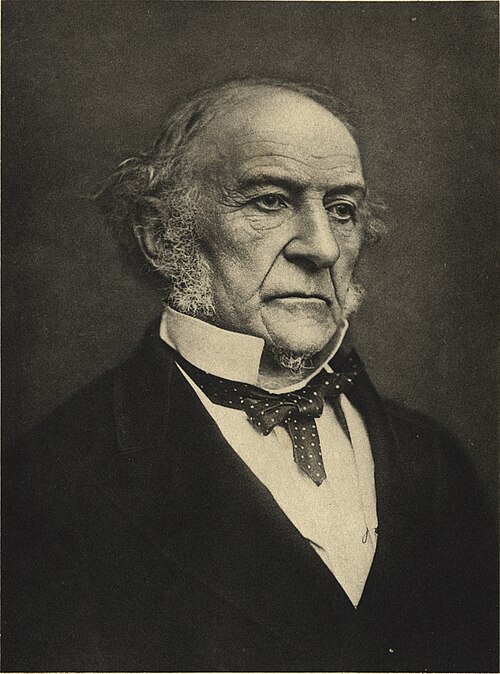
William Ewart Gladstone
ModernPoliticianUnited Kingdom1809 — 1898
Grand Old Man, four-time British Liberal PM.
Compare William Ewart Gladstone with another historical figure:
Quick Facts
Born
1809
Died
1898
Country
United Kingdom
Era
Modern
Occupation
Politician
Score Overview
Military (10%)50
Political (20%)78
Influence (20%)65
Legacy (20%)65
Leadership (15%)78
Strategy (15%)43
Total Score65.2
William Ewart Gladstone — Complete Timeline
1846 AD
Repeal of the Corn LawsReform◆ Major
As a minister in Sir Robert Peel's government, Gladstone supported the repeal of tariffs on imported grain. The repeal lowered food prices and marked a shift toward free trade, though it split the Conservative Party.
Free TradeEconomic ReformConservative Party
Impact: nationalconstructive
1870 AD
Education Act of 1870Reform◆ Major
Gladstone's government passed the Elementary Education Act, establishing school boards and providing state-funded elementary education in England and Wales. The act laid the foundation for universal primary education.
Education ReformSocial PolicyLiberal Government
Impact: nationalconstructive
1879 AD
Midlothian CampaignPolitical Action◆ Major
Gladstone conducted a series of public speeches in Midlothian, Scotland, attacking the foreign policy of Benjamin Disraeli's government. The campaign is considered the first modern political campaign, using mass rallies and media to sway public opinion.
Political CampaignPublic SpeakingLiberal Party
Impact: national
1884 AD
Third Reform ActReform◆ Major
Gladstone's government extended the franchise to agricultural laborers and others in rural areas, standardizing the voting qualification across counties and boroughs. The act added about two million men to the electorate.
Electoral ReformDemocracyLiberal Government
Impact: nationalconstructive
1886 AD
First Irish Home Rule BillPolitical Action◆ Major
Gladstone introduced the Government of Ireland Bill in the House of Commons, proposing a devolved parliament in Dublin. The bill split the Liberal Party and was defeated in the Commons, leading to the fall of his second government.
Irish Home RuleLiberal Party SplitLegislation
Impact: national
1893 AD
Second Irish Home Rule BillPolitical Action◆ Major
Gladstone introduced a second Home Rule Bill, which passed the House of Commons but was rejected by the House of Lords. The defeat demonstrated the Lords' veto power and delayed Irish self-government for decades.
Irish Home RuleHouse of LordsLegislation
Impact: national
1894 AD
Resignation over Budget DefeatPolitical Action
Gladstone resigned as Prime Minister after the House of Lords defeated his budget proposal, which included increased death duties. His resignation ended his fourth and final premiership, and he was succeeded by Lord Rosebery.
ResignationBudgetHouse of Lords
Impact: national
Detailed Scores
▶View all detailed scores
Military
Strategy
6
Tactics
5
Battles
6
Army Scale
5
War Impact
6
Political
Governance
7
Reform
7
Stability
7
Policy
7
Power
8
Influence
History
9
Global
8
Culture
9
Ideology
9
Legacy
9
People often compare with
See how William Ewart Gladstone stacks up against other historical figures
Popular Comparisons
William Ewart Gladstone vs Emeka Anyaoku
vs Emeka Anyaoku56
William Ewart Gladstone vs Kuniwo Nakamura
vs Kuniwo Nakamura54
William Ewart Gladstone vs Felipe Calderon
vs Felipe Calderon52
William Ewart Gladstone vs Nguyen Tan Dung
vs Nguyen Tan Dung50
William Ewart Gladstone vs Tommy Remengesau
vs Tommy Remengesau50
William Ewart Gladstone vs Aung San Suu Kyi
vs Aung San Suu Kyi48