Loading...
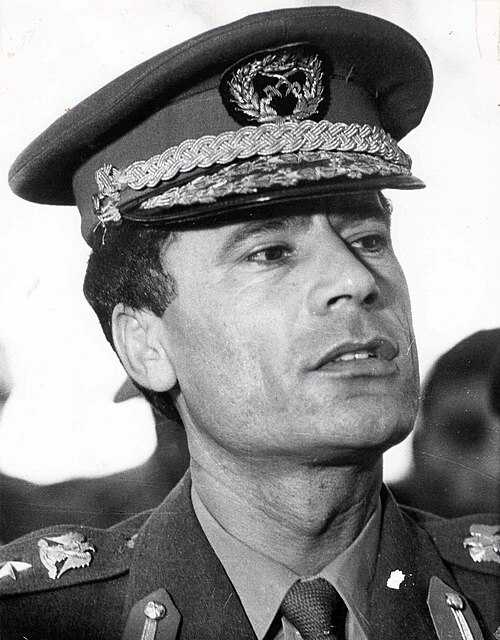
Muammar Gaddafi
ModernPoliticianLibya1942 — ?
Libyan revolutionary who ruled Libya for 42 years.
Compare Muammar Gaddafi with another historical figure:
Quick Facts
Born
1942
Country
Libya
Era
Modern
Occupation
Politician
Score Overview
Military (10%)20
Political (20%)48
Influence (20%)58
Legacy (20%)47
Leadership (15%)68
Strategy (15%)37
Total Score49.3
Muammar Gaddafi — Complete Timeline
1969 AD
1969 Libyan Coup d'ÉtatPolitical Action
Muammar Gaddafi led a group of young military officers in a bloodless coup against King Idris I. The Free Officers Movement seized control of the government, ending the Libyan monarchy and establishing the Libyan Arab Republic with Gaddafi as its de facto leader.
CoupLibyan RevolutionFree Officers
Impact: regional
1973 AD
Nationalization of Libyan OilPolitical Action◆ Major
Gaddafi's government nationalized foreign oil companies operating in Libya, taking majority control of oil production. This policy dramatically increased state revenues and gave Libya leverage in international affairs, funding social programs and military expansion.
OilNationalizationEconomic Policy
Impact: global
1988 AD
Lockerbie BombingOther◆ Major
Pan Am Flight 103 exploded over Lockerbie, Scotland, killing 270 people. Libyan intelligence agents were later implicated. Gaddafi's government initially refused to extradite suspects, leading to UN sanctions and international isolation for Libya.
TerrorismSanctionsInternational Relations
Impact: globaldestructive
2003 AD
Renunciation of WMD ProgramsPolitical Action◆ Major
Gaddafi announced Libya's decision to abandon its weapons of mass destruction programs and allow international inspections. This move led to the lifting of UN sanctions and a normalization of relations with Western countries, including the United States.
WMDDiplomacySanctions
Impact: globalconstructive
2011 AD
Libyan Civil War and DeathWar
During the Arab Spring, a popular uprising escalated into a civil war. NATO forces intervened militarily. Gaddafi was captured and killed by rebel forces near Sirte on October 20, 2011, ending his 42-year rule and plunging Libya into prolonged instability.
Civil WarArab SpringNATO Intervention
Impact: regionaltragic
Detailed Scores
▶View all detailed scores
Military
Strategy
6
Tactics
5
Battles
6
Army Scale
5
War Impact
6
Political
Governance
7
Reform
7
Stability
7
Policy
7
Power
8
Influence
History
9
Global
8
Culture
8
Ideology
9
Legacy
8
People often compare with
See how Muammar Gaddafi stacks up against other historical figures
Popular Comparisons
Muammar Gaddafi vs Simonetta Sommaruga
vs Simonetta Sommaruga55
Muammar Gaddafi vs Modibo Keita
vs Modibo Keita53
Muammar Gaddafi vs Enrico Letta
vs Enrico Letta49
Muammar Gaddafi vs Masinde Muliro
vs Masinde Muliro45
Muammar Gaddafi vs Hara Takashi
vs Hara Takashi43