Loading...
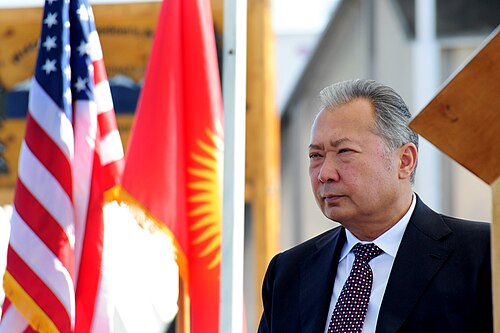
Kurmanbek Bakiyev
ModernPoliticianKyrgyzstan1949 — ?
Kyrgyz president overthrown in the 2010 revolution.
Compare Kurmanbek Bakiyev with another historical figure:
Quick Facts
Born
1949
Country
Kyrgyzstan
Era
Modern
Occupation
Politician
Score Overview
Military (10%)14
Political (20%)26
Influence (20%)46
Legacy (20%)36
Leadership (15%)35
Strategy (15%)25
Total Score33.4
Kurmanbek Bakiyev — Complete Timeline
2000 AD
Appointed Prime Minister of KyrgyzstanPolitical Action
Bakiyev was appointed Prime Minister of Kyrgyzstan under President Askar Akayev. He served until 2002, overseeing economic reforms. His tenure was marked by political instability and allegations of corruption. He later became a key opposition figure.
Prime MinisterKyrgyzstan
Impact: national
2005 AD
Led Tulip RevolutionPolitical Action
Bakiyev emerged as a leader of the Tulip Revolution, a popular uprising that ousted President Askar Akayev. The revolution was triggered by disputed parliamentary elections. Bakiyev became acting president and then won the subsequent presidential election, promising democratic reforms.
Tulip RevolutionRegime ChangeDemocracy
Impact: national
Elected President of KyrgyzstanPolitical Action◆ Major
Bakiyev was elected President of Kyrgyzstan in a landslide victory, winning 88.9% of the vote. His election followed the Tulip Revolution. He promised to combat corruption and promote democracy, but his rule became increasingly authoritarian.
Presidential ElectionKyrgyzstan
Impact: national
2010 AD
Overthrown in 2010 RevolutionPolitical Action
Bakiyev was overthrown in a popular uprising after his government cracked down on protesters, killing dozens. The revolution was fueled by corruption, nepotism, and rising utility prices. Bakiyev fled to Belarus, where he was granted asylum. His ouster led to a period of political turmoil.
RevolutionOusterKyrgyzstan
Impact: nationaldestructive
2013 AD
Sentenced in Absentia for Abuse of PowerPolitical Action
A Kyrgyz court sentenced Bakiyev in absentia to 24 years in prison for abuse of power and involvement in the deaths of protesters during the 2010 uprising. He remained in exile in Belarus. The sentence was part of efforts to hold former leaders accountable.
TrialCorruptionHuman Rights
Impact: nationaldestructive
Detailed Scores
▶View all detailed scores
Military
Strategy
6
Tactics
5
Battles
6
Army Scale
5
War Impact
6
Political
Governance
7
Reform
7
Stability
7
Policy
7
Power
8
Influence
History
9
Global
8
Culture
8
Ideology
9
Legacy
8
People often compare with
See how Kurmanbek Bakiyev stacks up against other historical figures
Popular Comparisons
Kurmanbek Bakiyev vs Jan Peter Balkenende
vs Jan Peter Balkenende55
Kurmanbek Bakiyev vs Gaston Thorn
vs Gaston Thorn54
Kurmanbek Bakiyev vs Johan Ferrier
vs Johan Ferrier50
Kurmanbek Bakiyev vs Millard Fillmore
vs Millard Fillmore50
Kurmanbek Bakiyev vs Moshood Abiola
vs Moshood Abiola46
Kurmanbek Bakiyev vs Jose Maria Iglesias
vs Jose Maria Iglesias41