Loading...
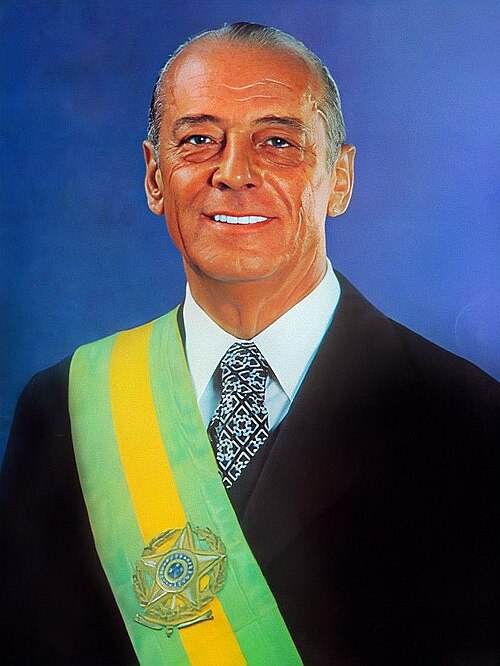
Joao Figueiredo
ModernGeneralBrazil1918 — 1999
Last Brazilian military president.
Compare Joao Figueiredo with another historical figure:
Quick Facts
Born
1918
Died
1999
Country
Brazil
Era
Modern
Occupation
General
Score Overview
Military (10%)23
Political (20%)68
Influence (20%)52
Legacy (20%)40
Leadership (15%)74
Strategy (15%)41
Total Score50.6
Joao Figueiredo — Complete Timeline
1979 AD
Enacted the Party Reform LawReform◆ Major
Figueiredo's government passed legislation ending the two-party system imposed by the military, allowing the formation of multiple political parties. This reform facilitated the reorganization of opposition forces and the eventual return to multi-party democracy.
Political ReformMulti-party SystemDemocratization
Impact: nationalconstructive
Assumed the Presidency of BrazilPolitical Action◆ Major
Figueiredo became the last military president of Brazil, succeeding Ernesto Geisel. His presidency marked the continuation of the political opening (abertura) process initiated by Geisel, aiming for a gradual transition to democracy.
Military DictatorshipAberturaTransition
Impact: national
Signed the Amnesty LawPolitical Action◆ Major
Figueiredo signed Law No. 6,683, granting amnesty to political exiles and those accused of political crimes during the military regime. The law also covered state agents, preventing prosecution for human rights abuses.
AmnestyHuman RightsTransition
Impact: nationalconstructive
1981 AD
Faced the 1981 Riocentro BombingOther◆ Major
A bomb exploded at a May Day concert at Riocentro, killing a military sergeant and wounding another. Evidence suggested involvement of hardline military factions opposed to abertura. The incident weakened Figueiredo's government and accelerated the democratic transition.
TerrorismMilitary HardlinersAbertura
Impact: nationaltragic
1983 AD
Launched the Economic Adjustment PlanReform◆ Major
Facing a severe debt crisis and inflation, Figueiredo's government implemented an IMF-backed austerity program, including currency devaluation and spending cuts. The plan failed to stabilize the economy, leading to recession and social unrest.
Economic CrisisIMFAusterity
Impact: nationaldestructive
1984 AD
Presided over the Diretas Já CampaignPolitical Action◆ Major
Figueiredo's government faced massive public demonstrations demanding direct presidential elections (Diretas J
Diretas JáDemocracy MovementPolitical Crisis
Impact: national
Detailed Scores
▶View all detailed scores
Military
Strategy
7
Tactics
7
Battles
7
Army Scale
7
War Impact
7
Political
Governance
7
Reform
7
Stability
7
Policy
8
Power
8
Influence
History
9
Global
8
Culture
9
Ideology
9
Legacy
8
People often compare with
See how Joao Figueiredo stacks up against other historical figures
Popular Comparisons
Joao Figueiredo vs Zheng Chenggong
vs Zheng Chenggong68
Joao Figueiredo vs William Tecumseh Sherman
vs William Tecumseh Sherman62
Joao Figueiredo vs Michiel de Ruyter
vs Michiel de Ruyter61
Joao Figueiredo vs Arjan Singh
vs Arjan Singh59
Joao Figueiredo vs Rafael Trujillo
vs Rafael Trujillo56
Joao Figueiredo vs Corlulu Ali Pasha
vs Corlulu Ali Pasha54