Loading...
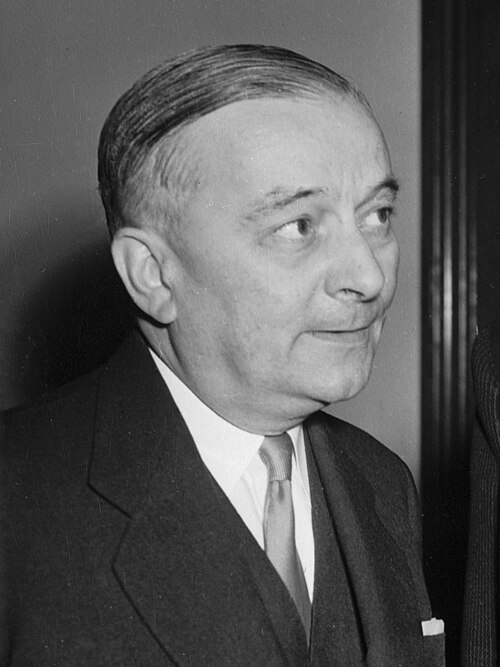
Georges Bidault
ModernPoliticianFrance1899 — 1983
Resistance leader turned prime minister.
Compare Georges Bidault with another historical figure:
Quick Facts
Born
1899
Died
1983
Country
France
Era
Modern
Occupation
Politician
Score Overview
Military (10%)40
Political (20%)47
Influence (20%)52
Legacy (20%)43
Leadership (15%)65
Strategy (15%)54
Total Score49.9
Georges Bidault — Complete Timeline
1943 AD
Leadership of the French Resistance and CNRPolitical Action◆ Major
Bidault became president of the National Council of the Resistance (CNR) in 1943, unifying various resistance groups under de Gaulle's authority. He helped coordinate resistance activities and drafted the CNR's program for post-war social and economic reforms, which influenced the Fourth Republic.
French ResistanceWorld War IICNR
Impact: nationalconstructive
1946 AD
First Term as Prime Minister and Foreign PolicyPolitical Action
Bidault served as Prime Minister from June to December 1946, leading a tripartite government of Socialists, Communists, and MRP. He focused on foreign policy, including negotiations for the Marshall Plan and the establishment of the Fourth Republic's constitution, but faced internal coalition tensions.
Fourth RepublicGovernmentPost-War
Impact: nationalconstructive
1949 AD
Second Term as Prime Minister and the Indochina WarPolitical Action◆ Major
Bidault became Prime Minister again in 1949, overseeing France's involvement in the First Indochina War. He supported the creation of the Associated State of Vietnam under Emperor Bao Dai, but the war continued without resolution, and his government fell in 1950 due to economic and colonial issues.
Indochina WarColonial PolicyFourth Republic
Impact: globaldestructive
1958 AD
Opposition to de Gaulle and the Algerian WarPolitical Action◆ Major
Bidault opposed de Gaulle's return to power in 1958 and his policy of Algerian self-determination. He became a leader of the Organisation de l'arm
Algerian WarOASFifth Republic
Impact: nationaldestructive
Detailed Scores
▶View all detailed scores
Military
Strategy
6
Tactics
5
Battles
6
Army Scale
5
War Impact
6
Political
Governance
7
Reform
7
Stability
7
Policy
7
Power
8
Influence
History
9
Global
8
Culture
8
Ideology
9
Legacy
8
People often compare with
See how Georges Bidault stacks up against other historical figures
Popular Comparisons
Georges Bidault vs William Howard Taft
vs William Howard Taft56
Georges Bidault vs Surendranath Banerjee
vs Surendranath Banerjee55
Georges Bidault vs Amcazade Koprulu Huseyin
vs Amcazade Koprulu Huseyin53
Georges Bidault vs Boris Johnson
vs Boris Johnson52
Georges Bidault vs Klaus Iohannis
vs Klaus Iohannis50
Georges Bidault vs Thongloun Sisoulith
vs Thongloun Sisoulith48