Loading...
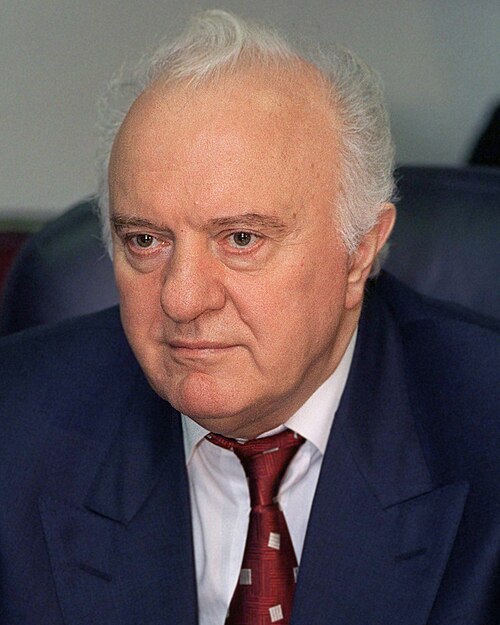
Eduard Shevardnadze
ModernPoliticianGeorgia1928 — ?
Soviet foreign minister and later Georgian president.
Compare Eduard Shevardnadze with another historical figure:
Quick Facts
Born
1928
Country
Georgia
Era
Modern
Occupation
Politician
Score Overview
Military (10%)50
Political (20%)70
Influence (20%)55
Legacy (20%)56
Leadership (15%)68
Strategy (15%)42
Total Score57.7
Eduard Shevardnadze — Complete Timeline
1985 AD
Appointed Soviet Foreign MinisterPolitical Action◆ Major
Mikhail Gorbachev appointed Shevardnadze as Soviet Foreign Minister. Shevardnadze played a key role in shaping the 'New Thinking' foreign policy, which emphasized de-escalation of the Cold War, arms reduction agreements, and improved relations with the West.
Cold WarSoviet UnionDiplomacy
Impact: globalconstructive
1987 AD
Signed the Intermediate-Range Nuclear Forces TreatyPolitical Action
Shevardnadze, as Soviet Foreign Minister, signed the INF Treaty with U.S. Secretary of State George Shultz. The treaty eliminated an entire class of nuclear missiles (500-5,500 km range) from Europe, marking a major step in ending the Cold War.
Nuclear Arms ControlCold WarTreaty
Impact: globalconstructive
1990 AD
Resigned as Soviet Foreign MinisterPolitical Action◆ Major
Shevardnadze resigned as Soviet Foreign Minister, warning of an impending dictatorship under Gorbachev. His resignation was a dramatic protest against the conservative backlash and the slow pace of reforms, highlighting the internal crisis of the Soviet Union.
Soviet UnionResignationPolitical Crisis
Impact: nationaltragic
1992 AD
Elected Chairman of the Georgian ParliamentPolitical Action◆ Major
After the ouster of President Zviad Gamsakhurdia, Shevardnadze returned to Georgia and was elected Chairman of the Parliament, effectively becoming the head of state. He was tasked with stabilizing the country amid civil war and economic collapse.
GeorgiaPost-SovietLeadership
Impact: national
1995 AD
Survived Assassination AttemptPolitical Action◆ Major
Shevardnadze survived a car bomb assassination attempt in Tbilisi. The attack, which killed several people, was widely attributed to opponents of his policies. It underscored the violent political struggles in post-Soviet Georgia.
Assassination AttemptGeorgiaViolence
Impact: nationaltragic
2003 AD
Rose RevolutionPolitical Action
Shevardnadze was forced to resign as President of Georgia following the Rose Revolution, a peaceful protest against disputed parliamentary elections. The revolution, led by Mikheil Saakashvili, ended Shevardnadze's rule and ushered in a new pro-Western government.
RevolutionGeorgiaRegime Change
Impact: national
Detailed Scores
▶View all detailed scores
Military
Strategy
6
Tactics
5
Battles
6
Army Scale
5
War Impact
6
Political
Governance
7
Reform
7
Stability
7
Policy
8
Power
8
Influence
History
9
Global
8
Culture
9
Ideology
9
Legacy
8
People often compare with
See how Eduard Shevardnadze stacks up against other historical figures
Popular Comparisons
Eduard Shevardnadze vs Marcelo Rebelo de Sousa
vs Marcelo Rebelo de Sousa54
Eduard Shevardnadze vs Thaksin Shinawatra
vs Thaksin Shinawatra51
Eduard Shevardnadze vs Alec Douglas-Home
vs Alec Douglas-Home46
Eduard Shevardnadze vs Francis Billy Hilly
vs Francis Billy Hilly38
Eduard Shevardnadze vs Bachir Gemayel
vs Bachir Gemayel38
Eduard Shevardnadze vs Pen Sovan
vs Pen Sovan35