Loading...
Wei Fenghe vs Wu Sangui
Wu Sangui leads by 17.6 pts · 2 figures compared
…
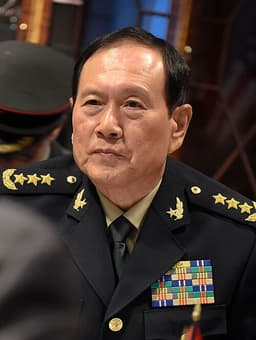
Wei Fenghe
General · Modern
46.5Total
Wu Sangui
General · Modern
64.1Total
Basic Information
Born
1954
1612
Died
—
1678
Era
Modern
Modern
Nationality
China
China
Occupation
General
General
Civilization
Eastern
Eastern
Score Comparison
Military (10%)
25.9
82.0
Political (20%)
35.1
68.0
Influence (20%)
51.8
56.7
Legacy (20%)
38.3
55.0
Leadership (15%)
74.0
80.0
Strategy (15%)
50.0
58.0
TOTAL
46.5
64.1
Wei Fenghe — Complete Timeline
2015 AD
Commander of the PLA Rocket ForcePolitical Action◆ Major
Wei Fenghe was appointed as the first commander of the newly established People's Liberation Army Rocket Force, which consolidated China's missile and nuclear forces. He oversaw the modernization of China's strategic deterrent, including the development of new intercontinental ballistic missiles.
Rocket ForceNuclear DeterrenceMilitary Reform
Impact: global
2018 AD
Appointed Defense Minister of ChinaPolitical Action◆ Major
Wei Fenghe was appointed as the Minister of National Defense of the People's Republic of China, succeeding Chang Wanquan. He became responsible for overseeing the People's Liberation Army's modernization and military diplomacy.
Chinese MilitaryAppointmentDefense Policy
Impact: global
2019 AD
Shangri-La Dialogue SpeechPolitical Action
Wei Fenghe delivered a speech at the Shangri-La Dialogue in Singapore, defending China's military buildup and South China Sea policies. He warned against foreign interference and emphasized China's right to self-defense, drawing criticism from the United States and allies.
Defense DiplomacySouth China SeaMilitary Posture
Impact: regional
2020 AD
US-China Military TensionsPolitical Action◆ Major
Wei Fenghe oversaw increased Chinese military activities in the South China Sea and Taiwan Strait, including exercises and patrols. He responded to US sanctions and arms sales to Taiwan with threats of retaliation, escalating tensions between the two militaries.
US-China RelationsTaiwanMilitary Confrontation
Impact: globaldestructive
Wu Sangui — Complete Timeline
1644 AD
Defeated Li Zicheng at the Battle of Shanhai PassWar◆ Major
Wu Sangui allied with the Manchu forces to defeat Li Zicheng's rebel army at the Battle of Shanhai Pass. The combined Qing-Ming loyalist army routed Li's forces, forcing Li to retreat from Beijing. This battle sealed the Qing conquest of northern China.
Ming-Qing TransitionBattleAlliance
Impact: globaldestructive
Opened Shanhai Pass to the ManchusPolitical Action
Wu Sangui, commanding the Ming garrison at Shanhai Pass, opened the pass to the Manchu army led by Dorgon. This allowed the Manchus to enter China proper and march on Beijing, which had been captured by Li Zicheng's rebel forces.
Ming-Qing TransitionBetrayalShanhai Pass
Impact: globaldestructive
Appointed Prince of Pingxi by the QingPolitical Action◆ Major
Wu Sangui was appointed Prince of Pingxi by the Qing dynasty for his role in their conquest. He was granted control over Yunnan province, becoming one of the three powerful feudatories that ruled southern China under Qing suzerainty.
Qing DynastyFeudatoryAppointment
Impact: national
1673 AD
Launched the Revolt of the Three FeudatoriesWar
Wu Sangui initiated the Revolt of the Three Feudatories against the Qing dynasty. He proclaimed a new dynasty and led a rebellion from his base in Yunnan, initially gaining control of much of southern China before the Qing counteroffensive.
Qing DynastyRebellionThree Feudatories
Impact: nationaldestructive
1678 AD
Proclaimed Emperor of the Zhou DynastyPolitical Action◆ Major
Wu Sangui proclaimed himself Emperor of the Zhou dynasty in Hengzhou (modern Hengyang). This act formalized his rebellion against the Qing. However, he died later that same year, and his rebellion collapsed shortly after.
Qing DynastyRebellionProclamation
Impact: nationaldestructive
Expert Analysis
Origins
Wei Fenghe was born in 1954 in Shandong, China, into a peasant family. He joined the People's Liberation Army in 1970, rising through the ranks in the Second Artillery Corps (strategic missile forces). His early career focused on missile operations and command, with training at the PLA National Defence University. Wu Sangui was born in 1612 in Liaodong, China, to a military family. His father, Wu Xiang, was a Ming general. Wu Sangui passed the military examinations and became a junior officer, later inheriting command of troops.
Rise to Power
Wei Fenghe's rise accelerated with the modernization of China's missile forces. He served as commander of the Second Artillery Corps from 2013, and in 2016 became the first commander of the PLA Rocket Force, a new branch consolidating all missile and nuclear capabilities. In 2018, he was appointed Minister of National Defense, overseeing military diplomacy. Wu Sangui rose to prominence defending the Ming frontier against the Manchus. By 1644, he commanded the elite garrison at Shanhai Pass, the strategic gateway to Beijing. After the fall of Beijing to Li Zicheng, Wu faced a choice: ally with the rebels or the Manchus. He chose the latter, opening the pass to Dorgon's forces, a turning point that enabled the Qing conquest.
Leadership & Governance
Wei Fenghe's leadership is characterized by bureaucratic control and strategic messaging. He oversaw the expansion of China's missile arsenal and issued aggressive statements on Taiwan and the South China Sea. His governance style is top-down, aligned with the Chinese Communist Party's directives, with a focus on military modernization and deterrence. Wu Sangui was a feudal lord: after the Qing conquest, he was granted Yunnan province as his domain, ruling with near-autonomous power. He governed through a mix of military force and patronage, but his authority ultimately depended on Qing tolerance. When the Qing moved to centralize control, Wu rebelled, showing a leadership style that prioritized personal power over loyalty.
Triumph & Tragedy
Wei Fenghe's greatest success was institutionalizing the Rocket Force as a credible nuclear deterrent, contributing to China's rise as a strategic power. His tragedy is the lack of major conflict—his legacy is untested in real warfare, and his political influence remains limited within a collective leadership. Wu Sangui's triumph was the Battle of Shanhai Pass (1644), where his alliance with the Manchus crushed Li Zicheng and changed Chinese history. His tragedy: his rebellion (1673-1678) failed due to strategic blunders, including indecisiveness and failure to secure alliances. He died in 1678, his revolt collapsing soon after.
Character & Destiny
Wei Fenghe is disciplined, cautious, and a loyal party soldier. His actions reflect institutional decision-making rather than personal ambition. His destiny is to be a cog in China's military machinery, rising to high office but not altering China's trajectory. Wu Sangui was opportunistic and ambitious, but also indecisive. His decision to open Shanhai Pass was pragmatic but branded him a traitor in Chinese history. His rebellion was a gamble for independence, but his character—wavering and self-serving—doomed it. Historians often judge him negatively, as a turncoat who put personal gain above national loyalty.
Legacy
Wei Fenghe's legacy is tied to China's missile force and its role in global power balances. He will be remembered as a key figure in China's military modernization, but his individual impact is overshadowed by the institutional framework. Wu Sangui's legacy is more controversial: he is a symbol of betrayal in Chinese historiography, yet his actions enabled the Qing dynasty, which ruled for 268 years. His rebellion also demonstrated the limits of feudal power under a centralized empire.
Conclusion
Wu Sangui had greater historical impact. His decision at Shanhai Pass reshaped China's trajectory, ending the Ming and ushering in the Qing dynasty. Wei Fenghe, despite high office, operated within a system that would have functioned similarly without him. Wu Sangui's total score of 64.1 versus Wei Fenghe's 46.5 reflects this: Wu's military (82.0) and leadership (80.0) significantly outweighed Wei's scores (25.9 and 74.0 respectively). While Wei Fenghe contributed to China's modern deterrent, Wu Sangui altered the course of Chinese history. Therefore, Wu Sangui is the more consequential figure.
Rankings
🥇
Wu SanguiLeader
Mil: 82.0Pol: 68.0Inf: 56.7
64.1
🥈
Wei Fenghe
Mil: 25.9Pol: 35.1Inf: 51.8
46.5
+17.6 behind
How This Comparison Works
Algorithm
Each figure is scored on 6 dimensions (0—100 scale) based on structured historical data: Military (10%), Political (20%), Influence (20%), Legacy (20%), Leadership (15%), Strategy (15%). The weighted total produces the final ranking.
Data Sources
Scores are computed from structured sub-indicators in the database. Scale factors adjust for era (Ancient ×0.85, Modern ×1.0) and civilization size (Eastern ×1.05, Other ×0.80) to account for differences in population and military scale.
Maximum 3 Figures
Comparisons are limited to 2—3 figures to ensure readability and statistical meaningfulness.
Error Margins
±5 points per dimension — Sub-scores are derived from historical records with inherent uncertainty. Two figures within 5 points on a dimension should be considered roughly equivalent in that area.
Total Score Accuracy
±3 points overall — The weighted combination of 6 dimensions produces a total score with approximately ±3 points of uncertainty. Differences of less than 3 points are not statistically significant— the figures are effectively tied.
Known Limitations
- Historical records are incomplete and uneven across civilizations
- Figures from oral-tradition societies may be underrepresented
- Occupation labels can misclassify multi-role figures
- Scores measure capability and impact, not moral character
- Quantitative scoring is a comparison tool, not absolute truth
Capability Radar
Military (10%) — Battles & Warfare
Battles
10
75
Win Rate
10
70
Expansion
10
70
Political (20%) — Governance & Reform
Reform
20
30
Diplomacy
30
70
Economy
10
40
Influence (20%) — Cultural & Global Reach
Cultural
10
50
Global
10
55
Legacy (20%) — Historical Impact
Historical
10
70
Longevity
10
60
Leadership (15%) — Power & Stability
Tenure
60
65
Stability
30
30
Strategy (15%) — Tactics & Innovation
Strategy
20
80
Tactics
20
75
Reform
30
40
Similar Comparisons
Comments & Discussion
No comments yet. Be the first to share your thoughts!