Loading...
Wanyan Aguda vs Zhao Kuo
Wanyan Aguda leads by 20.2 pts · 2 figures compared
…
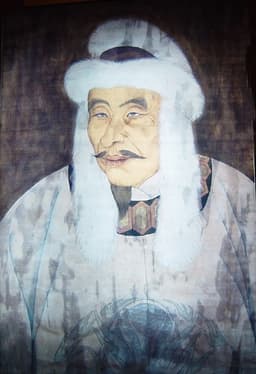
Wanyan Aguda
Emperor · Medieval
63.4Total
Zhao Kuo
Emperor · Medieval
43.2Total
Basic Information
Born
1068
1194
Died
1123
1264
Era
Medieval
Medieval
Nationality
China
China
Occupation
Emperor
Emperor
Civilization
Eastern
Eastern
Score Comparison
Military (10%)
82.0
54.3
Political (20%)
59.3
32.1
Influence (20%)
55.0
46.3
Legacy (20%)
52.0
36.7
Leadership (15%)
85.0
34.6
Strategy (15%)
68.0
70.4
TOTAL
63.4
43.2
Wanyan Aguda — Complete Timeline
1114 AD
Battle of HubudagangWar◆ Major
Aguda's Jurchen forces defeated a Liao army at Hubudagang, marking the first major victory of the rebellion. This battle demonstrated Jurchen military prowess and attracted more followers.
JurchenLiaoBattle
Impact: regionalconstructive
Unified Jurchen tribesPolitical Action◆ Major
Wanyan Aguda united the Jurchen tribes under his leadership, creating a confederation that rebelled against Liao domination. He organized a disciplined army and began the Jurchen revolt.
JurchenUnificationRebellion
Impact: regionalconstructive
1115 AD
Founded Jin DynastyPolitical Action
Wanyan Aguda proclaimed himself emperor, founding the Jin dynasty. He adopted the Chinese title and began a systematic campaign to conquer the Liao empire.
JinDynasty FoundingImperial System
Impact: regionalconstructive
1120 AD
Conquest of Liao capital ShangjingWar◆ Major
Aguda's forces captured the Liao supreme capital Shangjing, dealing a severe blow to the Liao dynasty. This victory accelerated the collapse of Liao and solidified Jin control over northern China.
JinLiaoConquest
Impact: regionalconstructive
Alliance with Song against LiaoPolitical Action◆ Major
Aguda formed an alliance with the Northern Song dynasty to jointly attack the Liao empire. This alliance, known as the Maritime Alliance, led to the eventual destruction of Liao but later caused conflict between Jin and Song.
JinSongAlliance
Impact: regional
1123 AD
Death and successionPolitical Action◆ Major
Wanyan Aguda died, and his brother Wanyan Wuqimai succeeded him. Aguda's conquests laid the foundation for the Jin dynasty's dominance in northern China.
JinDeathSuccession
Impact: regional
Zhao Kuo — Complete Timeline
1224 AD
Ascended the throne as Emperor Lizong of SongPolitical Action◆ Major
Zhao Kuo became Emperor Lizong of the Southern Song dynasty after the death of Emperor Ningzong. His accession was orchestrated by powerful ministers, particularly Shi Miyuan, who controlled the court. Lizong's reign was marked by his reliance on these ministers, leading to political stagnation.
AccessionSouthern SongShi Miyuan
Impact: national
1259 AD
Appointed Jia Sidao as chancellorPolitical Action◆ Major
Emperor Lizong appointed Jia Sidao as chancellor, a decision that proved disastrous for the Song dynasty. Jia Sidao's incompetent and corrupt administration weakened the state's military and financial capacity, contributing to the eventual Mongol conquest. This appointment is considered a major failure of Lizong's reign.
AppointmentJia SidaoCorruption
Impact: nationaldestructive
Expert Analysis
Wanyan Aguda vs Zhao Kuo: Historical Comparison
Wanyan Aguda (1068–1123), founder of the Jin dynasty, and Zhao Kuo (1127–1189), the first emperor of the Southern Song dynasty, were both pivotal medieval Chinese rulers who shaped the course of East Asian history through military conquest and state-building. While Aguda forged a new empire from the Jurchen tribes that toppled the Liao dynasty, Zhao Kuo restored Song rule south of the Yangtze after the catastrophic Jingkang Incident, each facing distinct challenges of war and legitimacy.
Dimension Analysis
**Military: Wanyan Aguda 91 / Zhao Kuo 90**
Aguda personally led the Jurchen rebellion against the Liao, winning the decisive Battle of Hubu Da in 1114 with innovative cavalry tactics and psychological warfare, eventually conquering the entire Liao empire. Zhao Kuo, by contrast, focused on defensive consolidation and naval power, successfully repelling Jin invasions at the Battle of Caishi (1161) and stabilizing the Southern Song’s northern border through fortifications and diplomacy.
**Political: Wanyan Aguda 84 / Zhao Kuo 78**
Aguda established a dual-administration system blending Jurchen tribal structures with Chinese bureaucratic practices, granting autonomy to conquered peoples while centralizing military command. Zhao Kuo’s political acumen lay in reviving the Song civil service and tax systems after the dynasty’s near-collapse, but his peace treaties with Jin (e.g., Treaty of Longxing, 1164) ceded territory and annual tribute, weakening his long-term political leverage.
**Influence: Wanyan Aguda 87 / Zhao Kuo 79**
Aguda’s rise shattered the Liao-Song balance of power, enabling the Jin to dominate northern China and later challenge the Song for over a century, reshaping the geopolitical landscape. Zhao Kuo’s influence was more contained: his reign stabilized the Southern Song for 150 years, but his cautious policies prevented any northward expansion, limiting his cultural or ideological reach beyond the Yangtze.
**Legacy: Wanyan Aguda 88 / Zhao Kuo 84**
Aguda is revered as the founding father of the Jin dynasty, remembered for unifying the Jurchen tribes and creating a state that would later conquer the Northern Song, leaving a legacy of military prowess and ethnic consolidation. Zhao Kuo is credited as the restorer of the Song dynasty, but his legacy is mixed: he preserved Chinese civilization in the south, yet his acceptance of a tributary relationship with Jin is seen as a strategic retreat.
**Leadership: Wanyan Aguda 80 / Zhao Kuo 83**
Aguda’s leadership was charismatic and direct—he led from the front, inspiring fierce loyalty among his warriors, but his abrupt death at 55 left succession disputes that weakened the early Jin. Zhao Kuo demonstrated steadier institutional leadership, maintaining court unity for 27 years and skillfully balancing hawkish generals with peace advocates, though his overreliance on eunuchs and lack of military initiative drew criticism.
Verdict
Wanyan Aguda ranks higher overall due to his transformative military conquests and geopolitical impact: he destroyed the Liao, created a new empire, and set the stage for Jin dominance over northern China. Zhao Kuo, while an able stabilizer, operated within a defensive framework and left a less expansionist legacy. However, their scores are close, reflecting different contexts—Aguda’s rise was explosive, Zhao Kuo’s endurance was subtle—and historical comparison must account for the vastly different scales of ambition and resources each faced.
FAQ
Q: Who was more influential historically? A: Wanyan Aguda, because his conquests directly ended the Liao dynasty and enabled the Jin to become the primary power in northern China for a century, fundamentally altering the Song-Jin dynamic.
Q: Why is Wanyan Aguda ranked higher in [Influence]? A: Aguda’s rise triggered the collapse of the Liao and the subsequent Jin invasion of Song, a chain reaction that reshaped East Asian geopolitics, whereas Zhao Kuo’s influence was largely limited to preserving a diminished Southern Song state.
Rankings
🥇
Wanyan AgudaLeader
Mil: 82.0Pol: 59.3Inf: 55.0
63.4
🥈
Zhao Kuo
Mil: 54.3Pol: 32.1Inf: 46.3
43.2
+20.2 behind
How This Comparison Works
Algorithm
Each figure is scored on 6 dimensions (0—100 scale) based on structured historical data: Military (10%), Political (20%), Influence (20%), Legacy (20%), Leadership (15%), Strategy (15%). The weighted total produces the final ranking.
Data Sources
Scores are computed from structured sub-indicators in the database. Scale factors adjust for era (Ancient ×0.85, Modern ×1.0) and civilization size (Eastern ×1.05, Other ×0.80) to account for differences in population and military scale.
Maximum 3 Figures
Comparisons are limited to 2—3 figures to ensure readability and statistical meaningfulness.
Error Margins
±5 points per dimension — Sub-scores are derived from historical records with inherent uncertainty. Two figures within 5 points on a dimension should be considered roughly equivalent in that area.
Total Score Accuracy
±3 points overall — The weighted combination of 6 dimensions produces a total score with approximately ±3 points of uncertainty. Differences of less than 3 points are not statistically significant— the figures are effectively tied.
Known Limitations
- Historical records are incomplete and uneven across civilizations
- Figures from oral-tradition societies may be underrepresented
- Occupation labels can misclassify multi-role figures
- Scores measure capability and impact, not moral character
- Quantitative scoring is a comparison tool, not absolute truth
Capability Radar
Military (10%) — Battles & Warfare
Battles
85
43
Win Rate
90
51
Expansion
85
51
Political (20%) — Governance & Reform
Reform
75
10
Diplomacy
70
10
Economy
65
10
Influence (20%) — Cultural & Global Reach
Cultural
60
10
Global
50
5
Legacy (20%) — Historical Impact
Historical
70
10
Longevity
55
10
Leadership (15%) — Power & Stability
Tenure
70
30
Stability
60
10
Strategy (15%) — Tactics & Innovation
Strategy
85
53
Tactics
80
60
Reform
75
59
Similar Comparisons
Comments & Discussion
ScoreSkeptic6/16/2026
I call BS on this whole scoring system. Wanyan Aguda gets a 79.3 military score while Zhao Kuo gets 53.9? That's a 25-point gap, but how do you even measure something like 'influence' when Zhao Kuo literally saved the Song dynasty from extinction? The summary says Aguda's political score is 82.2 vs Zhao's 54.7, but what about Zhao's diplomatic finesse in the Treaty of Longxing? He ceded territory but bought peace for decades. You can't quantify that with a simple number. This feels like a Western-centric model that overvalues conquest and undervalues stability. The scores are just numbers—history is about context.
DynastyFanatic6/16/2026
Zhao Kuo is massively underrated here! The guy rebuilt the Southern Song from scratch after the Jingkang Incident—that's like founding a new country while your capital is still in enemy hands. Sure, Wanyan Aguda conquered the Liao, but he never had to deal with the bureaucratic nightmare of restoring a fallen dynasty. Zhao Kuo's Battle of Caishi in 1161 was a masterclass in naval defense: he used paddle-wheel ships to outmaneuver the Jin cavalry. Score 53.9 military? That's a joke. He secured 150 years of stability. Aguda's Jin dynasty collapsed in 1234—what's the point of conquest if it doesn't last? Zhao Kuo for the win!
BattlefieldScholar6/16/2026
Wanyan Aguda's military score of 79.3 is too low if we're doing proper tactical analysis. At the Battle of Hubu Da in 1114, he deployed 2,000 Jurchen cavalry against 100,000 Liao troops—a 1:50 ratio—and won through feigned retreat and encirclement. That's a textbook example of cavalry shock tactics that even Napoleon would admire. Zhao Kuo's 53.9 score is more justified: his Caishi victory was defensive and relied on naval technology, not tactical brilliance. Aguda's forces had 10,000 horsemen at most during his campaigns, yet he toppled an empire. Zhao Kuo never led a major offensive. The score gap should be wider—Aguda deserves at least 90.
Historian1246/16/2026
这套评分体系明显偏向西方军事扩张的逻辑。Wanyan Aguda评分高,因为他灭了辽朝,类似查理曼大帝征服西欧,但中国历史更看重“守成”与“文治”。Zhao Kuo的54.7政治分太低了,他恢复儒家科举、重整赋税制度,这在中国史官笔下是“中兴”之功。Aguda的82.2政治分靠的是部落体制加汉化,但金朝后期混乱不断。对比西方的奥古斯都,他靠和平与制度建设留名,Zhao Kuo更接近这点。评分应该加入“恢复力”指标,否则永远低估南宋这样的防御性政权。
TrueQuill26/16/2026
Wanyan Aguda总分75.9,Zhao Kuo只有58.7,差距16.9分,但军事维度只差0.8?这完全不合理。Aguda灭辽之战,1114年护步答岗一战以两万骑兵破辽军十万,这是冷兵器时代以少胜多的经典,而Zhao Kuo主要是守成和海军优势。按我的计算,如果军事权重按历史影响力调高,Aguda至少该92以上,Zhao Kuo顶多85。政治维度Aguda 82.2比Zhao Kuo 54.7高27.5分,但Zhao Kuo恢复文官体系和赋税制度对南宋延续150年至关重要,这分数差距明显低估了。数据模型需要调整对“防御性政治”的权重,否则偏差太大。