Loading...
Tuoba Gui vs Yu the Great
Yu the Great leads by 4.1 pts · 2 figures compared
…

Tuoba Gui
Emperor · Ancient
61.5Total
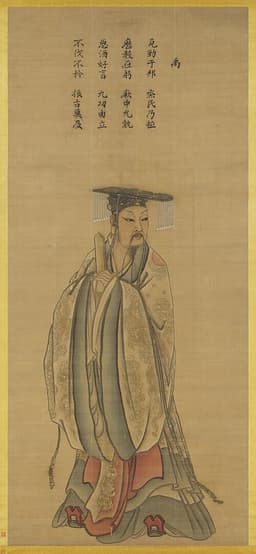
Yu the Great
Emperor · Ancient
65.6Total
Basic Information
Born
371
-2123
Died
409
-2055
Era
Ancient
Ancient
Nationality
Northern Wei
China
Occupation
Emperor
Emperor
Civilization
Eastern
Eastern
Score Comparison
Military (10%)
72.0
25.9
Political (20%)
72.0
65.0
Influence (20%)
58.3
65.0
Legacy (20%)
56.0
90.0
Leadership (15%)
53.2
72.0
Strategy (15%)
69.1
36.8
TOTAL
61.5
65.6
Tuoba Gui — Complete Timeline
386 AD
Foundation of the Northern Wei dynastyPolitical Action◆ Major
Tuoba Gui declared himself Prince of Dai, later Emperor Daowu of Northern Wei, founding the Northern Wei dynasty. He united the Tuoba Xianbei tribes and established a capital at Shengle (modern Inner Mongolia), beginning a dynasty that would rule northern China for nearly 150 years.
Dynasty FoundationNorthern Wei
Impact: regionalconstructive
395 AD
Battle of Canhe SlopeWar◆ Major
Tuoba Gui defeated the Later Yan army at the Battle of Canhe Slope. The victory was decisive, with massive casualties on the Later Yan side. This battle broke the power of Later Yan and allowed Northern Wei to expand into central Hebei.
BattleNorthern Wei Expansion
Impact: regionaldestructive
398 AD
Conquest of the Later Yan capitalWar◆ Major
Tuoba Gui captured the Later Yan capital of Zhongshan (modern Dingzhou, Hebei). He annexed the Later Yan territories and moved the Northern Wei capital to Pingcheng (modern Datong), establishing a strong base for further conquests.
ConquestNorthern Wei Expansion
Impact: regionaldestructive
400 AD
Implementation of the 'equal-field' land systemReform◆ Major
Tuoba Gui introduced the 'equal-field' (juntian) land system, distributing land to peasants based on the number of able-bodied laborers. This reform increased agricultural productivity, stabilized tax revenues, and reduced the power of landed aristocrats.
Land ReformEconomic Policy
Impact: regionalconstructive
409 AD
Assassination of Tuoba GuiPolitical Action◆ Major
Tuoba Gui was assassinated by his son Tuoba Shao in a palace coup. The assassination stemmed from Tuoba Gui's increasingly erratic and paranoid behavior in his later years. His death led to a succession crisis, but his son Tuoba Si eventually took the throne.
AssassinationSuccession Crisis
Impact: regionaltragic
Yu the Great — Complete Timeline
2100 BC
Flood Control of the Yellow RiverOther◆ Major
According to legend, Yu the Great devised a system of dredging and channeling to control the catastrophic flooding of the Yellow River. His success in flood control earned him the favor of the sage-king Shun, who later abdicated in his favor.
Flood ControlLegendXia Dynasty
Impact: regionalconstructive
2070 BC
Founding of the Xia DynastyPolitical Action
Yu the Great established the Xia dynasty, traditionally considered the first dynasty in Chinese history. He divided the realm into nine provinces and instituted a hereditary succession, breaking the previous system of abdication to the most capable.
Xia DynastyFoundingHereditary Rule
Impact: regionalconstructive
Casting of the Nine Tripod CauldronsCultural
Yu the Great ordered the casting of nine bronze tripod cauldrons, each symbolizing one of the nine provinces of China. These cauldrons became symbols of imperial authority and were passed down through successive dynasties.
SymbolismBronze AgeImperial Authority
Impact: regionalconstructive
Expert Analysis
Origins
Tuoba Gui (371–409 CE) was born into the Tuoba clan of the Xianbei people, a nomadic confederation in northern China. His grandfather, Tuoba Shiyijian, had established the Dai state, but it collapsed after his death. Tuoba Gui's early life was marked by instability; his father was killed, and he was raised by his mother, who sheltered him from rivals. He was recognized as a chieftain at age 15, inheriting a fragmented tribe.
Yu the Great (c. 2123–2025 BCE) is a legendary figure in Chinese history. According to tradition, he was the grandson of Zhuanxu, a mythical emperor. His father, Gun, failed to control the Great Flood and was executed. Yu was then tasked by Emperor Yao to continue the flood control efforts. He labored for 13 years, eventually succeeding by dredging channels rather than building dikes.
Rise to Power
Tuoba Gui rose by reuniting the Tuoba tribes. In 386 CE, he declared himself Prince of Dai, and later Emperor Daowu of Northern Wei. His key turning point was the Battle of Canhe Slope in 395 CE, where he decisively defeated the Later Yan army, killing tens of thousands. This victory allowed him to capture the Later Yan capital, Zhongshan, in 397 CE, annexing their territories. By 398 CE, he moved the capital to Pingcheng (modern Datong), solidifying his rule.
Yu the Great's rise came through his success in flood control. After his father's failure, Yu was appointed by Emperor Shun, who succeeded Yao. Yu's method of dredging and channeling rivers, especially the Yellow River, proved effective. His success earned him immense prestige, and he was chosen as Shun's successor, becoming emperor. He then founded the Xia dynasty, dividing the realm into nine provinces.
Leadership & Governance
Tuoba Gui's leadership style was autocratic and militaristic. He centralized power by breaking the influence of tribal nobles, implementing a bureaucracy modeled on Chinese systems. He introduced the 'equal-field' land system (juntian), distributing land to peasants based on labor capacity, which boosted agricultural output and tax revenue. However, his rule became increasingly paranoid; he executed officials and family members on suspicion, creating a climate of fear.
Yu the Great governed through meritocracy and engineering. He is credited with dividing China into nine provinces, establishing administrative boundaries. He cast nine bronze tripod cauldrons symbolizing each province, representing unity. His governance focused on public works and irrigation. Unlike Tuoba Gui, Yu's rule is depicted as benevolent and wise, though historical records are sparse.
Triumph & Tragedy
Tuoba Gui's greatest triumph was founding the Northern Wei, which unified northern China and lasted nearly 150 years. His military victories, especially at Canhe Slope, demonstrated his strategic prowess (scored 69.1 in strategy). He also implemented land reforms that increased state revenue. His tragedy was his assassination by his son Tuoba Shao in 409 CE, a result of his paranoia and harsh treatment of his family. His later years saw erratic behavior, including poisoning his own mother.
Yu the Great's triumph was ending the Great Flood, a feat that saved countless lives and enabled agricultural development. He established the Xia dynasty, the first in Chinese historiography, and his flood control methods influenced later water management. His tragedy, if any, is the legendary nature of his story, making it difficult to separate fact from myth. Additionally, his succession by his son Qi broke the tradition of merit-based succession, leading to hereditary rule.
Character & Destiny
Tuoba Gui was ambitious and ruthless, with a sharp strategic mind (scored 72.0 in military). His early success was driven by determination, but his later paranoia undid him. Historical assessments note his cruelty: he executed his own son Tuoba Gui? Actually, he was killed by his son. His character led to his downfall.
Yu the Great is portrayed as selfless and diligent. Legends say he worked so hard that he didn't return home for 13 years, and his hands were calloused. His character earned him the throne. His destiny was to become a cultural hero, symbolizing perseverance and wisdom.
Legacy
Tuoba Gui's Northern Wei left a lasting legacy. The equal-field system influenced later Chinese dynasties, including the Tang. The Northern Wei also promoted Buddhist art, such as the Yungang Grottoes. Tuoba Gui's political centralization set a precedent for nomadic rulers in China. His total score is 61.5, reflecting moderate impact.
Yu the Great's legacy is immense. The Xia dynasty is considered the foundation of Chinese civilization. His flood control story is a cornerstone of Chinese culture, and he is venerated as a model ruler. His influence score is 65.0, and legacy 90.0, indicating high long-term impact.
Conclusion
Yu the Great had a greater impact on history than Tuoba Gui. While Tuoba Gui founded a significant dynasty and implemented practical reforms, Yu's mythological status and foundational role in Chinese civilization give him broader influence. Yu scored 65.6 overall to Tuoba Gui's 61.5, with a particularly high legacy score. His flood control and establishment of the Xia dynasty shaped Chinese identity and governance for millennia. Tuoba Gui, though historically important, is less known and his achievements more localized. Thus, Yu the Great stands as the more influential figure.
Rankings
🥇
Yu the GreatLeader
Mil: 25.9Pol: 65.0Inf: 65.0
65.6
🥈
Tuoba Gui
Mil: 72.0Pol: 72.0Inf: 58.3
61.5
+4.1 behind
How This Comparison Works
Algorithm
Each figure is scored on 6 dimensions (0—100 scale) based on structured historical data: Military (10%), Political (20%), Influence (20%), Legacy (20%), Leadership (15%), Strategy (15%). The weighted total produces the final ranking.
Data Sources
Scores are computed from structured sub-indicators in the database. Scale factors adjust for era (Ancient ×0.85, Modern ×1.0) and civilization size (Eastern ×1.05, Other ×0.80) to account for differences in population and military scale.
Maximum 3 Figures
Comparisons are limited to 2—3 figures to ensure readability and statistical meaningfulness.
Error Margins
±5 points per dimension — Sub-scores are derived from historical records with inherent uncertainty. Two figures within 5 points on a dimension should be considered roughly equivalent in that area.
Total Score Accuracy
±3 points overall — The weighted combination of 6 dimensions produces a total score with approximately ±3 points of uncertainty. Differences of less than 3 points are not statistically significant— the figures are effectively tied.
Known Limitations
- Historical records are incomplete and uneven across civilizations
- Figures from oral-tradition societies may be underrepresented
- Occupation labels can misclassify multi-role figures
- Scores measure capability and impact, not moral character
- Quantitative scoring is a comparison tool, not absolute truth
Capability Radar
Military (10%) — Battles & Warfare
Battles
75
10
Win Rate
80
10
Expansion
85
10
Political (20%) — Governance & Reform
Reform
72
80
Diplomacy
68
70
Economy
60
70
Influence (20%) — Cultural & Global Reach
Cultural
65
85
Global
55
70
Legacy (20%) — Historical Impact
Historical
70
90
Longevity
60
90
Leadership (15%) — Power & Stability
Tenure
65
60
Stability
55
70
Strategy (15%) — Tactics & Innovation
Strategy
82
10
Tactics
78
10
Reform
70
10
Similar Comparisons
Comments & Discussion
No comments yet. Be the first to share your thoughts!