Loading...
Thomas Fairfax vs William Halsey
Thomas Fairfax leads by 9.5 pts · 2 figures compared
…
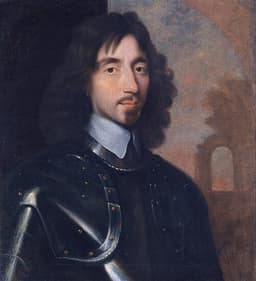
Thomas Fairfax
General · Modern
63.0Total

William Halsey
General · Modern
53.5Total
Basic Information
Born
1612
1882
Died
1671
1959
Era
Modern
Modern
Nationality
England
United States
Occupation
General
General
Civilization
Western
Western
Score Comparison
Military (10%)
61.7
78.0
Political (20%)
68.0
29.3
Influence (20%)
58.3
56.7
Legacy (20%)
55.0
58.0
Leadership (15%)
72.0
47.3
Strategy (15%)
75.0
55.0
TOTAL
63.0
53.5
Thomas Fairfax — Complete Timeline
1645 AD
Battle of NasebyWar
Fairfax led the New Model Army to a decisive victory over King Charles I's forces at Naseby. The battle destroyed the main Royalist army and effectively decided the First English Civil War in favor of Parliament.
English Civil WarBattleDecisive Victory
Impact: national
Appointed Commander-in-Chief of the New Model ArmyPolitical Action◆ Major
Fairfax was appointed commander-in-chief of the New Model Army, a professional army created by Parliament to fight the Royalists. This appointment placed him at the head of the most effective military force in England during the First English Civil War.
English Civil WarMilitary CommandParliament
Impact: national
1646 AD
Siege of OxfordWar◆ Major
Fairfax commanded the siege of Oxford, the Royalist capital. The city surrendered, and King Charles I fled, effectively ending the First English Civil War. Fairfax treated the defeated Royalists with moderation.
English Civil WarSiegeRoyalist Defeat
Impact: national
1647 AD
Refused to Arrest the Five MembersPolitical Action
Fairfax refused orders from the Army Council to arrest five Presbyterian members of Parliament who were critical of the army. This action demonstrated his independence from radical army factions and his commitment to parliamentary authority.
English Civil WarPolitical CrisisArmy-Parliament Relations
Impact: national
1650 AD
Resigned as Commander-in-ChiefPolitical Action◆ Major
Fairfax resigned his commission as commander-in-chief of the New Model Army rather than lead an invasion of Scotland to suppress the Scottish Covenanters who had proclaimed Charles II as king. He cited his conscience and opposition to preemptive war.
English Civil WarResignationConscience
Impact: national
1660 AD
Led the Restoration Delegation to Charles IIPolitical Action◆ Major
Fairfax led a parliamentary delegation to The Hague to invite Charles II to return as king, restoring the monarchy. He played a key role in the peaceful Restoration, helping to avoid further civil war.
RestorationMonarchyPolitical Transition
Impact: nationalconstructive
William Halsey — Complete Timeline
1941 AD
Attack on Pearl HarborWar◆ Major
Halsey was at sea commanding Task Force 8 when the Japanese attacked Pearl Harbor. His carrier, USS Enterprise, was returning from delivering aircraft to Wake Island. The attack galvanized Halsey's aggressive approach to the Pacific War.
World War IIPacific TheaterNaval Command
Impact: global
1942 AD
Doolittle RaidWar◆ Major
Halsey commanded the naval task force that transported Lieutenant Colonel Doolittle's B-25 bombers to within striking distance of Japan. The raid on Tokyo boosted American morale and forced Japan to reconsider its defensive perimeter.
World War IIPacific TheaterAir Raid
Impact: regionalconstructive
1944 AD
Battle of Leyte GulfWar◆ Major
Halsey commanded the Third Fleet during the Battle of Leyte Gulf. He pursued the Japanese Northern Force, leaving the invasion fleet vulnerable. His decision to chase the decoy force was criticized, but the battle resulted in the destruction of Japanese naval power.
World War IIPacific TheaterNaval Battle
Impact: regional
Typhoon CobraOther◆ Major
Halsey's Third Fleet sailed into Typhoon Cobra in the Philippine Sea. Three destroyers capsized and sank, with over 800 sailors lost. Halsey was found guilty of errors of judgment in a court of inquiry but was not punished.
World War IINaval DisasterWeather
Impact: regionaltragic
1945 AD
Surrender of JapanPolitical Action◆ Major
Halsey's Third Fleet was present in Tokyo Bay for the formal surrender of Japan on September 2, 1945. He had advocated for a more aggressive blockade and bombing campaign to force Japan's surrender earlier.
World War IIPacific TheaterSurrender
Impact: globalconstructive
Expert Analysis
Origins
Thomas Fairfax was born in 1612 into a Yorkshire gentry family. His father, Ferdinando Fairfax, was a prominent Parliamentarian commander. Educated at Cambridge and the Inner Temple, Fairfax gained military experience fighting in the Thirty Years' War in the Netherlands. He returned to England in 1640 and joined the Parliamentarian cause, inheriting his father's command after Ferdinando's death. His early military career was shaped by the feudal obligations of the northern nobility and the religious conflicts of the era.
William Halsey was born in 1882 in Elizabeth, New Jersey, into a naval family. His father was a Navy captain. Halsey attended the United States Naval Academy, graduating in 1904. He served in the Great White Fleet and during World War I commanded destroyers. His early career focused on torpedo boats and destroyers, earning a reputation for aggressive tactics. He also studied naval aviation, earning his pilot's wings at age 52, making him one of the older aviators.
Rise to Power
Fairfax rose to prominence during the English Civil War. In 1645, Parliament created the New Model Army, a professional force designed to overcome the Royalists. Fairfax was appointed Commander-in-Chief, with Oliver Cromwell as his second-in-command. His first major test was the Battle of Naseby (June 14, 1645), where he led a decisive victory over King Charles I's main army. Fairfax personally led cavalry charges and was wounded in the battle. This victory effectively destroyed Royalist military power. He followed with the Siege of Oxford (1646), the Royalist capital, forcing Charles I to flee. By 1646, Fairfax was the most successful military commander in England.
Halsey's rise was accelerated by World War II. At the attack on Pearl Harbor (December 7, 1941), Halsey was at sea commanding Task Force 8. His carrier, USS Enterprise, was returning from delivering aircraft to Wake Island. This absence spared his force from destruction, and Halsey became a symbol of defiance. He was promoted to Vice Admiral and commanded carrier raids in the Pacific. His most famous early action was the Doolittle Raid (April 1942), where he commanded the task force that launched B-25 bombers against Japan. This raid boosted American morale. By 1944, Halsey commanded the Third Fleet, the main offensive force in the Pacific.
Leadership & Governance
Fairfax's leadership style emphasized discipline and loyalty. He was a field commander who shared dangers with his men. At Naseby, he led from the front, sustaining a wound. His governance approach was tempered by political moderation. After the Civil War, he opposed the execution of Charles I and the establishment of the Commonwealth. He resigned his commission in 1650 rather than invade Scotland, reflecting his constitutional conservatism. His leadership score of 72.0 reflects his ability to command respect without authoritarian excess.
Halsey's leadership was aggressive and risk-taking, embodied in his motto "Hit hard, hit fast, hit often." He was popular with sailors but sometimes reckless. At the Battle of Leyte Gulf (October 1944), Halsey pursued the Japanese Northern Force, leaving the invasion fleet vulnerable. This decision allowed a Japanese force to attack the transports, though it was repulsed. His leadership score of 47.3 reflects the controversy over his judgment. He was less politically adept than Fairfax, scoring 29.3 in political acumen.
Triumph & Tragedy
Fairfax's greatest triumph was the Battle of Naseby, where he destroyed the main Royalist army, securing Parliament's victory. He also successfully besieged Oxford, ending the war. His tragedy was his marginalization during the Commonwealth. He opposed the king's execution and the military dictatorship, leading to his resignation. He lived in obscurity until the Restoration, when he helped bring Charles II back. His military score of 61.7 reflects his success in a limited war, while his political score of 68.0 shows his principled stance.
Halsey's greatest triumph was his aggressive carrier strategy that helped cripple the Japanese navy. He was present at the surrender of Japan (September 2, 1945) aboard USS Missouri. His tragedy was Typhoon Cobra (December 1944), where his fleet sailed into a typhoon, sinking three destroyers and killing over 800 sailors. A court of inquiry found him at fault, but no punishment was imposed. His military score of 78.0 reflects his tactical aggressiveness, but his strategy score of 55.0 accounts for his errors.
Character & Destiny
Fairfax was a reluctant revolutionary: a skilled soldier who preferred constitutional order. His character—loyal to Parliament but opposed to extremism—shaped his destiny. He could have seized power like Cromwell but chose to resign. Historians see him as a man of principle who prioritized legality over ambition. His legacy score of 55.0 reflects his overshadowed role in English history.
Halsey was a warrior who thrived in crisis. His aggressiveness made him a hero but also led to costly mistakes. He was criticized for poor weather judgment and strategic overreach. His destiny was to be a symbol of American naval power, but his reputation is mixed. His influence score of 56.7 shows his impact on naval doctrine, though his leadership score of 47.3 indicates flaws.
Legacy
Fairfax's legacy is the New Model Army, a professional force that influenced later military organization. He also helped restore the monarchy, ensuring a peaceful transition in 1660. His name is less known than Cromwell's, but his military reforms were foundational. He scored 55.0 in legacy, reflecting his role as a transitional figure.
Halsey's legacy is the carrier-centric navy that dominated the Pacific. His aggressive tactics influenced Cold War doctrine. However, his mistakes at Leyte Gulf and Typhoon Cobra are studied as cautionary tales. He scored 58.0 in legacy, slightly higher than Fairfax, due to the scale of WWII.
Conclusion
Thomas Fairfax had a greater overall impact than William Halsey, with a total score of 63.0 compared to 53.5. Fairfax's leadership (72.0 vs 47.3) and political acumen (68.0 vs 29.3) were superior. While Halsey's military score (78.0) exceeded Fairfax's (61.7), Fairfax's role in creating the New Model Army and ensuring a constitutional settlement had longer-lasting effects. Halsey's errors in judgment reduce his strategic effectiveness. Fairfax's principled moderation in an era of extremism demonstrates greater wisdom. Thus, Fairfax emerges as the more significant historical figure.
Rankings
🥇
Thomas FairfaxLeader
Mil: 61.7Pol: 68.0Inf: 58.3
63.0
🥈
William Halsey
Mil: 78.0Pol: 29.3Inf: 56.7
53.5
+9.5 behind
How This Comparison Works
Algorithm
Each figure is scored on 6 dimensions (0—100 scale) based on structured historical data: Military (10%), Political (20%), Influence (20%), Legacy (20%), Leadership (15%), Strategy (15%). The weighted total produces the final ranking.
Data Sources
Scores are computed from structured sub-indicators in the database. Scale factors adjust for era (Ancient ×0.85, Modern ×1.0) and civilization size (Eastern ×1.05, Other ×0.80) to account for differences in population and military scale.
Maximum 3 Figures
Comparisons are limited to 2—3 figures to ensure readability and statistical meaningfulness.
Error Margins
±5 points per dimension — Sub-scores are derived from historical records with inherent uncertainty. Two figures within 5 points on a dimension should be considered roughly equivalent in that area.
Total Score Accuracy
±3 points overall — The weighted combination of 6 dimensions produces a total score with approximately ±3 points of uncertainty. Differences of less than 3 points are not statistically significant— the figures are effectively tied.
Known Limitations
- Historical records are incomplete and uneven across civilizations
- Figures from oral-tradition societies may be underrepresented
- Occupation labels can misclassify multi-role figures
- Scores measure capability and impact, not moral character
- Quantitative scoring is a comparison tool, not absolute truth
Capability Radar
Military (10%) — Battles & Warfare
Battles
75
85
Win Rate
80
80
Expansion
40
85
Political (20%) — Governance & Reform
Reform
60
10
Diplomacy
50
20
Economy
30
10
Influence (20%) — Cultural & Global Reach
Cultural
55
55
Global
55
60
Legacy (20%) — Historical Impact
Historical
70
65
Longevity
60
50
Leadership (15%) — Power & Stability
Tenure
55
30
Stability
45
15
Strategy (15%) — Tactics & Innovation
Strategy
82
70
Tactics
78
75
Reform
85
40
Similar Comparisons
Comments & Discussion
No comments yet. Be the first to share your thoughts!