Loading...
Shang Kexi vs Thomas Fairfax
Thomas Fairfax leads by 8.3 pts · 2 figures compared
…
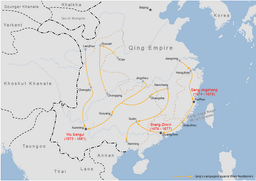
Shang Kexi
General · Modern
54.7Total
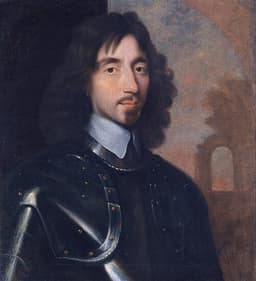
Thomas Fairfax
General · Modern
63.0Total
Basic Information
Born
1604
1612
Died
1676
1671
Era
Modern
Modern
Nationality
China
England
Occupation
General
General
Civilization
Eastern
Western
Score Comparison
Military (10%)
47.5
61.7
Political (20%)
68.0
68.0
Influence (20%)
56.4
58.3
Legacy (20%)
49.2
55.0
Leadership (15%)
48.8
72.0
Strategy (15%)
60.0
75.0
TOTAL
54.7
63.0
Shang Kexi — Complete Timeline
1634 AD
Defection to the Qing DynastyPolitical Action◆ Major
Shang Kexi, a Ming general stationed in Liaodong, surrendered to the Qing dynasty after a series of defeats. His defection provided the Qing with experienced Han Chinese troops and knowledge of Ming defenses.
DefectionMing-Qing WarQing Dynasty
Impact: nationaldestructive
1644 AD
Service in the Qing Conquest of ChinaWar◆ Major
Shang Kexi led his Han Chinese forces in the Qing invasion of China proper, participating in the capture of Beijing and subsequent campaigns against Ming loyalists in the south. His troops were instrumental in the Qing victory.
Military CampaignQing ConquestHan Chinese Forces
Impact: nationaldestructive
1649 AD
Enfeoffment as Prince of PingnanPolitical Action◆ Major
The Qing court enfeoffed Shang Kexi as the Prince of Pingnan (Pacifier of the South), granting him hereditary rule over Guangdong province. This made him one of the Three Feudatories, semi-autonomous vassals in southern China.
Three FeudatoriesQing DynastyFeudal Title
Impact: regionalconstructive
1673 AD
Rebellion of the Three FeudatoriesWar◆ Major
Shang Kexi initially remained loyal to the Qing when Wu Sangui launched the Rebellion of the Three Feudatories. However, his son Shang Zhixin joined the rebels, and Shang Kexi was caught in the conflict, dying before its resolution.
RebellionThree FeudatoriesQing Dynasty
Impact: nationaldestructive
1676 AD
Death and Succession CrisisOther◆ Major
Shang Kexi died during the Rebellion of the Three Feudatories, with his son Shang Zhixin having defected to the rebels. His death marked the end of his personal rule, and the Qing later suppressed the rebellion, abolishing the feudatory system.
DeathRebellionThree Feudatories
Impact: regionaltragic
Thomas Fairfax — Complete Timeline
1645 AD
Battle of NasebyWar
Fairfax led the New Model Army to a decisive victory over King Charles I's forces at Naseby. The battle destroyed the main Royalist army and effectively decided the First English Civil War in favor of Parliament.
English Civil WarBattleDecisive Victory
Impact: national
Appointed Commander-in-Chief of the New Model ArmyPolitical Action◆ Major
Fairfax was appointed commander-in-chief of the New Model Army, a professional army created by Parliament to fight the Royalists. This appointment placed him at the head of the most effective military force in England during the First English Civil War.
English Civil WarMilitary CommandParliament
Impact: national
1646 AD
Siege of OxfordWar◆ Major
Fairfax commanded the siege of Oxford, the Royalist capital. The city surrendered, and King Charles I fled, effectively ending the First English Civil War. Fairfax treated the defeated Royalists with moderation.
English Civil WarSiegeRoyalist Defeat
Impact: national
1647 AD
Refused to Arrest the Five MembersPolitical Action
Fairfax refused orders from the Army Council to arrest five Presbyterian members of Parliament who were critical of the army. This action demonstrated his independence from radical army factions and his commitment to parliamentary authority.
English Civil WarPolitical CrisisArmy-Parliament Relations
Impact: national
1650 AD
Resigned as Commander-in-ChiefPolitical Action◆ Major
Fairfax resigned his commission as commander-in-chief of the New Model Army rather than lead an invasion of Scotland to suppress the Scottish Covenanters who had proclaimed Charles II as king. He cited his conscience and opposition to preemptive war.
English Civil WarResignationConscience
Impact: national
1660 AD
Led the Restoration Delegation to Charles IIPolitical Action◆ Major
Fairfax led a parliamentary delegation to The Hague to invite Charles II to return as king, restoring the monarchy. He played a key role in the peaceful Restoration, helping to avoid further civil war.
RestorationMonarchyPolitical Transition
Impact: nationalconstructive
Expert Analysis
Origins
**Shang Kexi** was born in 1604 in Liaodong, a frontier region of the Ming dynasty. His family had a military background, and he rose through the Ming ranks as a general stationed against the rising Qing dynasty. However, after a series of defeats, Shang Kexi defected to the Qing in 1633, bringing his troops and knowledge of Ming defenses. This decision was driven by pragmatism: the Ming were collapsing, and the Qing offered rewards for cooperation.
**Thomas Fairfax** was born in 1612 in Yorkshire, England, into a prominent landed family. His father, Ferdinando Fairfax, was a parliamentary commander. Fairfax was educated at Cambridge and later served in the English army in Scotland. He gained military experience in the Bishops' Wars and was a natural leader, respected by his troops for his courage and integrity.
Rise to Power
Shang Kexi's rise came through his defection. The Qing emperor Hong Taiji welcomed him and used his forces in the conquest of China. Shang fought in the capture of Beijing in 1644 and later campaigns against Ming loyalists. In 1649, the Qing enfeoffed him as the Prince of Pingnan (Pacifier of the South), granting hereditary rule over Guangdong. This made him one of the Three Feudatories, semi-autonomous vassals who controlled large territories.
Fairfax's rise was meteoric. In 1645, at age 33, he was appointed commander-in-chief of the New Model Army, a professional army created by Parliament. His leadership at the Battle of Naseby (1645) destroyed the main Royalist army, effectively ending the First English Civil War. Fairfax's strategic score of 75.0 reflects his ability to plan and execute campaigns that outmaneuvered the enemy.
Leadership & Governance
Shang Kexi ruled Guangdong as a feudal lord. He collected taxes, maintained his own army, and governed with minimal interference from Beijing. His political score of 68.0 indicates his skill in navigating the Qing court, but his governance was autocratic. He suppressed local rebellions but also exploited the region, leading to resentment.
Fairfax, with a leadership score of 72.0, was a parliamentary general who believed in the rule of law. He maintained discipline in the New Model Army and refused to purge radicals, but also opposed the execution of King Charles I. After the king's execution, Fairfax resigned rather than invade Scotland, showing his commitment to constitutional principles.
Triumph & Tragedy
Shang Kexi's greatest success was securing Guangdong for the Qing and maintaining his power for decades. His greatest failure was the rebellion of his son, Shang Zhixin, who joined Wu Sangui's revolt in 1674. Shang Kexi remained loyal to the Qing but was unable to control his son, and he died in 1676 during the rebellion, his legacy tarnished by the revolt.
Fairfax's triumph was his military record: he won every major battle he commanded. His tragedy was that his political influence waned after the Civil War. He opposed the king's execution and the establishment of the Commonwealth, leading to his marginalization. He scored 58.3 in influence, reflecting his diminished role after 1650.
Character & Destiny
Shang Kexi was pragmatic and ambitious, willing to switch sides for power. His decision to defect shaped his destiny, making him a wealthy prince but also a pawn in Qing politics. His total score of 54.7 reflects a mixed legacy: he was effective but not visionary.
Fairfax was principled and modest. He refused to compromise his beliefs, even at the cost of his career. His character led him to step down rather than lead an unjust war. His total score of 63.0 underscores his effectiveness as a commander and his moral integrity.
Legacy
Shang Kexi is remembered as one of the Three Feudatories, a symbol of the Qing strategy of co-opting Ming elites. His rule in Guangdong contributed to the consolidation of Qing control but also sowed seeds of rebellion. His legacy score of 49.2 is modest because his impact was regional and ultimately overshadowed by the rebellion.
Fairfax's legacy is more profound. He is remembered as the commander who won the Civil War for Parliament and helped establish the supremacy of Parliament over the monarchy. His resignation set a precedent for military subordination to civilian authority. His legacy score of 55.0 reflects his enduring influence on British constitutional history.
Conclusion
While Shang Kexi was a capable general and administrator, his impact was limited to a specific region and period. Thomas Fairfax, with a higher total score of 63.0 against Shang's 54.7, had a greater and more lasting impact. Fairfax's military victories were decisive in shaping England's political future, and his principled leadership set a standard for military conduct. Therefore, Thomas Fairfax is the more significant figure in history.
Rankings
🥇
Thomas FairfaxLeader
Mil: 61.7Pol: 68.0Inf: 58.3
63.0
🥈
Shang Kexi
Mil: 47.5Pol: 68.0Inf: 56.4
54.7
+8.3 behind
How This Comparison Works
Algorithm
Each figure is scored on 6 dimensions (0—100 scale) based on structured historical data: Military (10%), Political (20%), Influence (20%), Legacy (20%), Leadership (15%), Strategy (15%). The weighted total produces the final ranking.
Data Sources
Scores are computed from structured sub-indicators in the database. Scale factors adjust for era (Ancient ×0.85, Modern ×1.0) and civilization size (Eastern ×1.05, Other ×0.80) to account for differences in population and military scale.
Maximum 3 Figures
Comparisons are limited to 2—3 figures to ensure readability and statistical meaningfulness.
Error Margins
±5 points per dimension — Sub-scores are derived from historical records with inherent uncertainty. Two figures within 5 points on a dimension should be considered roughly equivalent in that area.
Total Score Accuracy
±3 points overall — The weighted combination of 6 dimensions produces a total score with approximately ±3 points of uncertainty. Differences of less than 3 points are not statistically significant— the figures are effectively tied.
Known Limitations
- Historical records are incomplete and uneven across civilizations
- Figures from oral-tradition societies may be underrepresented
- Occupation labels can misclassify multi-role figures
- Scores measure capability and impact, not moral character
- Quantitative scoring is a comparison tool, not absolute truth
Capability Radar
Military (10%) — Battles & Warfare
Battles
55
75
Win Rate
50
80
Expansion
40
40
Political (20%) — Governance & Reform
Reform
35
60
Diplomacy
55
50
Economy
40
30
Influence (20%) — Cultural & Global Reach
Cultural
30
55
Global
30
55
Legacy (20%) — Historical Impact
Historical
45
70
Longevity
40
60
Leadership (15%) — Power & Stability
Tenure
60
55
Stability
45
45
Strategy (15%) — Tactics & Innovation
Strategy
50
82
Tactics
45
78
Reform
30
85
Similar Comparisons
Comments & Discussion
No comments yet. Be the first to share your thoughts!