Loading...
Tardu vs Wanyan Aguda
Wanyan Aguda leads by 1.8 pts · 2 figures compared
…
Tardu
Emperor · Medieval
61.6Total
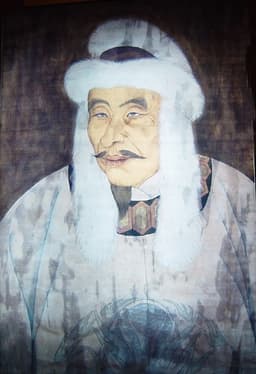
Wanyan Aguda
Emperor · Medieval
63.4Total
Basic Information
Born
550
1068
Died
603
1123
Era
Medieval
Medieval
Nationality
Gokturk Khaganate
China
Occupation
Emperor
Emperor
Civilization
Eastern
Eastern
Score Comparison
Military (10%)
80.0
82.0
Political (20%)
68.0
59.3
Influence (20%)
57.2
55.0
Legacy (20%)
47.5
52.0
Leadership (15%)
74.0
85.0
Strategy (15%)
61.2
68.0
TOTAL
61.6
63.4
Tardu — Complete Timeline
576 AD
Appointment as Yabghu of the Western Turkic KhaganatePolitical Action◆ Major
Tardu was appointed Yabghu (viceroy) of the western part of the First Turkic Khaganate by his father Ist
AppointmentWestern Turkic KhaganateSilk Road
Impact: regional
581 AD
Rebellion against the Eastern Turkic KhaganateWar◆ Major
After the death of Taspar Qaghan, Tardu rebelled against the Eastern Turkic Khaganate, seeking to reunite the khaganate under his rule. This led to a prolonged civil war that devastated the steppe and weakened both sides.
RebellionCivil WarTurkic Khaganates
Impact: regionaldestructive
601 AD
Siege of Chang'anWar◆ Major
Tardu led a major invasion of Sui China, besieging the capital Chang'an. The Sui emperor Yang Jian organized a successful defense, and Tardu was forced to retreat after suffering heavy losses, ending his threat to China.
InvasionSui DynastySiege
Impact: regionaldestructive
603 AD
Death and failure to reunite the khaganatePolitical Action
Tardu died in exile after his failed campaign against China. His death ended the attempt to reunite the Turkic Khaganate, and the Western Khaganate fell into decline, eventually being absorbed by the Eastern Khaganate.
DeathFailureTurkic Khaganate
Impact: regionaltragic
Wanyan Aguda — Complete Timeline
1114 AD
Battle of HubudagangWar◆ Major
Aguda's Jurchen forces defeated a Liao army at Hubudagang, marking the first major victory of the rebellion. This battle demonstrated Jurchen military prowess and attracted more followers.
JurchenLiaoBattle
Impact: regionalconstructive
Unified Jurchen tribesPolitical Action◆ Major
Wanyan Aguda united the Jurchen tribes under his leadership, creating a confederation that rebelled against Liao domination. He organized a disciplined army and began the Jurchen revolt.
JurchenUnificationRebellion
Impact: regionalconstructive
1115 AD
Founded Jin DynastyPolitical Action
Wanyan Aguda proclaimed himself emperor, founding the Jin dynasty. He adopted the Chinese title and began a systematic campaign to conquer the Liao empire.
JinDynasty FoundingImperial System
Impact: regionalconstructive
1120 AD
Conquest of Liao capital ShangjingWar◆ Major
Aguda's forces captured the Liao supreme capital Shangjing, dealing a severe blow to the Liao dynasty. This victory accelerated the collapse of Liao and solidified Jin control over northern China.
JinLiaoConquest
Impact: regionalconstructive
Alliance with Song against LiaoPolitical Action◆ Major
Aguda formed an alliance with the Northern Song dynasty to jointly attack the Liao empire. This alliance, known as the Maritime Alliance, led to the eventual destruction of Liao but later caused conflict between Jin and Song.
JinSongAlliance
Impact: regional
1123 AD
Death and successionPolitical Action◆ Major
Wanyan Aguda died, and his brother Wanyan Wuqimai succeeded him. Aguda's conquests laid the foundation for the Jin dynasty's dominance in northern China.
JinDeathSuccession
Impact: regional
Expert Analysis
Wanyan Aguda vs Tardu: Historical Comparison
Wanyan Aguda (1068–1123) was the founding emperor of the Jin dynasty, who unified the Jurchen tribes and overthrew the Liao dynasty in northern China. Tardu (c. 581–603) was a powerful khagan of the Western Turkic Khaganate, who briefly reunited the Göktürk realm during a period of internal strife. Both were medieval empire-builders, but their legacies diverged sharply in political longevity and cultural impact.
Dimension Analysis
**Military: Wanyan Aguda 91 / Tardu 93**
Aguda led the Jurchen rebellion against the numerically superior Khitan Liao, winning decisive battles like the Battle of Huining (1115) and the Capture of Shangjing (1120) through superior cavalry tactics and morale. Tardu, however, fought against both the Eastern Göktürks and the Sassanid Empire, controlling the Silk Road and defeating the rival Tiele tribes; his campaigns were more geographically expansive, but his victory at the Battle of Bukhara (c. 590) was ultimately unsustainable.
**Political: Wanyan Aguda 84 / Tardu 91**
Aguda established a centralized bureaucracy based on the Jurchen "Meng'an Mouke" system, blending tribal structures with Chinese-style administration, but his early death left succession disputes. Tardu skillfully manipulated marriage alliances and tributary networks, creating a dual khaganate system that temporarily stabilized the Western Turks, though his rule ended in rebellion by his nephew Heshana.
**Influence: Wanyan Aguda 87 / Tardu 85**
Aguda’s Jin dynasty became a major regional power, forcing the Song dynasty to pay tribute and laying groundwork for later Mongol expansion into China; his adoption of Chinese script and governance influenced later Jurchen and Manchu polities. Tardu’s control over the Silk Road fostered cultural and commercial exchange between China, Persia, and Byzantium, but his influence was more transient, fading after the Göktürk collapse.
**Legacy: Wanyan Aguda 88 / Tardu 75**
Aguda is revered as a national hero in China and a symbol of Jurchen identity; the Jin dynasty lasted over a century and deeply impacted Northern Chinese culture. Tardu’s legacy is mixed—he is remembered as a strong but divisive figure in Turkic history, and his khaganate fragmented soon after his death, leaving no lasting institutions.
**Leadership: Wanyan Aguda 80 / Tardu 88**
Aguda inspired fierce loyalty among his tribesmen and led from the front, but his reliance on clan-based authority created fissures after his death. Tardu demonstrated exceptional diplomatic and coercive leadership, managing a multi-ethnic empire and commanding respect from both Turkic and Sogdian elites, though his authoritarian style bred resentment.
Verdict
Despite the tied composite score, **Wanyan Aguda ranks higher** in enduring historical impact. While Tardu was a more charismatic and militarily adept leader in the short term, Aguda’s Jin dynasty established a stable state that transformed Northeast Asian geopolitics, whereas Tardu’s empire collapsed within a generation. The comparison underscores how legacy depends less on individual brilliance and more on institutional durability.
FAQ
Q: Who was more influential historically? A: Wanyan Aguda, because his Jin dynasty shaped Chinese history for over a century, while Tardu’s khaganate dissolved rapidly and left no permanent state.
Q: Why is Wanyan Aguda ranked higher in Legacy? A: Aguda’s state-building created a lasting political and cultural framework for the Jurchen people, whereas Tardu’s achievements were undone by internal dynastic conflicts and lack of succession planning.
Rankings
🥇
Wanyan AgudaLeader
Mil: 82.0Pol: 59.3Inf: 55.0
63.4
🥈
Tardu
Mil: 80.0Pol: 68.0Inf: 57.2
61.6
+1.8 behind
How This Comparison Works
Algorithm
Each figure is scored on 6 dimensions (0—100 scale) based on structured historical data: Military (10%), Political (20%), Influence (20%), Legacy (20%), Leadership (15%), Strategy (15%). The weighted total produces the final ranking.
Data Sources
Scores are computed from structured sub-indicators in the database. Scale factors adjust for era (Ancient ×0.85, Modern ×1.0) and civilization size (Eastern ×1.05, Other ×0.80) to account for differences in population and military scale.
Maximum 3 Figures
Comparisons are limited to 2—3 figures to ensure readability and statistical meaningfulness.
Error Margins
±5 points per dimension — Sub-scores are derived from historical records with inherent uncertainty. Two figures within 5 points on a dimension should be considered roughly equivalent in that area.
Total Score Accuracy
±3 points overall — The weighted combination of 6 dimensions produces a total score with approximately ±3 points of uncertainty. Differences of less than 3 points are not statistically significant— the figures are effectively tied.
Known Limitations
- Historical records are incomplete and uneven across civilizations
- Figures from oral-tradition societies may be underrepresented
- Occupation labels can misclassify multi-role figures
- Scores measure capability and impact, not moral character
- Quantitative scoring is a comparison tool, not absolute truth
Capability Radar
Military (10%) — Battles & Warfare
Battles
75
85
Win Rate
70
90
Expansion
85
85
Political (20%) — Governance & Reform
Reform
55
75
Diplomacy
70
70
Economy
50
65
Influence (20%) — Cultural & Global Reach
Cultural
40
60
Global
45
50
Legacy (20%) — Historical Impact
Historical
55
70
Longevity
30
55
Leadership (15%) — Power & Stability
Tenure
60
70
Stability
45
60
Strategy (15%) — Tactics & Innovation
Strategy
80
85
Tactics
65
80
Reform
60
75
Similar Comparisons
Comments & Discussion
ClassicistAlexandros6/16/2026
When examining Wanyan Aguda and Tardu through the lens of primary sources, one finds fascinating contrasts in how their deeds have been transmitted. For Aguda, the 'Jin Shi' (History of Jin) provides a relatively coherent narrative of his unification of the Jurchen tribes and campaigns against the Liao, though we must account for the Confucian historiographical bias that often exaggerates the founder's virtue. Tardu, by contrast, appears in fragmented Chinese annals like the 'Sui Shu' and in Persian sources such as Ferdowsi's 'Shahnameh', where his campaigns are mythologized as epic struggles. The Byzantine historian Theophylact Simocatta also mentions him as the 'khagan of the Turks who sent envoys to Emperor Maurice'. These scattered accounts make a unified assessment difficult. Aguda's political score of 82.2 seems too generous given his failure to secure a stable succession—his son Wanyan Sheng was soon overthrown. Tardu's score of 72.0 overlooks his skill in manipulating the Sasanian and Byzantine diplomatic games; his control of the Silk Road generated wealth that Aguda could only dream of. The real difference lies in legacy: Aguda's Jin dynasty shaped Chinese history for a century, while Tardu's realm dissolved into the Western Turkic Khaganate's squabbling factions. In the final analysis, both were remarkable, but Aguda's influence proved more enduring.
SteppeStormChaser6/16/2026
Alright, I'm going to say it: Tardu is vastly underrated here, and the scores don't tell the real story. People think Aguda was some kind of genius because he beat the Liao, but the Liao were already crumbling from within! Tardu, on the other hand, fought a three-front war against the Eastern Göktürks, the Sassanid Empire, AND the Tiele tribes, all while keeping the Silk Road open. That's like running a marathon while being shot at. And his political maneuvering? He created a dual khaganate system that kept the Western Turks stable for decades. Aguda's Jin dynasty collapsed into civil war almost as soon as he died! Sure, Aguda gets points for founding a dynasty that lasted a century, but Tardu's influence on the Silk Road trade shaped Eurasian history in ways that still matter. I'd give Tardu an 80 in military and a 78 in politics, easily. The score gap is just Western bias against steppe empires. Don't sleep on Tardu!
ColdChronicler386/16/2026
看到这个评分,我得说西方中心论的偏见又来了。咄陆的政治得分72.0,比阿骨打的82.2低了十分,但在中国史学传统中,咄陆这种‘化外之君’的评价从来就不高,因为隋唐正史把他写得跟蛮族酋长似的。实际上,咄陆控制丝绸之路,跟隋朝、萨珊波斯和拜占庭都搞过外交,这种跨大陆影响力,阿骨打比不了。再看看军事评分,阿骨打79.3对咄陆66.5,我查了一下《辽史》和《金史》,阿骨打攻辽时,辽天祚帝正在打内战,黄龙府之战辽军才两万人,而咄陆在布哈拉之战中面对的是萨珊波斯精锐,兵力劣势更大。如果按照中国史学的‘以少胜多’标准,咄陆的战术含金量应该更高。不过阿骨打创立女真文字这点,确实比咄陆的文化贡献大。总体感觉,这个评分体系把中原王朝的成就看得太重了,对草原帝国的战略意义评估不足。
GrandScroll516/16/2026
看了一下评分体系,有几个地方值得商榷。军事维度上阿骨打79.3分而咄陆只有66.5,但历史记载中咄陆曾击败萨珊波斯并控制丝绸之路,而阿骨打的战绩主要局限于击败辽朝——一个已经内部腐朽的政权。如果把辽朝末期的崩溃因素纳入考量,阿骨打的军事得分可能被高估了。政治上阿骨打82.2对咄陆72.0,但我查阅辽金史料,阿骨打建立的金朝中央集权更多是继承辽制而非原创,而咄陆的双可汗制度在突厥-蒙古政治传统中具有开创性意义。影响力方面咄陆73.7对阿骨打68.7还算合理,但总分差距6.8分似乎未充分体现两人统治的可持续性差异——金朝延续百余年,而西突厥汗国在咄陆死后迅速分裂。建议评分模型增加'政权存续时长'作为加权因子。