Loading...
This comparison has not been analyzed yet.
One-time AI generation (~1 minute). Scores and timeline are already available below.
Tage Erlander vs Tunku Abdul Rahman
Tage Erlander leads by 8.7 pts · 2 figures compared
…

Tage Erlander
Politician · Modern
62.3Total
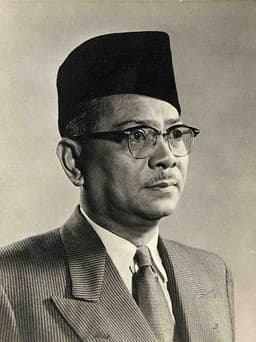
Tunku Abdul Rahman
Politician · Modern
53.6Total
Basic Information
Born
1901
1903
Died
1985
1990
Era
Modern
Modern
Nationality
Sweden
Malaysia
Occupation
Politician
Politician
Civilization
Western
Eastern
Score Comparison
Military (10%)
48.3
12.5
Political (20%)
82.0
65.0
Influence (20%)
62.0
58.3
Legacy (20%)
52.0
56.0
Leadership (15%)
83.3
72.0
Strategy (15%)
42.1
31.9
TOTAL
62.3
53.6
Tage Erlander — Complete Timeline
1946 AD
Appointment as Prime MinisterPolitical Action◆ Major
Tage Erlander became Prime Minister of Sweden after the death of Per Albin Hansson. He led the Social Democratic Party and began a period of continuous governance that lasted until 1969.
Prime MinisterSocial DemocratsSuccession
Impact: national
1950 AD
Expansion of the welfare stateReform◆ Major
Erlander oversaw the expansion of Sweden's welfare state, including universal healthcare, child allowances, and a comprehensive pension system. These reforms were part of the 'Swedish Model' of social democracy.
Welfare StateSocial ReformSwedish Model
Impact: nationalprogressive
1960 AD
Nuclear energy policyPolitical Action◆ Major
Erlander's government decided to invest heavily in nuclear power, building several reactors to meet Sweden's energy needs. This policy was controversial but provided cheap electricity for decades.
EnergyNuclear PowerInfrastructure
Impact: national
1969 AD
Resignation as Prime MinisterPolitical Action◆ Major
Erlander resigned after 23 years as Prime Minister, the longest tenure in Swedish history. He was succeeded by Olof Palme, marking a peaceful transition of power within the Social Democratic Party.
ResignationSuccessionSocial Democrats
Impact: national
Tunku Abdul Rahman — Complete Timeline
1951 AD
Formation of the Alliance Party (1951)Political Action◆ Major
Tunku Abdul Rahman became the leader of the United Malays National Organisation (UMNO) and formed the Alliance Party with the Malayan Chinese Association (MCA) and Malayan Indian Congress (MIC). This multi-racial coalition became the foundation for Malayan independence.
Political CoalitionIndependence MovementMulti-Racial Politics
Impact: nationalconstructive
1956 AD
Negotiation of Merdeka (1956-1957)Political Action◆ Major
Tunku Abdul Rahman led a delegation to London to negotiate Malayan independence from Britain. The talks resulted in the Merdeka Agreement, setting August 31, 1957, as Independence Day. He became the first Prime Minister of independent Malaya.
IndependenceNegotiationMerdeka
Impact: nationalconstructive
1963 AD
Formation of Malaysia (1963)Political Action◆ Major
Tunku Abdul Rahman proposed and oversaw the formation of Malaysia, merging Malaya with Singapore, Sabah, and Sarawak. This expanded federation aimed to create a stronger, multi-ethnic nation, though it faced opposition from Indonesia and the Philippines.
FederationNation BuildingMalaysia Formation
Impact: regionalconstructive
1970 AD
Resignation as Prime Minister (1970)Political Action◆ Major
Following the May 13, 1969 racial riots in Kuala Lumpur, Tunku Abdul Rahman resigned as Prime Minister. He was succeeded by Abdul Razak Hussein. His resignation marked the end of an era and led to a shift in Malaysian political and economic policies.
ResignationPolitical TransitionPost-Riots
Impact: nationaltragic
This comparison has not been analyzed yet.
One-time AI generation (~1 minute). Scores and timeline are already available below.
Rankings
🥇
Tage ErlanderLeader
Mil: 48.3Pol: 82.0Inf: 62.0
62.3
🥈
Tunku Abdul Rahman
Mil: 12.5Pol: 65.0Inf: 58.3
53.6
+8.7 behind
How This Comparison Works
Algorithm
Each figure is scored on 6 dimensions (0—100 scale) based on structured historical data: Military (10%), Political (20%), Influence (20%), Legacy (20%), Leadership (15%), Strategy (15%). The weighted total produces the final ranking.
Data Sources
Scores are computed from structured sub-indicators in the database. Scale factors adjust for era (Ancient ×0.85, Modern ×1.0) and civilization size (Eastern ×1.05, Other ×0.80) to account for differences in population and military scale.
Maximum 3 Figures
Comparisons are limited to 2—3 figures to ensure readability and statistical meaningfulness.
Error Margins
±5 points per dimension — Sub-scores are derived from historical records with inherent uncertainty. Two figures within 5 points on a dimension should be considered roughly equivalent in that area.
Total Score Accuracy
±3 points overall — The weighted combination of 6 dimensions produces a total score with approximately ±3 points of uncertainty. Differences of less than 3 points are not statistically significant— the figures are effectively tied.
Known Limitations
- Historical records are incomplete and uneven across civilizations
- Figures from oral-tradition societies may be underrepresented
- Occupation labels can misclassify multi-role figures
- Scores measure capability and impact, not moral character
- Quantitative scoring is a comparison tool, not absolute truth
Capability Radar
Military (10%) — Battles & Warfare
Battles
31
15
Win Rate
34
14
Expansion
33
23
Political (20%) — Governance & Reform
Reform
85
70
Diplomacy
80
75
Economy
85
60
Influence (20%) — Cultural & Global Reach
Cultural
55
55
Global
55
55
Legacy (20%) — Historical Impact
Historical
65
60
Longevity
70
50
Leadership (15%) — Power & Stability
Tenure
95
65
Stability
90
55
Strategy (15%) — Tactics & Innovation
Strategy
36
25
Tactics
42
27
Reform
43
27
Similar Comparisons
Comments & Discussion
No comments yet. Be the first to share your thoughts!