Loading...
Suleiman the Magnificent vs Wu Zetian
Suleiman the Magnificent leads by 3.2 pts · 2 figures compared
…
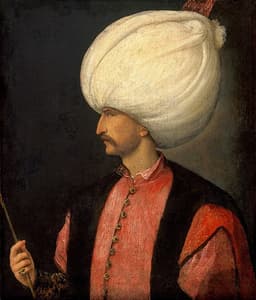
Suleiman the Magnificent
Emperor · Medieval
73.2Total

Wu Zetian
Emperor · Medieval
70.0Total
Basic Information
Born
1494
624
Died
1566
705
Era
Medieval
Medieval
Nationality
Ottoman Empire
China
Occupation
Emperor
Emperor
Civilization
Middle Eastern
Eastern
Score Comparison
Military (10%)
85.0
60.0
Political (20%)
78.0
62.7
Influence (20%)
72.0
65.0
Legacy (20%)
68.0
80.0
Leadership (15%)
72.0
78.0
Strategy (15%)
72.0
66.3
TOTAL
73.2
70.0
Suleiman the Magnificent — Complete Timeline
1522 AD
Siege of RhodesWar◆ Major
Suleiman personally led a massive Ottoman campaign against the Knights Hospitaller on Rhodes. After a six-month siege, the knights surrendered and were allowed to leave. This victory secured Ottoman control over the eastern Mediterranean.
SiegeMediterraneanKnights Hospitaller
Impact: regional
1526 AD
Battle of MohácsWar
Suleiman's Ottoman army defeated the Hungarian forces of King Louis II at Moh
BattleHungaryOttoman expansion
Impact: regional
1529 AD
Siege of ViennaWar◆ Major
Suleiman besieged Vienna, the Habsburg capital, with a large army. The siege failed due to supply issues, disease, and strong defenses. This defeat halted Ottoman expansion into central Europe and marked the empire's furthest advance westward.
SiegeViennaDefeat
Impact: regional
1530 AD
Codification of Ottoman lawReform◆ Major
Suleiman oversaw the compilation and standardization of Ottoman legal codes, known as Kanun. These laws regulated criminal justice, land tenure, and taxation, creating a unified legal system that balanced sharia with secular law. He earned the title 'Kanuni' (the Lawgiver).
Legal reformKanunOttoman Empire
Impact: nationalconstructive
1536 AD
Execution of Ibrahim PashaPolitical Action◆ Major
Suleiman ordered the execution of his grand vizier and close friend Ibrahim Pasha, who had served for 13 years. The reasons remain debated, but likely involved Ibrahim's growing power and conflicts with Suleiman's wife, Hurrem Sultan. This event demonstrated the absolute power of the sultan.
ExecutionCourt politicsPower
Impact: nationaltragic
Wu Zetian — Complete Timeline
655 AD
Became Empress ConsortPolitical Action◆ Major
Wu Zetian was elevated from concubine to empress consort of Emperor Gaozong of Tang in 655. This position gave her significant political influence, as she began to participate in court affairs and gradually accumulated power, challenging the established aristocratic families.
Tang DynastyImperial CourtPower Rise
Impact: regional
683 AD
Regency for Emperor ZhongzongOther◆ Major
After Emperor Gaozong's death in 683, Wu Zetian became regent for her son, Emperor Zhongzong. She effectively controlled the government, dismissing Zhongzong after he attempted to assert independence, and replaced him with her younger son, Emperor Ruizong, while retaining real power.
Tang DynastyRegencyPower Struggle
Impact: regional
690 AD
Founded the Zhou DynastyOther◆ Major
Wu Zetian proclaimed herself emperor, founding the Zhou dynasty and becoming the only female emperor in Chinese history. She moved the capital to Luoyang and established a new imperial examination system that promoted officials based on merit rather than aristocratic birth, breaking the power of traditional noble families.
Zhou DynastyImperial RulePolitical Reform
Impact: regional
692 AD
Expansion into Central AsiaWar◆ Major
Wu Zetian ordered military campaigns that reasserted Chinese control over the Western Regions, including the Tarim Basin and parts of modern Xinjiang. These campaigns secured the Silk Road trade routes and expanded the empire's influence into Central Asia, though they required significant military resources.
Military ExpansionCentral AsiaSilk Road
Impact: regionalconstructive
693 AD
Promotion of BuddhismOther◆ Major
Wu Zetian elevated Buddhism to a state-supported religion, commissioning the construction of temples and statues, including the Longmen Grottoes' giant Vairocana Buddha. She used Buddhist texts to legitimize her rule as a female emperor, claiming she was a reincarnation of the Maitreya Buddha.
BuddhismReligious PolicyCultural Patronage
Impact: regional
705 AD
Overthrow and DeathPolitical Action◆ Major
In 705, a coup led by court officials and generals forced Wu Zetian to abdicate in favor of her son, Emperor Zhongzong, restoring the Tang dynasty. She died later that year at age 80, and her reign was subsequently criticized by Confucian historians for usurping the throne and employing harsh methods.
Tang DynastyCoupAbdication
Impact: regionaldestructive
Expert Analysis
Wu Zetian vs Suleiman the Magnificent
The Emperor and the Sultan
On a winter morning in 705, the only woman ever to rule China in her own right lay dying in a Luoyang palace, stripped of her throne, her dynasty, and her name. Across the world, in a tent outside the walls of Szigetvár, an aging Ottoman sultan breathed his last in the saddle, still commanding an army he had led for nearly half a century. Wu Zetian and Suleiman the Magnificent—two sovereigns who never met, whose empires never touched—yet whose lives pose a single, haunting question: what does it take to hold absolute power, and what does it cost?
Origins
Wu Zetian was born in 624 into a wealthy but politically marginal family. Her father was a timber merchant who had helped the founding Tang emperor, but in a society that prized aristocratic pedigree, she was an outsider. When she entered the palace at fourteen as a low-ranking concubine, she carried no name, no connections—only her wits. The Tang court was a knife’s-edge world of intrigue, where a wrong word meant death. Wu learned to read people as others read books.
Suleiman, born in 1494, inherited the opposite. He was the tenth sultan of a dynasty that had already conquered Constantinople. His father, Selim the Grim, had tripled Ottoman territory. Suleiman grew up in the shadow of a father who executed his own brothers; he knew that power was not a gift but a burden passed through blood. Where Wu had to claw her way upward, Suleiman had the throne handed to him at twenty-six, polished and waiting.
Rise to Power
Wu’s ascent was a masterpiece of patience. After the death of Emperor Taizong, she was sent to a Buddhist convent—a common fate for concubines without children. But she had already caught the eye of the new emperor, Gaozong, and she maneuvered her way back into the palace. Over the next decade, she eliminated rivals with cold precision: she was accused of smothering her own infant daughter to frame the empress, and she orchestrated the exile of senior ministers who opposed her. By 660, Gaozong’s failing health left her as the de facto ruler. When he died in 683, she ruled through puppet sons until, in 690, she declared herself emperor—the first and only woman in Chinese history to do so.
Suleiman’s rise was smoother but no less dramatic. He became sultan in 1520 after his father’s death, and within two years he had launched his first major campaign: the Siege of Rhodes in 1522. For six months, he personally directed the bombardment of the Knights Hospitaller’s fortress. When the knights finally surrendered, Suleiman allowed them to leave with their lives—a gesture of magnanimity that Wu would have found dangerously naive. He was young, confident, and eager to prove himself worthy of his father’s conquests.
Leadership & Governance
Wu Zetian ruled through fear and talent. She created a secret police network to root out dissent, and she executed thousands of aristocrats who questioned her legitimacy. But she also revolutionized the civil service examinations, opening them to commoners for the first time. She promoted men like Di Renjie, a brilliant judge from a humble background, because she knew that loyalty came from those who owed everything to her. Her military record was mixed: she expanded Chinese control into Central Asia, but her campaigns against the Tibetans were costly and indecisive. Her score of 62.0 in military reflects a ruler who relied more on political manipulation than battlefield genius.
Suleiman governed through law and spectacle. He codified Ottoman law—the Kanun—in 1530, standardizing criminal and administrative codes across a sprawling empire. He was known as "the Lawgiver" to his own people, though Europeans called him "Magnificent" for his wealth and art patronage. His military record was formidable: the Battle of Mohács in 1526 crushed Hungary, and his Siege of Vienna in 1529—though a failure due to supply lines and disease—demonstrated his ambition. Yet his score of 85.0 in military masks a darker truth: his later campaigns, like the disastrous 1566 siege of Szigetvár, achieved little. And his naval buildup, which culminated in the defeat at Lepanto in 1571, happened after his death—a legacy of overreach.
Triumph & Tragedy
Wu’s greatest triumph was her sheer survival. For fifteen years, she ruled as emperor—longer than many Tang men. She built a new capital at Luoyang, patronized Buddhism, and left a bureaucracy that lasted centuries. Her tragedy came in 705, when a coup forced her to abdicate. She died that same year, stripped of her imperial title, her Zhou dynasty erased from official history. For centuries, Chinese historians painted her as a monstrous usurper.
Suleiman’s triumph was the Siege of Rhodes, where he proved his mettle. His tragedy was personal: in 1536, he ordered the execution of his grand vizier and childhood friend Ibrahim Pasha, after thirteen years of partnership. The reasons remain murky—suspicion of treason, the influence of his wife Roxelana—but the act poisoned his court. Later, he executed his own son Mustafa, a potential rival. By the end, Suleiman was a lonely figure, surrounded by sycophants.
Character & Destiny
Wu Zetian was a pragmatist who understood that power required constant vigilance. She was ruthless because she had no choice: as a woman in a patriarchal system, any sign of weakness would have destroyed her. Her political score of 80.0 reflects a master of manipulation, but her strategy score of 65.6 suggests she was reactive, not visionary. She ruled by exploiting cracks in the system.
Suleiman was a romantic who believed in order and glory. His leadership score of 79.0 shows a man who inspired loyalty, but his strategy score of 66.5 reveals a tendency to overreach. He saw himself as a universal emperor, but his empire was too vast and diverse for one man to control. His codification of law was his most lasting achievement, yet it was born from a desire for control that ultimately suffocated innovation.
Legacy
Wu Zetian’s legacy is paradoxical. She was reviled for centuries, yet her reforms—especially the opening of the civil service—shaped Chinese governance for a millennium. Today, she is seen as a symbol of female ambition, her score of 85.0 in legacy reflecting a rehabilitation that began only in the twentieth century.
Suleiman’s legacy is the Ottoman Golden Age. His patronage of the architect Sinan produced the Süleymaniye Mosque, and his legal reforms became the foundation of Ottoman justice. Yet his score of 66.7 in legacy is lower than Wu’s—perhaps because his empire declined so sharply after his death. He is remembered as a peak, not a turning point.
Conclusion
Wu Zetian and Suleiman the Magnificent both held absolute power, but they wielded it in opposite directions. Wu rose from nothing and ruled through cunning, leaving a system that outlasted her. Suleiman inherited everything and ruled through might, leaving a memory that faded. One broke every rule; the other embodied them. In the end, power is not about what you take—it is about what you leave behind. Wu left a door open for others. Suleiman left a door that slowly closed.
Rankings
🥇
Suleiman the MagnificentLeader
Mil: 85.0Pol: 78.0Inf: 72.0
73.2
🥈
Wu Zetian
Mil: 60.0Pol: 62.7Inf: 65.0
70.0
+3.2 behind
How This Comparison Works
Algorithm
Each figure is scored on 6 dimensions (0—100 scale) based on structured historical data: Military (10%), Political (20%), Influence (20%), Legacy (20%), Leadership (15%), Strategy (15%). The weighted total produces the final ranking.
Data Sources
Scores are computed from structured sub-indicators in the database. Scale factors adjust for era (Ancient ×0.85, Modern ×1.0) and civilization size (Eastern ×1.05, Other ×0.80) to account for differences in population and military scale.
Maximum 3 Figures
Comparisons are limited to 2—3 figures to ensure readability and statistical meaningfulness.
Error Margins
±5 points per dimension — Sub-scores are derived from historical records with inherent uncertainty. Two figures within 5 points on a dimension should be considered roughly equivalent in that area.
Total Score Accuracy
±3 points overall — The weighted combination of 6 dimensions produces a total score with approximately ±3 points of uncertainty. Differences of less than 3 points are not statistically significant— the figures are effectively tied.
Known Limitations
- Historical records are incomplete and uneven across civilizations
- Figures from oral-tradition societies may be underrepresented
- Occupation labels can misclassify multi-role figures
- Scores measure capability and impact, not moral character
- Quantitative scoring is a comparison tool, not absolute truth
Capability Radar
Military (10%) — Battles & Warfare
Battles
95
65
Win Rate
90
70
Expansion
95
75
Political (20%) — Governance & Reform
Reform
90
85
Diplomacy
88
80
Economy
85
85
Influence (20%) — Cultural & Global Reach
Cultural
90
85
Global
88
70
Legacy (20%) — Historical Impact
Historical
92
90
Longevity
85
85
Leadership (15%) — Power & Stability
Tenure
95
90
Stability
85
75
Strategy (15%) — Tactics & Innovation
Strategy
92
75
Tactics
85
60
Reform
80
80
Similar Comparisons
Comments & Discussion
No comments yet. Be the first to share your thoughts!