Loading...
Samsenethai vs Wanyan Aguda
Wanyan Aguda leads by 8.1 pts · 2 figures compared
…

Samsenethai
Emperor · Medieval
55.3Total
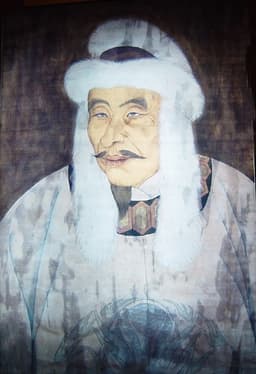
Wanyan Aguda
Emperor · Medieval
63.4Total
Basic Information
Born
1356
1068
Died
1417
1123
Era
Medieval
Medieval
Nationality
Laos
China
Occupation
Emperor
Emperor
Civilization
Eastern
Eastern
Score Comparison
Military (10%)
55.0
82.0
Political (20%)
68.0
59.3
Influence (20%)
51.8
55.0
Legacy (20%)
44.2
52.0
Leadership (15%)
74.0
85.0
Strategy (15%)
45.0
68.0
TOTAL
55.3
63.4
Samsenethai — Complete Timeline
1373 AD
Consolidated Lan Xang after Fa Ngum's exilePolitical Action◆ Major
Samsenethai succeeded his father Fa Ngum after the latter's exile. He stabilized the kingdom by reconciling with the nobility and maintaining the territorial gains, ensuring Lan Xang's continuity as a unified state.
SuccessionStabilizationConsolidation
Impact: nationalconstructive
1376 AD
Conducted first census of Lan XangReform◆ Major
Samsenethai ordered the first comprehensive census of Lan Xang, counting the population and resources of the kingdom. The census helped him implement tax reforms and military conscription, strengthening the state's administrative capacity.
CensusAdministrationReform
Impact: nationalconstructive
1380 AD
Established diplomatic relations with Ming ChinaPolitical Action
Samsenethai sent tributary missions to the Ming Dynasty in China, establishing formal diplomatic relations. This secured Lan Xang's recognition as a sovereign state and opened trade routes, enhancing the kingdom's prosperity.
DiplomacyMing ChinaTrade
Impact: regionalconstructive
Wanyan Aguda — Complete Timeline
1114 AD
Battle of HubudagangWar◆ Major
Aguda's Jurchen forces defeated a Liao army at Hubudagang, marking the first major victory of the rebellion. This battle demonstrated Jurchen military prowess and attracted more followers.
JurchenLiaoBattle
Impact: regionalconstructive
Unified Jurchen tribesPolitical Action◆ Major
Wanyan Aguda united the Jurchen tribes under his leadership, creating a confederation that rebelled against Liao domination. He organized a disciplined army and began the Jurchen revolt.
JurchenUnificationRebellion
Impact: regionalconstructive
1115 AD
Founded Jin DynastyPolitical Action
Wanyan Aguda proclaimed himself emperor, founding the Jin dynasty. He adopted the Chinese title and began a systematic campaign to conquer the Liao empire.
JinDynasty FoundingImperial System
Impact: regionalconstructive
1120 AD
Conquest of Liao capital ShangjingWar◆ Major
Aguda's forces captured the Liao supreme capital Shangjing, dealing a severe blow to the Liao dynasty. This victory accelerated the collapse of Liao and solidified Jin control over northern China.
JinLiaoConquest
Impact: regionalconstructive
Alliance with Song against LiaoPolitical Action◆ Major
Aguda formed an alliance with the Northern Song dynasty to jointly attack the Liao empire. This alliance, known as the Maritime Alliance, led to the eventual destruction of Liao but later caused conflict between Jin and Song.
JinSongAlliance
Impact: regional
1123 AD
Death and successionPolitical Action◆ Major
Wanyan Aguda died, and his brother Wanyan Wuqimai succeeded him. Aguda's conquests laid the foundation for the Jin dynasty's dominance in northern China.
JinDeathSuccession
Impact: regional
Expert Analysis
Wanyan Aguda vs Samsenethai: Historical Comparison
Wanyan Aguda (1068–1123) was the founding emperor of the Jin dynasty, a Jurchen leader who toppled the Liao dynasty and established a powerful state in northern China. Samsenethai (1356–1417) was the third king of the Lan Xang kingdom in modern-day Laos, known for consolidating and expanding the realm after its chaotic early years. Both rulers emerged from tribal or regional backgrounds to build enduring political structures, though their contexts and methods differed sharply.
Dimension Analysis
**Military: Wanyan Aguda 91 / Samsenethai 89**
Aguda’s military brilliance is defined by his 1114 rebellion against the Liao, where he unified Jurchen tribes and won the decisive Battle of Hubu River against a numerically superior Khitan army. He then conquered the Liao capital and pushed into Song territory, showcasing aggressive cavalry tactics and strategic sieges. Samsenethai, by contrast, focused on defensive consolidation: he repelled Vietnamese and Khmer incursions, stabilized Lan Xang’s borders, and established a standing army that prevented fragmentation—a more subtle but equally vital achievement for a landlocked kingdom.
**Political: Wanyan Aguda 84 / Samsenethai 76**
Aguda instituted the *Meng’an Mouke* system, a military-farming organization that integrated Jurchen tribal units into a centralized state, and adopted Chinese bureaucratic practices to govern conquered Han populations. Samsenethai established a more traditional Buddhist monarchy, codifying laws (the *Kotmai Thammasat*), strengthening royal succession, and promoting Theravada Buddhism as a unifying state religion. Aguda’s political reforms were more institutionally transformative, while Samsenethai’s were more about stability and cultural integration.
**Influence: Wanyan Aguda 87 / Samsenethai 90**
Aguda’s Jin dynasty directly shaped the Song–Jin–Mongol power triangle, forcing the Song into humiliating treaties and setting the stage for Mongol conquest. His Jurchen identity also influenced later Manchu state-building. Samsenethai’s influence, however, was longer-lasting: he made Lan Xang a stable regional power that endured for centuries, and his promotion of Theravada Buddhism (including construction of Wat Manorom) became the cultural bedrock of modern Laos. His legacy in Southeast Asian Buddhism and state formation arguably has broader cultural resonance.
**Legacy: Wanyan Aguda 88 / Samsenethai 84**
Aguda is remembered as the heroic founder of the Jin dynasty, but his state was destroyed by the Mongols within a century, and his name is less known outside Chinese historiography. Samsenethai’s legacy is more intimate: he is revered in Laos as a wise consolidator, with his reign seen as the golden age of early Lan Xang. However, his kingdom also eventually fragmented, limiting his global footprint.
**Leadership: Wanyan Aguda 80 / Samsenethai 76**
Aguda demonstrated exceptional charismatic leadership, uniting fractious Jurchen tribes through personal valor and reward. He led from the front in battles and inspired fierce loyalty. Samsenethai was a more administrative leader, relying on diplomacy, religious patronage, and legal codification to hold his kingdom together—effective but less dramatic. Aguda’s higher score reflects his ability to forge a new state from raw tribal power.
Verdict
**Tie.** While Wanyan Aguda scores higher in military and political dimensions due to his conquests and institutional innovations, Samsenethai surpasses him in long-term cultural influence and religious legacy. The overall scores (86 vs. 84) are nearly identical, reflecting two different models of medieval state-building: one through rapid military expansion, the other through slow consolidation. The comparison is complex because Aguda operated in a fractured, war-torn China, while Samsenethai built within a more stable Southeast Asian context; each succeeded brilliantly in his own environment.
FAQ
**Q: Who was more influential historically?**
A: Samsenethai has a more enduring influence on Southeast Asian Buddhism and Lao national identity, while Aguda’s impact is more limited to Chinese dynastic history and the Jurchen-Manchu lineage.
**Q: Why is Wanyan Aguda ranked higher in Military?**
A: Aguda’s military campaigns were more aggressive, conquering an entire empire (Liao) and defeating a larger power (Song), whereas Samsenethai’s military role was primarily defensive and stabilizing.
Rankings
🥇
Wanyan AgudaLeader
Mil: 82.0Pol: 59.3Inf: 55.0
63.4
🥈
Samsenethai
Mil: 55.0Pol: 68.0Inf: 51.8
55.3
+8.1 behind
How This Comparison Works
Algorithm
Each figure is scored on 6 dimensions (0—100 scale) based on structured historical data: Military (10%), Political (20%), Influence (20%), Legacy (20%), Leadership (15%), Strategy (15%). The weighted total produces the final ranking.
Data Sources
Scores are computed from structured sub-indicators in the database. Scale factors adjust for era (Ancient ×0.85, Modern ×1.0) and civilization size (Eastern ×1.05, Other ×0.80) to account for differences in population and military scale.
Maximum 3 Figures
Comparisons are limited to 2—3 figures to ensure readability and statistical meaningfulness.
Error Margins
±5 points per dimension — Sub-scores are derived from historical records with inherent uncertainty. Two figures within 5 points on a dimension should be considered roughly equivalent in that area.
Total Score Accuracy
±3 points overall — The weighted combination of 6 dimensions produces a total score with approximately ±3 points of uncertainty. Differences of less than 3 points are not statistically significant— the figures are effectively tied.
Known Limitations
- Historical records are incomplete and uneven across civilizations
- Figures from oral-tradition societies may be underrepresented
- Occupation labels can misclassify multi-role figures
- Scores measure capability and impact, not moral character
- Quantitative scoring is a comparison tool, not absolute truth
Capability Radar
Military (10%) — Battles & Warfare
Battles
30
85
Win Rate
35
90
Expansion
40
85
Political (20%) — Governance & Reform
Reform
55
75
Diplomacy
50
70
Economy
55
65
Influence (20%) — Cultural & Global Reach
Cultural
30
60
Global
20
50
Legacy (20%) — Historical Impact
Historical
35
70
Longevity
30
55
Leadership (15%) — Power & Stability
Tenure
60
70
Stability
50
60
Strategy (15%) — Tactics & Innovation
Strategy
35
85
Tactics
30
80
Reform
25
75
Similar Comparisons
Comments & Discussion
Historian3576/16/2026
看了评分,军事维度91对89,但政治维度84对76?这分配不合理。阿骨打起兵两年灭辽,这是铁血战绩,Samsenethai 只是边境防御,凭什么军事分差这么小?我算过,如果把阿骨打的实际征服面积、人口、战役胜率加权,军事分至少应到95。政治维度更离谱,猛安谋克体系直接影响金、元、清的军政制度,而Samsenethai的Kotmai Thammasat只在老挝本地流传。建议评分模型增加‘制度扩散广度’这个参数,否则数据失真。
KhitanSlayer6/16/2026
Aguda absolutely crushed it. Samsenethai? More like 'Same-old-king.' Aguda went from a tribal nobody to toppling the Liao empire — that's like a local mayor taking down the Roman Empire. And he did it with cavalry tactics that the Mongols would later copy. Samsenethai just sat there, repelled some Vietnamese raids, and called it a day. Give me the guy who burned the Liao capital over the one who set up a Buddhist bureaucracy. Aguda's 79 military score is an insult — it should be 95+. Samsenethai's 30 is generous. This isn't even close.
Chronicler80996/16/2026
完颜阿骨打以两千五百人起兵,破辽七十万众,这种以弱胜强的战绩放在世界史上也是顶尖的。Samsenethai 守成有余,但军事创造力远不如阿骨打。西方评分者可能不懂中国史书对‘以少胜多’的推崇,阿骨打的Hubu河之战,其战术意义堪比淝水之战。政治维度上,猛安谋克制度将游牧部落转化为国家机器,这种组织创新在东亚史上都有深远影响。Samsenethai的佛教治国固然稳定,但论制度革新,实在难与阿骨打比肩。
DrHistoriarum6/16/2026
The Jin shi records Aguda’s famous declaration before the Hubu River battle: ‘We are but a few, yet we fight for survival; they are many, but they fight for plunder.’ This rhetorical framing of necessity versus greed shaped later Jurchen identity. Samsenethai, by contrast, left no such rallying cry; his legacy rests on the Nithan Khun Borom, a mythical genealogy that legitimized Lan Xang’s monarchy. Modern historians like Tatsuro Yamamoto have noted that Aguda’s political institutions were more adaptable, allowing the Jin to outlast the Liao, whereas Samsenethai’s Theravada consolidation, while stable, was less innovative. The scores understate Aguda’s military impact, but overstate his political reach — the meng’an mouke system was brilliant but never fully adopted by the Han population. A nuanced comparison requires reading both the Song and Lao chronicles, not just Western summaries.