Loading...
Saad Hariri vs Tom Adams
Tom Adams leads by 3.2 pts · 2 figures compared
…
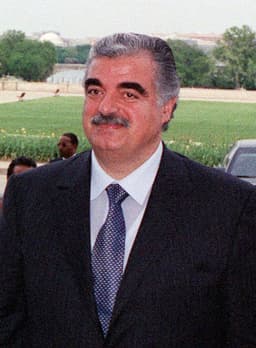
Saad Hariri
Politician · Modern
38.4Total

Tom Adams
Politician · Modern
41.6Total
Basic Information
Born
1970
1931
Died
—
—
Era
Modern
Modern
Nationality
Lebanon
Barbados
Occupation
Politician
Politician
Civilization
Middle Eastern
Other
Score Comparison
Military (10%)
15.3
44.2
Political (20%)
32.2
30.8
Influence (20%)
48.6
47.1
Legacy (20%)
37.5
36.7
Leadership (15%)
41.5
48.4
Strategy (15%)
43.2
43.8
TOTAL
38.4
41.6
Saad Hariri — Complete Timeline
2009 AD
Elected Prime Minister of LebanonPolitical Action◆ Major
Saad Hariri was elected Prime Minister of Lebanon on November 9, 2009, after his March 14 Alliance won parliamentary elections. He formed a national unity government that included Hezbollah, reflecting Lebanon's complex political landscape.
Prime MinisterElectionCoalition
Impact: national
2011 AD
Resigned as Prime Minister in 2011Political Action◆ Major
Hariri resigned as Prime Minister on January 12, 2011, after Hezbollah and its allies withdrew from his government, collapsing the coalition. The resignation followed tensions over the Special Tribunal for Lebanon investigating his father's assassination.
ResignationHezbollahPolitical Crisis
Impact: nationaldestructive
2016 AD
Returned as Prime Minister in 2016Political Action◆ Major
Saad Hariri was again appointed Prime Minister in December 2016 after a two-year political vacuum. He formed a unity government with Hezbollah and President Michel Aoun, but the government struggled with economic crises and corruption.
Return to PowerUnity GovernmentEconomic Crisis
Impact: national
2017 AD
Resigned from Saudi Arabia in 2017Political Action◆ Major
Hariri announced his resignation as Prime Minister on November 4, 2017, while in Saudi Arabia, sparking allegations that he was forced to resign by Saudi authorities. He later returned to Lebanon and rescinded the resignation after international mediation.
ResignationSaudi ArabiaPolitical Crisis
Impact: regionaldestructive
2022 AD
Stepped down after 2022 electionsPolitical Action
After the 2022 parliamentary elections, Hariri's Future Movement lost significant seats. He announced he would not run for prime minister again and boycotted the political process, citing Hezbollah's dominance and lack of reform.
ElectionBoycottPolitical Withdrawal
Impact: national
Tom Adams — Complete Timeline
1958 AD
Elected to Barbados House of AssemblyPolitical Action
Tom Adams was elected to the Barbados House of Assembly as a member of the Barbados Labour Party (BLP), beginning his political career. He was the son of former Premier Grantley Adams.
ParliamentBLPPolitical Career
Impact: national
1976 AD
Became Prime Minister of BarbadosPolitical Action◆ Major
Tom Adams led the BLP to victory in the 1976 general election, becoming Prime Minister of Barbados. He succeeded Errol Barrow and focused on economic diversification and social programs.
Prime MinisterBLPElection
Impact: nationalconstructive
1981 AD
Won 1981 general electionPolitical Action◆ Major
Adams led the BLP to a second consecutive victory in the 1981 general election, securing a majority in Parliament. His government continued economic policies and maintained close ties with the United States.
ElectionBLPRe-election
Impact: national
1983 AD
Led Barbados during US invasion of GrenadaPolitical Action◆ Major
Adams supported the US-led invasion of Grenada in 1983, providing logistical support and diplomatic backing. This decision was controversial domestically and regionally.
GrenadaUS InvasionForeign Policy
Impact: regional
1985 AD
Died in officePolitical Action◆ Major
Tom Adams died suddenly in office at the age of 53, reportedly from a heart attack. His death led to a leadership transition within the BLP and a period of political uncertainty.
DeathPrime MinisterSuccession
Impact: nationaltragic
Expert Analysis
Origins
Saad Hariri was born in 1970 in Riyadh, Saudi Arabia, to Rafic Hariri, a billionaire businessman and later prime minister of Lebanon, and Nidal Boustani. He studied business administration at Georgetown University, inheriting his father's political mantle after Rafic's assassination in 2005. Tom Adams was born in 1931 in Bridgetown, Barbados, to Grantley Adams, the first premier of Barbados and a key figure in West Indies Federation, and Grace Thorne. He studied at Harrison College and the University of Oxford, entering politics as a natural successor.
Rise to Power
Hariri rose after his father's assassination, leading the March 14 Alliance to victory in the 2005 parliamentary elections. He became prime minister in 2009, but his coalition collapsed in 2011 when Hezbollah withdrew. Adams led the Barbados Labour Party (BLP) to victory in the 1976 general election, defeating Errol Barrow's Democratic Labour Party (DLP). He won a second term in 1981, consolidating power.
Leadership & Governance
Hariri's governance was marked by attempts to balance sectarian factions. He formed a national unity government with Hezbollah in 2016, but his resignation from Saudi Arabia in 2017 highlighted his vulnerability. His economic policies struggled amid corruption and debt. Adams focused on economic diversification and tourism. He supported the US invasion of Grenada in 1983, a decisive move that aligned Barbados with the US but divided domestic opinion. His governance score of 48.4 contrasts with Hariri's 41.5.
Triumph & Tragedy
Hariri's triumph was leading the March 14 Alliance to electoral victory in 2009, but his tragedy was the collapse of his government in 2011 and his forced resignation in 2017. He scored 32.2 in political and 43.2 in strategy. Adams' triumph was winning two elections and maintaining stability, but his tragedy was dying in office at 53, leaving his party without clear succession. He scored 44.2 in military (due to his role in the Grenada invasion) and 43.8 in strategy.
Character & Destiny
Hariri was seen as a pragmatic but weak leader, often overshadowed by Hezbollah and external powers. His indecisiveness led to a score of 15.3 in military and 38.4 total. Adams was decisive and pro-Western, with a stronger leadership score of 48.4. His sudden death cut short his influence.
Legacy
Hariri's legacy is tied to Lebanon's political stagnation and the decline of the Future Movement. He stepped down after 2022 elections, leaving a fragmented landscape. Adams is remembered for strengthening Barbados' ties with the US and maintaining democratic stability. His legacy score of 36.7 is slightly below Hariri's 48.6 in influence.
Conclusion
Tom Adams had a greater impact relative to his country's scale. His decisive actions in the Cold War and stable governance contrast with Hariri's paralysis. Adams' total score of 41.6 vs 38.4 supports this. While Hariri faced larger systemic challenges, Adams achieved more concrete outcomes for Barbados.
Rankings
🥇
Tom AdamsLeader
Mil: 44.2Pol: 30.8Inf: 47.1
41.6
🥈
Saad Hariri
Mil: 15.3Pol: 32.2Inf: 48.6
38.4
+3.2 behind
How This Comparison Works
Algorithm
Each figure is scored on 6 dimensions (0—100 scale) based on structured historical data: Military (10%), Political (20%), Influence (20%), Legacy (20%), Leadership (15%), Strategy (15%). The weighted total produces the final ranking.
Data Sources
Scores are computed from structured sub-indicators in the database. Scale factors adjust for era (Ancient ×0.85, Modern ×1.0) and civilization size (Eastern ×1.05, Other ×0.80) to account for differences in population and military scale.
Maximum 3 Figures
Comparisons are limited to 2—3 figures to ensure readability and statistical meaningfulness.
Error Margins
±5 points per dimension — Sub-scores are derived from historical records with inherent uncertainty. Two figures within 5 points on a dimension should be considered roughly equivalent in that area.
Total Score Accuracy
±3 points overall — The weighted combination of 6 dimensions produces a total score with approximately ±3 points of uncertainty. Differences of less than 3 points are not statistically significant— the figures are effectively tied.
Known Limitations
- Historical records are incomplete and uneven across civilizations
- Figures from oral-tradition societies may be underrepresented
- Occupation labels can misclassify multi-role figures
- Scores measure capability and impact, not moral character
- Quantitative scoring is a comparison tool, not absolute truth
Capability Radar
Military (10%) — Battles & Warfare
Battles
19
22
Win Rate
22
24
Expansion
27
28
Political (20%) — Governance & Reform
Reform
15
20
Diplomacy
30
20
Economy
20
20
Influence (20%) — Cultural & Global Reach
Cultural
10
10
Global
20
10
Legacy (20%) — Historical Impact
Historical
15
10
Longevity
10
10
Leadership (15%) — Power & Stability
Tenure
20
20
Stability
10
20
Strategy (15%) — Tactics & Innovation
Strategy
30
28
Tactics
32
33
Reform
35
39
Similar Comparisons
Comments & Discussion
No comments yet. Be the first to share your thoughts!