Loading...
Radovan Karadzic vs Santiago Carrillo
Santiago Carrillo leads by 15.3 pts · 2 figures compared
…
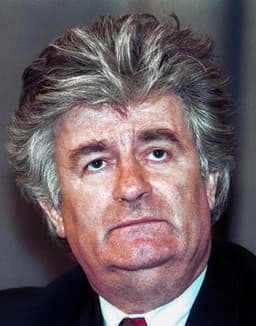
Radovan Karadzic
Politician · Modern
40.6Total

Santiago Carrillo
Politician · Modern
55.9Total
Basic Information
Born
1945
1915
Died
—
2012
Era
Modern
Modern
Nationality
Bosnia
Spain
Occupation
Politician
Politician
Civilization
Western
Western
Score Comparison
Military (10%)
14.9
49.8
Political (20%)
25.0
68.0
Influence (20%)
50.2
58.0
Legacy (20%)
38.3
49.2
Leadership (15%)
51.9
65.0
Strategy (15%)
54.8
41.8
TOTAL
40.6
55.9
Radovan Karadzic — Complete Timeline
1990 AD
Founding of the Serb Democratic Party (SDS)Political Action◆ Major
Karadžić co-founded the Serb Democratic Party (SDS) in Bosnia and Herzegovina in 1990. The party advocated for the unification of Bosnian Serb territories with Serbia and played a key role in the Bosnian War, promoting ethnic separation and conflict.
Political PartyNationalismBosnian War
Impact: regionaldestructive
1992 AD
Siege of SarajevoWar◆ Major
As leader of the Bosnian Serbs, Karad
SiegeWar CrimesSarajevo
Impact: regionaldestructive
1995 AD
Srebrenica GenocideWar◆ Major
Karadžić was found responsible for the Srebrenica genocide in July 1995, where Bosnian Serb forces killed over 8,000 Bosniak men and boys. The massacre was the worst atrocity in Europe since World War II and led to his indictment for genocide.
GenocideSrebrenicaWar Crimes
Impact: globaldestructive
2008 AD
Arrest and Extradition to The HaguePolitical Action◆ Major
Karadžić was arrested in Belgrade on July 21, 2008, after 13 years as a fugitive. He had been living under the alias Dragan Dabić, working as a New Age healer. He was extradited to the ICTY in The Hague to face trial for war crimes.
ArrestFugitiveICTY
Impact: global
2016 AD
Conviction for Genocide by ICTYPolitical Action◆ Major
Radovan Karad
War CrimesGenocideICTY
Impact: globaldestructive
Santiago Carrillo — Complete Timeline
1936 AD
Involved in the Paracuellos massacresPolitical Action◆ Major
During the Spanish Civil War, Carrillo was a leader of the Republican youth organization. He was accused of involvement in the Paracuellos massacres, where thousands of Nationalist prisoners were executed. The extent of his responsibility remains debated.
Spanish Civil WarMassacreControversy
Impact: nationaldestructive
1939 AD
Exiled from SpainPolitical Action◆ Major
After the Nationalist victory in the Spanish Civil War, Carrillo went into exile, living in the Soviet Union, France, and other countries. He remained the PCE's leader in exile for nearly four decades.
Spanish Civil WarExilePCE
Impact: nationaltragic
1976 AD
Led the Spanish Communist Party (PCE) during the TransitionPolitical Action
As Secretary-General of the PCE, Carrillo led the party's legalization and integration into Spain's democratic system. He accepted the monarchy and the democratic constitution, a key step in the transition.
Spanish TransitionCommunismDemocratization
Impact: nationalprogressive
1977 AD
Adopted EurocommunismPolitical Action◆ Major
Carrillo publicly endorsed Eurocommunism, a doctrine that rejected Soviet-style communism and accepted democratic pluralism. This distanced the PCE from Moscow and made it acceptable in Western Europe.
EurocommunismPCEIdeology
Impact: regionalprogressive
Legalization of the PCEPolitical Action◆ Major
Prime Minister Adolfo Suarez legalized the PCE, with Carrillo's acceptance of the monarchy and democratic rules. This ended the party's clandestine status and allowed it to participate in elections.
Spanish TransitionPCELegalization
Impact: nationalprogressive
Expert Analysis
Origins
Radovan Karadzic was born on June 19, 1945, in Petnjica, Montenegro, into a poor family. His father was a partisan fighter. Karadzic studied medicine at the University of Sarajevo, becoming a psychiatrist. He later co-founded the Serb Democratic Party (SDS) in 1990. Santiago Carrillo was born on January 18, 1915, in Gijón, Spain, into a socialist family. His father was a prominent socialist leader. Carrillo joined the Socialist Youth and later the Communist Party of Spain (PCE) in 1936. He became a leader of the Unified Socialist Youth during the Spanish Civil War.
Rise to Power
Karadzic rose to prominence during the breakup of Yugoslavia. In 1990, he co-founded the SDS, advocating for Bosnian Serb interests. He became president of the self-proclaimed Republika Srpska in 1992, leading Bosnian Serbs in the Bosnian War. His rise was marked by nationalist rhetoric and support from Serbia. Carrillo rose through the Spanish Communist Party ranks. He became Secretary-General of the PCE in 1960, leading the party from exile. His rise was defined by his role in the Spanish Civil War and his subsequent exile. He returned to Spain after Franco's death and led the PCE's legalization in 1977.
Leadership & Governance
Karadzic's leadership was authoritarian and nationalist. He ordered the Siege of Sarajevo (1992-1996), resulting in over 10,000 deaths. He was responsible for the Srebrenica genocide in 1995, where 8,000 Bosniak men and boys were killed. His governance was based on ethnic cleansing and war crimes. Carrillo adopted Eurocommunism, rejecting Soviet-style communism. He accepted the Spanish monarchy and democracy, leading the PCE into the political mainstream. He supported the 1978 Constitution and the transition to democracy. His governance was pragmatic and reformist.
Triumph & Tragedy
Karadzic's greatest success was uniting Bosnian Serbs and creating Republika Srpska. His greatest failure was the genocide and his conviction for war crimes. He scored 14.9 in military, 25.0 in political, and 50.2 in influence. Carrillo's triumph was legalizing the PCE and integrating it into Spanish democracy. His tragedy was the Paracuellos massacres during the Civil War, where he was accused of involvement. He scored 49.8 in military, 68.0 in political, and 58.0 in influence.
Character & Destiny
Karadzic was charismatic but ruthless. He evaded capture for 13 years, living as a New Age healer. His character led to his downfall and conviction. Carrillo was pragmatic and resilient. He survived exile and adapted to changing political circumstances. His character enabled him to lead the PCE through transition. Historians view Carrillo as a key figure in Spain's democratization.
Legacy
Karadzic's legacy is one of genocide and war crimes. He is remembered as a symbol of ethnic hatred. His actions led to international intervention and the establishment of the ICTY. Carrillo's legacy is the successful transition of Spanish communism to democracy. He is remembered as a Eurocommunist pioneer. His influence on Spanish politics is lasting.
Conclusion
Santiago Carrillo had greater impact. His scores total 55.9 against Karadzic's 40.6. Carrillo's political score of 68.0 far exceeds Karadzic's 25.0. While Karadzic's influence was destructive, Carrillo's contributions to democracy are enduring. Carrillo's legacy is positive and transformative, whereas Karadzic's is negative and criminal.
Rankings
🥇
Santiago CarrilloLeader
Mil: 49.8Pol: 68.0Inf: 58.0
55.9
🥈
Radovan Karadzic
Mil: 14.9Pol: 25.0Inf: 50.2
40.6
+15.3 behind
How This Comparison Works
Algorithm
Each figure is scored on 6 dimensions (0—100 scale) based on structured historical data: Military (10%), Political (20%), Influence (20%), Legacy (20%), Leadership (15%), Strategy (15%). The weighted total produces the final ranking.
Data Sources
Scores are computed from structured sub-indicators in the database. Scale factors adjust for era (Ancient ×0.85, Modern ×1.0) and civilization size (Eastern ×1.05, Other ×0.80) to account for differences in population and military scale.
Maximum 3 Figures
Comparisons are limited to 2—3 figures to ensure readability and statistical meaningfulness.
Error Margins
±5 points per dimension — Sub-scores are derived from historical records with inherent uncertainty. Two figures within 5 points on a dimension should be considered roughly equivalent in that area.
Total Score Accuracy
±3 points overall — The weighted combination of 6 dimensions produces a total score with approximately ±3 points of uncertainty. Differences of less than 3 points are not statistically significant— the figures are effectively tied.
Known Limitations
- Historical records are incomplete and uneven across civilizations
- Figures from oral-tradition societies may be underrepresented
- Occupation labels can misclassify multi-role figures
- Scores measure capability and impact, not moral character
- Quantitative scoring is a comparison tool, not absolute truth
Capability Radar
Military (10%) — Battles & Warfare
Battles
20
30
Win Rate
15
32
Expansion
15
33
Political (20%) — Governance & Reform
Reform
10
60
Diplomacy
20
65
Economy
10
30
Influence (20%) — Cultural & Global Reach
Cultural
15
40
Global
25
40
Legacy (20%) — Historical Impact
Historical
30
50
Longevity
10
45
Leadership (15%) — Power & Stability
Tenure
40
55
Stability
5
25
Strategy (15%) — Tactics & Innovation
Strategy
20
37
Tactics
25
43
Reform
10
41
Similar Comparisons
Comments & Discussion
No comments yet. Be the first to share your thoughts!