Loading...
Qin Shi Huang vs Xiao Jia of Shang
Qin Shi Huang leads by 47.5 pts · 2 figures compared
…
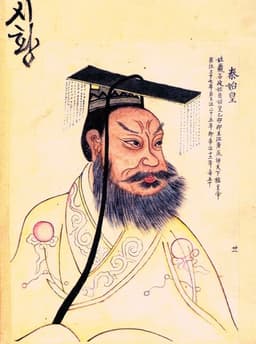
Qin Shi Huang
Emperor · Ancient
85.2Total

Xiao Jia of Shang
Emperor · Ancient
37.7Total
Basic Information
Born
-259
-1520
Died
-210
-1500
Era
Ancient
Ancient
Nationality
China
Shang China
Occupation
Emperor
Emperor
Civilization
Eastern
Eastern
Score Comparison
Military (10%)
80.0
25.9
Political (20%)
90.0
32.1
Influence (20%)
85.0
44.0
Legacy (20%)
90.0
33.3
Leadership (15%)
78.0
48.4
Strategy (15%)
82.0
36.8
TOTAL
85.2
37.7
Qin Shi Huang — Complete Timeline
246 BC
Construction of the Mausoleum and Terracotta ArmyOther◆ Major
Qin Shi Huang commissioned a vast mausoleum complex near Xi'an, guarded by thousands of life-sized terracotta soldiers, horses, and chariots. The project employed hundreds of thousands of workers and reflected his obsession with immortality and imperial power.
Impact: global
230 BC
Conquest of the Six Warring StatesWar
From 230 to 221 BCE, Ying Zheng led the Qin state in a series of campaigns that conquered the Han, Zhao, Wei, Chu, Yan, and Qi states. This unified China under a single ruler for the first time, ending the Warring States period.
Impact: global
221 BC
Standardization of Writing, Currency, and MeasurementsReform◆ Major
Qin Shi Huang ordered the standardization of Chinese script, currency, and weights and measures across the unified empire. This facilitated administration, trade, and cultural integration, laying a foundation for future dynasties.
Impact: globalconstructive
Proclamation of the Qin DynastyPolitical Action
After conquering the last independent state, Ying Zheng declared himself Shi Huangdi (First Emperor), founding the Qin Dynasty. He adopted a new title to signify his supreme authority and initiated centralized imperial rule.
Impact: global
214 BC
Initiation of the Great Wall ConstructionOther◆ Major
Qin Shi Huang ordered the connection and extension of existing northern fortifications to create a unified defensive wall against nomadic Xiongnu raids. This project involved massive conscripted labor and became the precursor to the later Great Wall.
Impact: regional
213 BC
Burning of Books and Burying of ScholarsPolitical Action◆ Major
On the advice of Li Si, Qin Shi Huang ordered the burning of historical records and philosophical texts not aligned with Legalist doctrine. He also had 460 Confucian scholars buried alive to suppress dissent and consolidate ideological control.
Impact: nationaldestructive
Xiao Jia of Shang — Complete Timeline
1520 BC
Accession as Seventh Shang KingPolitical Action
Xiao Jia became king after Tai Geng. Historical records contain no specific events, military campaigns, or reforms attributed to his reign. The period is considered a continuation of the stable early Shang period.
SuccessionObscure Reign
Expert Analysis
qin-shi-huang-vs-xiao-jia-of-shang
# The First Emperor and the Forgotten King
On a winter morning in 221 BC, a man in his late thirties stood before the ruins of the last independent kingdom in China. Ying Zheng, king of Qin, had just watched the fall of Qi, the final holdout among the six warring states. He was not merely a conqueror; he was about to become something the world had never seen. He declared himself *Shi Huangdi*—the First Emperor—and set in motion a revolution that would define China for two millennia. Half a world away in time, a thousand years earlier, another king named Xiao Jia ascended the throne of the Shang dynasty, ruling over a realm that would leave barely a whisper in the historical record. Between these two rulers lies a chasm not just of centuries, but of ambition, vision, and the raw force of personality.
Origins
Qin Shi Huang was born in 259 BC, a prince of the western state of Qin, a harsh frontier kingdom known for its martial culture and ruthless legalism. His father, King Zhuangxiang, died when Ying Zheng was a child, leaving him to inherit a kingdom that had already begun its transformation into a war machine. The boy grew up surrounded by ambitious ministers and generals, learning early that power was a weapon to be wielded, not a privilege to be enjoyed.
Xiao Jia, by contrast, lived in a world where kingship was still semi-sacred, embedded in bronze-age rituals and ancestral worship. He was the seventh king of the Shang dynasty, ruling from around 1520 to 1500 BC. The Shang were a people of oracle bones and bronze vessels, their power centered on the Yellow River plain. Xiao Jia’s father, Tai Geng, had been a king, but the records are so sparse that historians cannot even agree on his mother’s name. He inherited a stable kingdom, but one where the king’s role was more priest than emperor.
Rise to Power
Ying Zheng’s path to power was forged in blood. At thirteen, he became king of Qin, but real authority lay with his regent, Lü Buwei. For years, the young king bided his time, watching, learning, and waiting. In 238 BC, at twenty-one, he crushed a rebellion led by his half-brother and seized full control. Then came the campaigns: from 230 to 221 BC, his armies devoured the six rival states—Han, Zhao, Wei, Chu, Yan, and finally Qi. Each conquest was a masterpiece of strategy and brutality. When the last city fell, Ying Zheng had unified China for the first time in history.
Xiao Jia’s rise was far simpler. He became king upon his father’s death, likely without bloodshed. The Shang succession was not always smooth—brothers sometimes fought brothers—but Xiao Jia’s reign appears in the king lists without any recorded conflict. He was not a conqueror; he was a caretaker.
Leadership & Governance
Qin Shi Huang governed like a man possessed by a vision. He standardized writing, currency, and weights and measures across his empire, creating a unified administrative system that would outlast his dynasty. He ordered the construction of a vast network of roads and canals, and initiated the Great Wall by connecting existing northern fortifications into a single defensive line. His most audacious project was his own mausoleum near Xi’an, guarded by thousands of life-sized terracotta soldiers, a silent army for the afterlife. Yet his rule had a dark side: in 213 BC, on the advice of his chancellor Li Si, he ordered the burning of historical records and philosophical texts not aligned with Legalist doctrine, and had scholars buried alive. He believed that control of the past was essential to control of the future.
Xiao Jia governed as his ancestors had. The Shang kings ruled through a network of clan leaders and priests, their authority rooted in divination and sacrifice. There is no record of any reform, any campaign, any construction project under Xiao Jia. His reign was a quiet interlude in a dynasty that would eventually fall to corruption and invasion. He was not a bad king; he was simply a king who left no mark.
Triumph & Tragedy
Qin Shi Huang’s greatest triumph was the unification itself—a feat that reshaped the world. His greatest tragedy was his obsession with immortality. He sent expeditions to find the elixir of life, consumed mercury pills prescribed by alchemists, and died in 210 BC at the age of forty-nine, possibly from mercury poisoning. His dynasty collapsed within three years of his death, undone by his own harsh policies and the resentment they bred.
Xiao Jia’s reign had no triumphs and no tragedies—at least none recorded. He died around 1500 BC, likely of natural causes, and was succeeded by his son. The Shang dynasty would continue for another three centuries, but Xiao Jia himself was forgotten, a name in a list, a placeholder in history.
Character & Destiny
Qin Shi Huang was driven by an almost superhuman will. He believed that he could shape reality itself, that his power was absolute, and that his legacy would be eternal. This hubris was both his strength and his undoing. He crushed his enemies, standardized his empire, and built monuments that still stand, but he could not conquer death, and he could not make his subjects love him.
Xiao Jia, by contrast, seems to have been a man content with his lot. He ruled as his ancestors had, without ambition or innovation. His destiny was to be ordinary, and in the vast sweep of Chinese history, ordinariness is the fastest path to oblivion.
Legacy
Qin Shi Huang’s legacy is immense. He gave China its name, its administrative structure, and its sense of unity. The Great Wall, the Terracotta Army, the standardized script—these are his fingerprints on the world. He is remembered as both a tyrant and a founder, a figure of awe and horror.
Xiao Jia’s legacy is almost nothing. He is known only because the Shang king lists survived, copied and recopied over millennia. No monuments bear his name. No stories are told of his deeds. He is a ghost in the historical record, a reminder that most rulers, no matter how powerful in their own time, are soon forgotten.
Conclusion
The contrast between Qin Shi Huang and Xiao Jia is not a contrast between good and evil, or between success and failure. It is a contrast between ambition and acceptance. One man sought to conquer time itself, and though he failed, his effort reshaped the world. The other man simply lived, and in living, became nothing. History, it seems, does not reward those who merely exist. It rewards those who dare—for better or worse—to leave a mark that cannot be erased.
Rankings
🥇
Qin Shi HuangLeader
Mil: 80.0Pol: 90.0Inf: 85.0
85.2
🥈
Xiao Jia of Shang
Mil: 25.9Pol: 32.1Inf: 44.0
37.7
+47.5 behind
How This Comparison Works
Algorithm
Each figure is scored on 6 dimensions (0—100 scale) based on structured historical data: Military (10%), Political (20%), Influence (20%), Legacy (20%), Leadership (15%), Strategy (15%). The weighted total produces the final ranking.
Data Sources
Scores are computed from structured sub-indicators in the database. Scale factors adjust for era (Ancient ×0.85, Modern ×1.0) and civilization size (Eastern ×1.05, Other ×0.80) to account for differences in population and military scale.
Maximum 3 Figures
Comparisons are limited to 2—3 figures to ensure readability and statistical meaningfulness.
Error Margins
±5 points per dimension — Sub-scores are derived from historical records with inherent uncertainty. Two figures within 5 points on a dimension should be considered roughly equivalent in that area.
Total Score Accuracy
±3 points overall — The weighted combination of 6 dimensions produces a total score with approximately ±3 points of uncertainty. Differences of less than 3 points are not statistically significant— the figures are effectively tied.
Known Limitations
- Historical records are incomplete and uneven across civilizations
- Figures from oral-tradition societies may be underrepresented
- Occupation labels can misclassify multi-role figures
- Scores measure capability and impact, not moral character
- Quantitative scoring is a comparison tool, not absolute truth
Capability Radar
Military (10%) — Battles & Warfare
Battles
85
10
Win Rate
90
10
Expansion
90
10
Political (20%) — Governance & Reform
Reform
95
10
Diplomacy
75
10
Economy
90
10
Influence (20%) — Cultural & Global Reach
Cultural
95
10
Global
85
10
Legacy (20%) — Historical Impact
Historical
95
10
Longevity
95
10
Leadership (15%) — Power & Stability
Tenure
70
30
Stability
65
30
Strategy (15%) — Tactics & Innovation
Strategy
85
10
Tactics
80
10
Reform
95
10
Similar Comparisons
Comments & Discussion
BronzeEagle6/17/2026
Let's be real here. Comparing Qin Shi Huang to Xiao Jia is like comparing a supernova to a candle. The First Emperor didn't just conquer—he standardized writing, currency, and even axle lengths across a unified realm. Xiao Jia? His reign is so obscure that historians still debate when it started. One reshaped civilization; the other barely dented history.
数据侦探6/17/2026
别被叙事骗了。嬴政确实统一了度量衡,但你查过秦朝寿命吗?十五年就崩了。商朝的小甲,哪怕史料只有甲骨文几笔,统治却延续了二十载。稳定比光鲜的短命王朝更有深度。数字不说谎,只是说话小声。
LegionnaireMind6/17/2026
Qin Shi Huang was a visionary fascist who crushed dissent with iron fists, burning books and burying scholars alive. Sure, he built roads and walls, but at what human cost? Xiao Jia might be obscure, but his Shang dynasty left bronze vessels art historians still obsess over. I'd rather study a quiet artisan than a loud tyrant.
经典迷6/17/2026
小甲是商朝第七王,祖庚的儿子,名字在《史记·殷本纪》里就一行字:“帝小甲,太庚之子,在位十七年。”而秦始皇呢?史记用了整卷篇幅写他。历史记住的不是统治长短,而是留下的故事量。小甲像本泛黄的书页,始皇是整座图书馆。量级差太多。
SkepticScribe6/17/2026
Calling Xiao Jia "forgotten" is lazy. He ruled during the Shang dynasty's middle period when oracle bone inscriptions emerged. The guy likely managed sacrifices and wars that shaped early Chinese ritual identity. Meanwhile, Qin Shi Huang's "unification" lasted barely a generation before rebellion. Xiao Jia's legacy is subtle but real—not flashy, but survival counts.