Loading...
Qin Shi Huang vs Samir Rifai the Younger
Qin Shi Huang leads by 41.6 pts · 2 figures compared
…
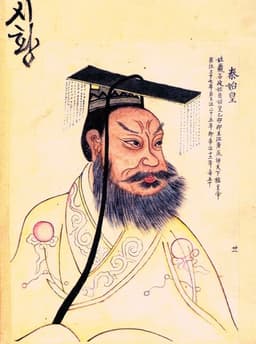
Qin Shi Huang
Emperor · Ancient
85.2Total

Samir Rifai the Younger
Politician · Modern
43.6Total
Basic Information
Born
-259
1966
Died
-210
—
Era
Ancient
Modern
Nationality
China
Jordan
Occupation
Emperor
Politician
Civilization
Eastern
Middle Eastern
Score Comparison
Military (10%)
80.0
32.7
Political (20%)
90.0
39.4
Influence (20%)
85.0
47.1
Legacy (20%)
90.0
36.7
Leadership (15%)
78.0
62.2
Strategy (15%)
82.0
41.7
TOTAL
85.2
43.6
Qin Shi Huang — Complete Timeline
246 BC
Construction of the Mausoleum and Terracotta ArmyOther◆ Major
Qin Shi Huang commissioned a vast mausoleum complex near Xi'an, guarded by thousands of life-sized terracotta soldiers, horses, and chariots. The project employed hundreds of thousands of workers and reflected his obsession with immortality and imperial power.
Impact: global
230 BC
Conquest of the Six Warring StatesWar
From 230 to 221 BCE, Ying Zheng led the Qin state in a series of campaigns that conquered the Han, Zhao, Wei, Chu, Yan, and Qi states. This unified China under a single ruler for the first time, ending the Warring States period.
Impact: global
221 BC
Standardization of Writing, Currency, and MeasurementsReform◆ Major
Qin Shi Huang ordered the standardization of Chinese script, currency, and weights and measures across the unified empire. This facilitated administration, trade, and cultural integration, laying a foundation for future dynasties.
Impact: globalconstructive
Proclamation of the Qin DynastyPolitical Action
After conquering the last independent state, Ying Zheng declared himself Shi Huangdi (First Emperor), founding the Qin Dynasty. He adopted a new title to signify his supreme authority and initiated centralized imperial rule.
Impact: global
214 BC
Initiation of the Great Wall ConstructionOther◆ Major
Qin Shi Huang ordered the connection and extension of existing northern fortifications to create a unified defensive wall against nomadic Xiongnu raids. This project involved massive conscripted labor and became the precursor to the later Great Wall.
Impact: regional
213 BC
Burning of Books and Burying of ScholarsPolitical Action◆ Major
On the advice of Li Si, Qin Shi Huang ordered the burning of historical records and philosophical texts not aligned with Legalist doctrine. He also had 460 Confucian scholars buried alive to suppress dissent and consolidate ideological control.
Impact: nationaldestructive
Samir Rifai the Younger — Complete Timeline
2009 AD
Appointed Prime Minister of JordanPolitical Action◆ Major
Samir Rifai the Younger was appointed Prime Minister by King Abdullah II in December 2009. He was the son of former PM Samir Rifai, and his appointment was seen as a continuation of the political establishment.
Jordanian PoliticsPrime MinisterDynasty
Impact: national
2011 AD
Resigned amid Arab Spring protestsPolitical Action◆ Major
Rifai resigned in February 2011 following weeks of protests inspired by the Arab Spring. Demonstrators demanded political reforms, anti-corruption measures, and an end to his government's economic policies.
Arab SpringProtestsResignation
Impact: nationaltragic
Expert Analysis
qin-shi-huang-vs-samir-rifai-the-younger
# The Emperor and the Prime Minister: Two Paths to Power, Two Ends of History
On a winter day in 2011, Samir Rifai the Younger walked out of the Raghadan Palace in Amman, his resignation letter in hand. Just weeks earlier, protesters had filled the streets of Jordan’s capital, chanting for reform. His tenure as Prime Minister had lasted barely fourteen months. Twenty-two centuries earlier, another ruler faced no such protests—because he had long since silenced them. Qin Shi Huang, the First Emperor of China, died in 210 BC with his mausoleum still unfinished, guarded by thousands of terracotta soldiers who would stand watch over his legacy for millennia. What separates these two men, beyond the obvious chasm of time? The answer lies not merely in power, but in the nature of the worlds they inherited and the choices they made within them.
Origins
Qin Shi Huang was born Ying Zheng in 259 BC, during the brutal Warring States period of ancient China. His father was king of Qin, one of seven competing states locked in a centuries-long struggle for supremacy. The boy grew up in a court where survival meant conquest, where philosophy served the state, and where the only law was the iron will of the ruler. His education came from Legalist scholars who taught him that human nature was inherently selfish and that only harsh laws and centralized control could create order.
Samir Rifai the Younger was born in 1966, into a very different kind of privilege. His father, Samir Rifai the Elder, had served as Prime Minister of Jordan under King Hussein. The younger Rifai grew up in the corridors of power, studying political science and economics, learning the delicate art of balancing tribal loyalties, international aid, and the Hashemite monarchy’s survival. His world was one of negotiation, not conquest.
Rise to Power
Ying Zheng became king of Qin at the age of thirteen, but his rise was forged in blood. Between 230 and 221 BC, he led his armies in a series of devastating campaigns that crushed the six rival states one by one. He conquered Han first, then Zhao, Wei, Chu, Yan, and finally Qi. When the last independent king surrendered in 221 BC, Ying Zheng did something unprecedented: he declared himself *Shi Huangdi*—the First Emperor—and proclaimed the Qin Dynasty. His path was linear, violent, and absolute.
Samir Rifai’s ascent followed the modern script of political appointment. In December 2009, King Abdullah II named him Prime Minister, a position he had long prepared for through ministerial posts and diplomatic roles. There were no armies to conquer, no states to subjugate. The challenge was different: manage an economy, satisfy international donors, and keep a restive population calm in a region already simmering with discontent.
Leadership & Governance
Qin Shi Huang governed with a vision so radical it reshaped China forever. He ordered the standardization of writing, currency, and weights and measures across his vast empire. He connected and extended the northern fortifications into what would become the Great Wall. But his methods were ruthless. In 213 BC, on the advice of his chancellor Li Si, he ordered the burning of historical records and philosophical texts that did not align with Legalist doctrine. Scholars who resisted were buried alive. His mausoleum, commissioned in 246 BC, required the labor of hundreds of thousands of workers and became the resting place of the Terracotta Army—thousands of life-sized soldiers meant to guard him in the afterlife.
Samir Rifai governed in a different register. He managed a small, resource-poor kingdom dependent on foreign aid and remittances. His reforms were moderate: economic liberalization, tax changes, and efforts to attract investment. But he lacked the emperor’s absolute authority. The king retained ultimate power, parliament had a voice, and the streets could still roar.
Triumph & Tragedy
Qin Shi Huang’s greatest triumph was unification itself—the creation of a single Chinese identity from warring fragments. His tragedy was that his dynasty crumbled within four years of his death. The First Emperor’s obsession with control could not survive him. The Legalist terror bred rebellion, and the Han Dynasty rose on the ashes of his empire.
Samir Rifai’s moment of triumph was his appointment—a sign of trust from the monarchy. His tragedy came in February 2011, when the Arab Spring reached Jordan. Protesters demanded political freedoms, an end to corruption, and economic justice. Rifai resigned, his government collapsing under the weight of popular discontent. He had no Terracotta Army to defend him, no Great Wall to hide behind. He simply walked away.
Character & Destiny
Qin Shi Huang’s character was forged in certainty. He believed he had discovered the formula for eternal order: absolute power, standardized systems, and the eradication of dissent. This confidence drove his greatest achievements and his most catastrophic errors. He died seeking an elixir of immortality, poisoned by mercury pills that his alchemists had promised would grant him eternal life.
Samir Rifai’s character was shaped by pragmatism. He knew his power was borrowed, his tenure temporary. He was a manager, not a monarch. His destiny was to serve, not to shape. When the protests came, he had neither the will nor the means to suppress them. He resigned, as modern prime ministers do.
Legacy
Qin Shi Huang left behind an empire that, though short-lived, became the template for every Chinese dynasty that followed. The standardized script he imposed is still used today. The Great Wall still winds across the north. The Terracotta Army still stands, a silent monument to his ambition and his fear of death. His legacy score of 85 reflects a man who, for better or worse, changed the course of civilization.
Samir Rifai’s legacy is more modest. He is remembered, if at all, as a prime minister who could not hold his ground against the winds of history. His legacy score of 47.8 is a numerical echo of his transience. He did not build walls or armies. He simply served, and then he left.
Conclusion
What drove these different outcomes? Not simply power, but the nature of the worlds they inhabited. Qin Shi Huang lived in an age when one man could reshape reality through sheer force, when the only check on ambition was death. Samir Rifai lived in an age of checks and balances, of public opinion, of fragile institutions. The First Emperor’s tragedy was that his empire could not survive his ambition. The Prime Minister’s tragedy was that his ambition could not survive his era. Between the terracotta soldier and the resignation letter lies the whole arc of human governance—from the dream of absolute control to the reality of negotiated power. Both men sought to leave their mark. One built an army of clay. The other left only silence.
Rankings
🥇
Qin Shi HuangLeader
Mil: 80.0Pol: 90.0Inf: 85.0
85.2
🥈
Samir Rifai the Younger
Mil: 32.7Pol: 39.4Inf: 47.1
43.6
+41.6 behind
How This Comparison Works
Algorithm
Each figure is scored on 6 dimensions (0—100 scale) based on structured historical data: Military (10%), Political (20%), Influence (20%), Legacy (20%), Leadership (15%), Strategy (15%). The weighted total produces the final ranking.
Data Sources
Scores are computed from structured sub-indicators in the database. Scale factors adjust for era (Ancient ×0.85, Modern ×1.0) and civilization size (Eastern ×1.05, Other ×0.80) to account for differences in population and military scale.
Maximum 3 Figures
Comparisons are limited to 2—3 figures to ensure readability and statistical meaningfulness.
Error Margins
±5 points per dimension — Sub-scores are derived from historical records with inherent uncertainty. Two figures within 5 points on a dimension should be considered roughly equivalent in that area.
Total Score Accuracy
±3 points overall — The weighted combination of 6 dimensions produces a total score with approximately ±3 points of uncertainty. Differences of less than 3 points are not statistically significant— the figures are effectively tied.
Known Limitations
- Historical records are incomplete and uneven across civilizations
- Figures from oral-tradition societies may be underrepresented
- Occupation labels can misclassify multi-role figures
- Scores measure capability and impact, not moral character
- Quantitative scoring is a comparison tool, not absolute truth
Capability Radar
Military (10%) — Battles & Warfare
Battles
85
22
Win Rate
90
23
Expansion
90
27
Political (20%) — Governance & Reform
Reform
95
25
Diplomacy
75
35
Economy
90
30
Influence (20%) — Cultural & Global Reach
Cultural
95
10
Global
85
10
Legacy (20%) — Historical Impact
Historical
95
10
Longevity
95
10
Leadership (15%) — Power & Stability
Tenure
70
30
Stability
65
30
Strategy (15%) — Tactics & Innovation
Strategy
85
32
Tactics
80
33
Reform
95
38
Similar Comparisons
Comments & Discussion
TerracottaSkeptic6/17/2026
Forget the feel-good comparison — Qin Shi Huang actually *built* something that lasts, Samir Rifai couldn't even handle a few months of street protests. The First Emperor unified weights, measures, and script across a continent, rolled out a postal system, and linked defensive walls into the Great Wall. Rifai? His biggest legacy is a failed IMF loan. History judges by monuments, not resignation letters.
长城守护者6/17/2026
拿秦始皇跟一个干了十四个月的现代政客比?根本不在一个量级。始皇帝书同文车同轨,废分封设郡县,那长城修了两千年还在立着。萨米尔·里法伊连个示威游行都压不住,2011年二月上台四月就下台,连个像样的基础设施都没修过。这种对比纯粹是欺负古人不能骂人。
DataChronos6/17/2026
The numbers don't lie: Qin ruled for 37 years after unifying China, Samir Rifai lasted 14 months. But what's more telling is *reach*. The First Emperor's legal code standardized everything from axle width to writing characters across millions of square kilometers. Rifai couldn't even standardize Jordan's electricity grid. Scale matters. One man built a civilization's operating system; the other managed a cabinet shuffle.
文牍学徒6/17/2026
史实上俩人的权力来源就天差地别。秦始皇是铁血打出来的皇帝,手下有白起王翦这种杀神,法律至上压制一切反对声音。萨米尔·里法伊呢?他上台是国王任命,靠的是家族裙带关系——他爸就干过首相。他下台更惨,两千公务员罢工他就扛不住了。开始即结束,哪来的可比性。
ParadoxPundit6/17/2026
Here's the twist: Samir Rifai might actually be the *more* historically significant figure. Qin's absolute control created a template that China kept recycling for two millennia — peak stability, but zero political evolution. Rifai's brief, failed tenure against the Arab Spring represents something new: the moment when even hereditary privilege couldn't insulate from popular will. One man's failure might matter more than another's consolidation.