Loading...
This comparison has not been analyzed yet.
One-time AI generation (~1 minute). Scores and timeline are already available below.
Pyotr Bagration vs Thomas Kinkaid
Thomas Kinkaid leads by 2.0 pts · 2 figures compared
…
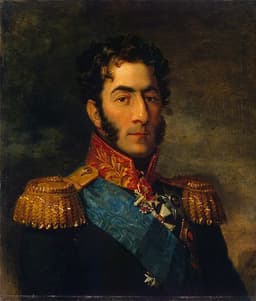
Pyotr Bagration
General · Modern
52.9Total

Thomas Kinkaid
General · Modern
54.9Total
Basic Information
Born
1765
1888
Died
1812
1972
Era
Modern
Modern
Nationality
Russia
United States
Occupation
General
General
Civilization
Western
Western
Score Comparison
Military (10%)
65.0
70.0
Political (20%)
32.2
43.7
Influence (20%)
62.0
54.1
Legacy (20%)
58.0
47.5
Leadership (15%)
40.4
68.0
Strategy (15%)
55.0
57.5
TOTAL
52.9
54.9
Pyotr Bagration — Complete Timeline
1805 AD
Battle of AusterlitzWar◆ Major
Bagration commanded the Russian rear guard during the Battle of Austerlitz. His forces covered the retreat of the Russian army after the defeat by Napoleon, preventing a complete rout and preserving a portion of the army.
Napoleonic WarsRetreatRear Guard
Impact: regional
Battle of SchöngrabernWar◆ Major
Bagration commanded a Russian rearguard action at Sch
Napoleonic WarsRear GuardRetreat
Impact: regionalconstructive
1807 AD
Battle of FriedlandWar◆ Major
Bagration commanded a corps at the Battle of Friedland, a decisive French victory. His forces fought on the left flank and were forced to retreat across the Alle River under heavy fire, suffering significant losses.
Napoleonic WarsDefeatRetreat
Impact: regionaldestructive
1812 AD
Battle of BorodinoWar
Bagration commanded the left flank of the Russian army at the Battle of Borodino. He was mortally wounded by a cannonball fragment while leading a counterattack against French forces. His wounding demoralized his troops and contributed to the Russian defensive failure.
Napoleonic WarsMortal WoundBattle
Impact: nationaltragic
Thomas Kinkaid — Complete Timeline
1942 AD
Commanded Task Force 16 at the Battle of MidwayWar◆ Major
Kinkaid commanded Task Force 16, which included the carriers Enterprise and Hornet, at the Battle of Midway. The US victory destroyed four Japanese carriers and turned the tide in the Pacific.
World War IIMidwayNaval Battle
Impact: global
Commanded Naval Forces in the Aleutian Islands CampaignWar
Kinkaid commanded the North Pacific Force during the Aleutian Islands campaign, overseeing the recapture of Attu and Kiska from Japanese forces. The campaign was the only World War II battle fought on North American soil.
World War IIAleutian IslandsNaval Campaign
Impact: regional
1944 AD
Commanded Seventh Fleet at the Battle of Leyte GulfWar◆ Major
Kinkaid commanded the US Seventh Fleet during the Battle of Leyte Gulf, the largest naval battle of World War II. His forces engaged Japanese surface ships and supported the invasion of Leyte.
World War IILeyte GulfNaval Battle
Impact: regional
Commanded Naval Forces at the Battle of Surigao StraitWar◆ Major
Kinkaid's Seventh Fleet defeated a Japanese battleship force at the Battle of Surigao Strait, the last battleship-to-battleship engagement in history. The victory prevented Japanese forces from attacking the Leyte beachhead.
World War IISurigao StraitNaval Battle
Impact: regional
This comparison has not been analyzed yet.
One-time AI generation (~1 minute). Scores and timeline are already available below.
Rankings
🥇
Thomas KinkaidLeader
Mil: 70.0Pol: 43.7Inf: 54.1
54.9
🥈
Pyotr Bagration
Mil: 65.0Pol: 32.2Inf: 62.0
52.9
+2.0 behind
How This Comparison Works
Algorithm
Each figure is scored on 6 dimensions (0—100 scale) based on structured historical data: Military (10%), Political (20%), Influence (20%), Legacy (20%), Leadership (15%), Strategy (15%). The weighted total produces the final ranking.
Data Sources
Scores are computed from structured sub-indicators in the database. Scale factors adjust for era (Ancient ×0.85, Modern ×1.0) and civilization size (Eastern ×1.05, Other ×0.80) to account for differences in population and military scale.
Maximum 3 Figures
Comparisons are limited to 2—3 figures to ensure readability and statistical meaningfulness.
Error Margins
±5 points per dimension — Sub-scores are derived from historical records with inherent uncertainty. Two figures within 5 points on a dimension should be considered roughly equivalent in that area.
Total Score Accuracy
±3 points overall — The weighted combination of 6 dimensions produces a total score with approximately ±3 points of uncertainty. Differences of less than 3 points are not statistically significant— the figures are effectively tied.
Known Limitations
- Historical records are incomplete and uneven across civilizations
- Figures from oral-tradition societies may be underrepresented
- Occupation labels can misclassify multi-role figures
- Scores measure capability and impact, not moral character
- Quantitative scoring is a comparison tool, not absolute truth
Capability Radar
Military (10%) — Battles & Warfare
Battles
75
65
Win Rate
70
60
Expansion
40
40
Political (20%) — Governance & Reform
Reform
10
20
Diplomacy
30
45
Economy
10
25
Influence (20%) — Cultural & Global Reach
Cultural
55
20
Global
45
35
Legacy (20%) — Historical Impact
Historical
65
45
Longevity
50
30
Leadership (15%) — Power & Stability
Tenure
20
40
Stability
15
35
Strategy (15%) — Tactics & Innovation
Strategy
75
60
Tactics
80
55
Reform
30
30
Similar Comparisons
Comments & Discussion
No comments yet. Be the first to share your thoughts!