Loading...
Ptolemy I Soter vs Skandagupta
Ptolemy I Soter leads by 9.5 pts · 2 figures compared
…
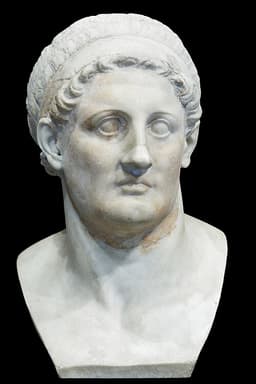
Ptolemy I Soter
Emperor · Ancient
66.2Total

Skandagupta
Emperor · Ancient
56.7Total
Basic Information
Born
-367
440
Died
-283
467
Era
Ancient
Ancient
Nationality
Egypt
India
Occupation
Emperor
Emperor
Civilization
Middle Eastern
Indian
Score Comparison
Military (10%)
76.0
74.7
Political (20%)
75.0
45.0
Influence (20%)
40.0
56.4
Legacy (20%)
80.0
48.3
Leadership (15%)
75.0
68.0
Strategy (15%)
61.2
61.2
TOTAL
66.2
56.7
Ptolemy I Soter — Complete Timeline
321 BC
Capture of Alexander's BodyPolitical Action◆ Major
Ptolemy I intercepted the funeral cortege of Alexander the Great and brought his body to Memphis, later to Alexandria. This act legitimized his rule over Egypt and made Alexandria a pilgrimage site, enhancing his prestige among the Diadochi.
DiadochiAlexanderEgypt
Impact: regionalconstructive
312 BC
Battle of GazaWar
Ptolemy I defeated Demetrius Poliorcetes, son of Antigonus I, at Gaza. This victory secured Ptolemy's control over Syria and Palestine temporarily, though he later lost these territories. The battle was part of the ongoing Wars of the Diadochi.
DiadochiBattleEgypt
Impact: regional
305 BC
Foundation of the Ptolemaic DynastyPolitical Action
Ptolemy I Soter declared himself king of Egypt, founding the Ptolemaic dynasty. He established a Greek-speaking monarchy that ruled Egypt for nearly 300 years, blending Greek and Egyptian cultures. His reign began the Hellenistic period in Egypt.
DiadochiEgyptHellenistic
Impact: regionalconstructive
295 BC
Founding of the Library of AlexandriaCultural◆ Major
Ptolemy I established the Library of Alexandria as part of the Musaeum, a center of learning. The library aimed to collect all known Greek works and became the largest and most famous library of the ancient world, fostering scholarship.
EgyptLibraryHellenistic
Impact: globalconstructive
Skandagupta — Complete Timeline
455 AD
Defeated the Huna (Hephthalite) InvasionWar◆ Major
Skandagupta repelled a major invasion by the Huna (Hephthalite) nomads from Central Asia. The victory preserved the Gupta Empire's integrity and is recorded in the Junagadh rock inscription, which praises his military prowess.
BattleHuna Invasion
Impact: regional
458 AD
Repaired the Sudarshana Lake DamOther
Skandagupta ordered the repair of the Sudarshana Lake dam in Gujarat, which had been damaged by floods. The project, supervised by his governor Parnadatta, restored irrigation for agriculture and demonstrated Gupta administrative capability.
InfrastructureIrrigation
constructive
Issued the Junagadh Rock InscriptionCultural
Skandagupta commissioned the Junagadh rock inscription, which records his reign, military victories, and public works. The inscription provides key historical evidence of Gupta administration and the Huna threat.
InscriptionPropaganda
Impact: regional
460 AD
Maintained Gupta Territorial IntegrityPolitical Action◆ Major
Skandagupta successfully defended the Gupta Empire against internal rebellions and external threats, preventing its fragmentation. His reign marked the last period of Gupta unity before the empire declined under later rulers.
DefenseEmpire Maintenance
Impact: regional
Expert Analysis
Origins
Ptolemy I Soter was born in 367 BCE in the kingdom of Macedon, the son of Lagus and Arsinoe. He was a childhood friend and trusted bodyguard of Alexander the Great, receiving a strong military education in the Macedonian court. Ptolemy's early years were shaped by the campaigns of Alexander, where he distinguished himself as a capable commander. After Alexander's death in 323 BCE, Ptolemy positioned himself as satrap of Egypt, a province he would transform into his own kingdom.
Skandagupta was born around 450 CE into the Gupta dynasty of India, likely the son of Emperor Kumaragupta I. The Gupta Empire was at its height, but internal pressures and external threats were mounting. Skandagupta's early life is less documented, but he likely received training in administration and warfare. He ascended the throne around 455 CE, possibly after a contested succession, as suggested by the Junagadh inscription which mentions his restoration of the dynasty's fortunes.
Rise to Power
Ptolemy's rise began with the partition of Alexander's empire in 323 BCE. As satrap of Egypt, he quickly consolidated power by capturing Alexander's body in 322 BCE, bringing it to Memphis and later Alexandria. This act legitimized his rule as Alexander's successor. He defended Egypt against invasions by Perdiccas in 321 BCE and later against Antigonus I. In 305 BCE, Ptolemy declared himself king (Pharaoh), founding the Ptolemaic dynasty. His victory over Demetrius Poliorcetes at the Battle of Gaza in 312 BCE secured his control over Syria and Palestine.
Skandagupta rose to power during a period of crisis. The Gupta Empire faced invasions by the Huna (Hephthalite) nomads from Central Asia. Skandagupta's military prowess came to the fore when he repelled a major Huna invasion around 458 CE, as recorded in the Junagadh inscription. This victory preserved the Gupta Empire's territorial integrity and earned him the title 'Vikramaditya' (Sun of Valour). He also quelled internal rebellions, possibly including a challenge from a rival claimant named Purugupta.
Leadership & Governance
Ptolemy I Soter scored 75.0 in leadership and 75.0 in political acumen. He established a Greek-speaking monarchy that blended Egyptian and Hellenistic traditions. He created a centralized bureaucracy, promoted trade, and founded the Library of Alexandria as part of the Musaeum, a research institution that attracted scholars from across the Mediterranean. His governance focused on cultural synthesis and economic prosperity, but his rule remained authoritarian, with power concentrated in the Greek elite.
Skandagupta scored 68.0 in leadership and 45.0 in political skills. His governance emphasized defense and public works. He repaired the Sudarshana Lake dam in Gujarat, a project supervised by his governor Parnadatta. The Junagadh inscription highlights his administrative oversight and patronage of infrastructure. However, his reign faced economic strain from constant warfare, and his political score reflects the challenges of maintaining unity in a decentralized empire.
Triumph & Tragedy
Ptolemy's greatest triumph was founding the Ptolemaic dynasty, which ruled Egypt for nearly 300 years, and establishing Alexandria as a cultural capital. The Library of Alexandria became the ancient world's greatest repository of knowledge. His tragedy was the eventual decline of his dynasty due to internal strife and Roman intervention. His military score of 76.0 reflects his success in securing Egypt, but his expansion was limited compared to other Diadochi.
Skandagupta's triumph was repelling the Huna invasions, preserving the Gupta Empire for a few more decades. His military score of 74.7 is comparable to Ptolemy's. His tragedy was that his victories came at a cost: the empire's resources were depleted, and after his death around 467 CE, the Gupta Empire fragmented. He is often called the 'last great Gupta emperor,' as his successors could not stem the decline.
Character & Destiny
Ptolemy was pragmatic and cautious, choosing to secure Egypt rather than pursue Alexander's dream of world conquest. He was a patron of learning but also a shrewd politician who eliminated rivals. His character shaped a stable but insular kingdom. Skandagupta was a warrior-king, decisive in battle but perhaps less adept at diplomacy. His military focus saved the empire temporarily but left it vulnerable to long-term decay.
Legacy
Ptolemy's legacy is immense: the Ptolemaic dynasty, the Library of Alexandria, and the Hellenistic culture that influenced Rome. His influence score of 40.0 is lower because his impact was regionally confined, but his legacy score of 80.0 reflects the enduring importance of his institutions. Skandagupta's legacy is more modest: he is remembered as a defender of India against Central Asian invaders, but his empire collapsed soon after. His legacy score is 48.3.
Conclusion
Ptolemy I Soter had a greater impact than Skandagupta, as reflected in his total score of 66.2 versus 56.7. Ptolemy founded a dynasty that shaped the Mediterranean world for centuries, while Skandagupta's victories only delayed the Gupta decline. Ptolemy's political and cultural achievements—especially the Library of Alexandria—left a lasting mark on civilization, whereas Skandagupta's legacy is primarily defensive. In the comparison of empire builders, Ptolemy's strategic vision and institutional creations surpass Skandagupta's reactive military prowess.
Rankings
🥇
Ptolemy I SoterLeader
Mil: 76.0Pol: 75.0Inf: 40.0
66.2
🥈
Skandagupta
Mil: 74.7Pol: 45.0Inf: 56.4
56.7
+9.5 behind
How This Comparison Works
Algorithm
Each figure is scored on 6 dimensions (0—100 scale) based on structured historical data: Military (10%), Political (20%), Influence (20%), Legacy (20%), Leadership (15%), Strategy (15%). The weighted total produces the final ranking.
Data Sources
Scores are computed from structured sub-indicators in the database. Scale factors adjust for era (Ancient ×0.85, Modern ×1.0) and civilization size (Eastern ×1.05, Other ×0.80) to account for differences in population and military scale.
Maximum 3 Figures
Comparisons are limited to 2—3 figures to ensure readability and statistical meaningfulness.
Error Margins
±5 points per dimension — Sub-scores are derived from historical records with inherent uncertainty. Two figures within 5 points on a dimension should be considered roughly equivalent in that area.
Total Score Accuracy
±3 points overall — The weighted combination of 6 dimensions produces a total score with approximately ±3 points of uncertainty. Differences of less than 3 points are not statistically significant— the figures are effectively tied.
Known Limitations
- Historical records are incomplete and uneven across civilizations
- Figures from oral-tradition societies may be underrepresented
- Occupation labels can misclassify multi-role figures
- Scores measure capability and impact, not moral character
- Quantitative scoring is a comparison tool, not absolute truth
Capability Radar
Military (10%) — Battles & Warfare
Battles
75
75
Win Rate
70
80
Expansion
85
55
Political (20%) — Governance & Reform
Reform
80
60
Diplomacy
85
70
Economy
90
65
Influence (20%) — Cultural & Global Reach
Cultural
85
55
Global
80
45
Legacy (20%) — Historical Impact
Historical
90
60
Longevity
85
50
Leadership (15%) — Power & Stability
Tenure
85
65
Stability
80
60
Strategy (15%) — Tactics & Innovation
Strategy
80
75
Tactics
65
70
Reform
60
60
Similar Comparisons
Comments & Discussion
No comments yet. Be the first to share your thoughts!