Loading...
Ptolemy I Soter vs Ramesses III
Ptolemy I Soter leads by 8.8 pts · 2 figures compared
…
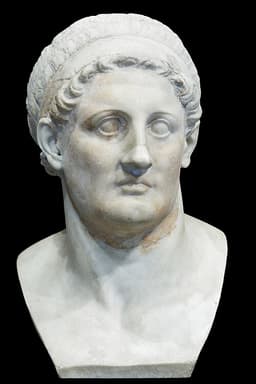
Ptolemy I Soter
Emperor · Ancient
66.2Total

Ramesses III
Emperor · Ancient
57.4Total
Basic Information
Born
-367
-1186
Died
-283
-1155
Era
Ancient
Ancient
Nationality
Egypt
Egypt
Occupation
Emperor
Emperor
Civilization
Middle Eastern
Middle Eastern
Score Comparison
Military (10%)
76.0
61.7
Political (20%)
75.0
68.0
Influence (20%)
40.0
59.0
Legacy (20%)
80.0
50.0
Leadership (15%)
75.0
53.2
Strategy (15%)
61.2
58.0
TOTAL
66.2
57.4
Ptolemy I Soter — Complete Timeline
321 BC
Capture of Alexander's BodyPolitical Action◆ Major
Ptolemy I intercepted the funeral cortege of Alexander the Great and brought his body to Memphis, later to Alexandria. This act legitimized his rule over Egypt and made Alexandria a pilgrimage site, enhancing his prestige among the Diadochi.
DiadochiAlexanderEgypt
Impact: regionalconstructive
312 BC
Battle of GazaWar
Ptolemy I defeated Demetrius Poliorcetes, son of Antigonus I, at Gaza. This victory secured Ptolemy's control over Syria and Palestine temporarily, though he later lost these territories. The battle was part of the ongoing Wars of the Diadochi.
DiadochiBattleEgypt
Impact: regional
305 BC
Foundation of the Ptolemaic DynastyPolitical Action
Ptolemy I Soter declared himself king of Egypt, founding the Ptolemaic dynasty. He established a Greek-speaking monarchy that ruled Egypt for nearly 300 years, blending Greek and Egyptian cultures. His reign began the Hellenistic period in Egypt.
DiadochiEgyptHellenistic
Impact: regionalconstructive
295 BC
Founding of the Library of AlexandriaCultural◆ Major
Ptolemy I established the Library of Alexandria as part of the Musaeum, a center of learning. The library aimed to collect all known Greek works and became the largest and most famous library of the ancient world, fostering scholarship.
EgyptLibraryHellenistic
Impact: globalconstructive
Ramesses III — Complete Timeline
1180 BC
First Libyan WarWar
Ramesses III repelled a Libyan invasion in his fifth year. The Libyans, led by Chief Ternu, were defeated near the western border. This victory was recorded at Medinet Habu and secured Egypt's western frontier for several years.
LibyaInvasionDefense
Impact: regional
1175 BC
Battle of the Delta against the Sea PeoplesWar◆ Major
Ramesses III defeated a coalition of Sea Peoples who invaded Egypt by land and sea. The Egyptian navy used archers and grappling hooks to repel the invaders in the Nile Delta. This victory preserved Egypt's independence and marked the last major defense of the New Kingdom.
Sea PeoplesNaval BattleDefense
Impact: global
1170 BC
Construction of Medinet Habu mortuary templeCultural◆ Major
Ramesses III built his mortuary temple at Medinet Habu on the west bank of Thebes. The temple complex covers 7.5 hectares and includes reliefs depicting his military victories, including the Sea Peoples battle. It is one of the best-preserved temples of the New Kingdom.
ArchitectureTempleThebes
Impact: regionalconstructive
1155 BC
Harem conspiracy assassination attemptPolitical Action◆ Major
A harem conspiracy led by Queen Tiye and Prince Pentaweret attempted to assassinate Ramesses III. The plot involved palace officials and magicians. The conspiracy was discovered and the perpetrators were tried and executed. Ramesses III died shortly after, possibly from the attack.
ConspiracyAssassinationPalace
Impact: nationaldestructive
Expert Analysis
Origins
Ptolemy I Soter was born in 367 BCE in Macedonia, son of Arsinoe and Lagus, a nobleman. He was a childhood friend and trusted general of Alexander the Great, serving as a bodyguard and commander during the Asian campaigns. His education included Greek philosophy and military tactics under Aristotle's tutelage. After Alexander's death in 323 BCE, Ptolemy secured the satrapy of Egypt, using his administrative skills and strategic acumen to build a power base.
Ramesses III was born around 1217 BCE, the second son of Pharaoh Setnakhte, founder of the 20th Dynasty. His family background was not royal; his father seized the throne during a period of civil unrest. Ramesses III grew up in the royal court at Pi-Ramesses, learning military arts and governance. He ascended the throne in 1186 BCE after his father's death, inheriting an Egypt still recovering from the late Bronze Age collapse.
Rise to Power
Ptolemy rose to prominence as one of Alexander's key generals, commanding troops at the Battle of Issus (333 BCE) and Gaugamela (331 BCE). After Alexander's death, he was appointed satrap of Egypt in 323 BCE, a position he fortified by eliminating rivals and winning local support. In 321 BCE, he intercepted Alexander's funeral cortege and brought the body to Memphis, using it to legitimize his rule. He defeated Perdiccas, the regent, in 320 BCE, securing Egypt's independence. By 305 BCE, Ptolemy declared himself king, founding the Ptolemaic dynasty.
Ramesses III rose to power as the second pharaoh of the 20th Dynasty after his father's brief reign. He faced immediate challenges: Libyan incursions and the Sea Peoples' migrations. In his fifth year (1181 BCE), he repelled a Libyan invasion, and in his eighth year (1178 BCE), he confronted the Sea Peoples at the Battle of the Delta. His naval and land victories preserved Egypt's sovereignty, earning him a reputation as a military savior.
Leadership & Governance
Ptolemy I ruled Egypt with a blend of Greek and Egyptian traditions. He established a Greek-speaking bureaucracy, but also respected local customs, presenting himself as a pharaoh. He founded the Library of Alexandria and the Musaeum, attracting scholars like Euclid and Hecataeus of Abdera. His governance focused on economic stability, promoting trade and agriculture. He minted coins with his image, a Greek practice, while also building temples to Egyptian gods. Politically, he scored 75.0, reflecting his ability to maintain power and establish a dynasty.
Ramesses III governed as a traditional pharaoh, emphasizing military preparedness and monumental building. He constructed the Medinet Habu temple complex, which served as an administrative center and propaganda tool. He organized Egypt into administrative districts, collected taxes, and maintained a standing army. However, his reign saw economic decline due to the costs of defense and construction. He scored 68.0 in political leadership, indicating competence but less innovation than Ptolemy.
Triumph & Tragedy
Ptolemy's greatest triumph was founding the Ptolemaic dynasty, which lasted nearly 300 years. His establishment of the Library of Alexandria made the city a center of learning, influencing Western thought. He also captured Alexander's body, boosting his legitimacy. However, his military score of 76.0 reflects successes like the Battle of Gaza (312 BCE), but also setbacks: he failed to fully control Syria and Palestine, losing them to Antigonus and later Seleucus. His ambition to expand was checked by rivals.
Ramesses III's triumph was defeating the Sea Peoples, preserving Egypt during a period of widespread collapse. His military score of 61.7 acknowledges this victory, but also his limited offensive campaigns. His tragedy was the harem conspiracy, where his wife Tiye and son Pentaweret attempted to assassinate him. The plot succeeded in part; Ramesses III was killed, and the trial records show a palace in turmoil. His reign ended in decline, with economic troubles and tomb robberies plaguing Egypt.
Character & Destiny
Ptolemy was pragmatic and strategic, known for his caution and patience. He avoided overreaching, consolidating power in Egypt rather than pursuing Alexander's dream of a unified empire. His character shaped his destiny: he died naturally in 283 BCE at age 84, passing a stable kingdom to his son. Historical assessments by Diodorus Siculus and Plutarch highlight his intelligence and moderation.
Ramesses III was a military leader but also a victim of his circumstances. He faced existential threats and internal plots. His character, as depicted in reliefs, shows a warrior pharaoh, but his decision-making was reactive. The harem conspiracy reveals a court rife with intrigue. He was assassinated around 1155 BCE, his legacy tarnished by the decline that followed. Scholars note his reign as the last peak of New Kingdom Egypt.
Legacy
Ptolemy's legacy is immense. He founded a dynasty that produced Cleopatra VII, and his Library of Alexandria became a symbol of knowledge. His blending of Greek and Egyptian cultures created the Hellenistic civilization. In scoring, he scored 80.0 in legacy, reflecting his enduring impact on science, philosophy, and governance. The Ptolemaic system of rule influenced later empires.
Ramesses III's legacy is more contained. He is remembered as the last great pharaoh, his temple at Medinet Habu a testament to his victories. However, his reign did not reverse Egypt's decline. His legacy score of 50.0 reflects a significant but limited impact: he delayed collapse but could not prevent it. Modern historians view him as a capable defender, but not a founder of lasting institutions.
Conclusion
Ptolemy I Soter had greater impact than Ramesses III. With a total score of 66.2 against Ramesses' 57.4, Ptolemy excelled in political, military, and legacy metrics. He founded a dynasty and an institution—the Library of Alexandria—that shaped Western civilization. Ramesses III, while a skilled defender, left no equivalent innovation; his victories were defensive, and his reign ended in assassination and decline. Ptolemy's strategic foresight and cultural contributions outweigh Ramesses' military successes. Thus, Ptolemy emerges as the more consequential figure.
Rankings
🥇
Ptolemy I SoterLeader
Mil: 76.0Pol: 75.0Inf: 40.0
66.2
🥈
Ramesses III
Mil: 61.7Pol: 68.0Inf: 59.0
57.4
+8.8 behind
How This Comparison Works
Algorithm
Each figure is scored on 6 dimensions (0—100 scale) based on structured historical data: Military (10%), Political (20%), Influence (20%), Legacy (20%), Leadership (15%), Strategy (15%). The weighted total produces the final ranking.
Data Sources
Scores are computed from structured sub-indicators in the database. Scale factors adjust for era (Ancient ×0.85, Modern ×1.0) and civilization size (Eastern ×1.05, Other ×0.80) to account for differences in population and military scale.
Maximum 3 Figures
Comparisons are limited to 2—3 figures to ensure readability and statistical meaningfulness.
Error Margins
±5 points per dimension — Sub-scores are derived from historical records with inherent uncertainty. Two figures within 5 points on a dimension should be considered roughly equivalent in that area.
Total Score Accuracy
±3 points overall — The weighted combination of 6 dimensions produces a total score with approximately ±3 points of uncertainty. Differences of less than 3 points are not statistically significant— the figures are effectively tied.
Known Limitations
- Historical records are incomplete and uneven across civilizations
- Figures from oral-tradition societies may be underrepresented
- Occupation labels can misclassify multi-role figures
- Scores measure capability and impact, not moral character
- Quantitative scoring is a comparison tool, not absolute truth
Capability Radar
Military (10%) — Battles & Warfare
Battles
75
70
Win Rate
70
75
Expansion
85
50
Political (20%) — Governance & Reform
Reform
80
55
Diplomacy
85
60
Economy
90
60
Influence (20%) — Cultural & Global Reach
Cultural
85
60
Global
80
55
Legacy (20%) — Historical Impact
Historical
90
65
Longevity
85
60
Leadership (15%) — Power & Stability
Tenure
85
65
Stability
80
55
Strategy (15%) — Tactics & Innovation
Strategy
80
65
Tactics
65
70
Reform
60
60
Similar Comparisons
Comments & Discussion
No comments yet. Be the first to share your thoughts!