Loading...
This comparison has not been analyzed yet.
One-time AI generation (~1 minute). Scores and timeline are already available below.
Prithvi Narayan Shah vs Titu Cusi Yupanqui
Prithvi Narayan Shah leads by 10.3 pts · 2 figures compared
…
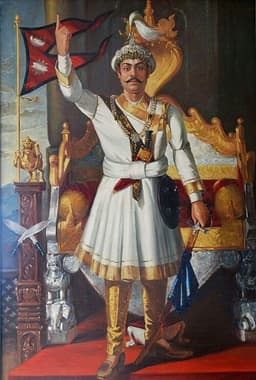
Prithvi Narayan Shah
Emperor · Modern
61.9Total
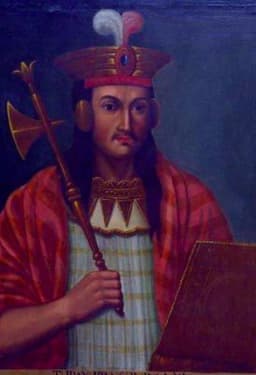
Titu Cusi Yupanqui
Emperor · Modern
51.6Total
Basic Information
Born
1723
1529
Died
1775
1571
Era
Modern
Modern
Nationality
Nepal
Inca Empire
Occupation
Emperor
Emperor
Civilization
Indian
Western
Score Comparison
Military (10%)
70.0
50.0
Political (20%)
72.0
46.6
Influence (20%)
55.0
54.1
Legacy (20%)
58.0
45.0
Leadership (15%)
72.0
65.7
Strategy (15%)
51.0
50.0
TOTAL
61.9
51.6
Prithvi Narayan Shah — Complete Timeline
1767 AD
Battle of KirtipurWar◆ Major
Prithvi Narayan Shah's forces captured the strategic town of Kirtipur after a prolonged siege. The victory was crucial for controlling the Kathmandu Valley and demonstrated his military strategy, though it involved heavy casualties on both sides.
SiegeMilitary CampaignGorkha Conquest
Impact: regional
1768 AD
Unification of NepalWar
Prithvi Narayan Shah conquered the Kathmandu Valley, defeating the Malla kingdoms of Kathmandu, Patan, and Bhaktapur. This victory unified the valley under his rule and marked the foundation of the modern state of Nepal.
ConquestUnificationKathmandu Valley
Impact: regionalconstructive
1769 AD
Proclamation of the Kingdom of NepalPolitical Action
After unifying the Kathmandu Valley, Prithvi Narayan Shah proclaimed the Kingdom of Nepal, with Kathmandu as its capital. He established the Shah dynasty, which ruled Nepal until 2008, and laid the administrative foundations of the state.
Foundation of NepalShah DynastyState Formation
Impact: regionalconstructive
1774 AD
Divyopadesh (Divine Counsel)Cultural◆ Major
Prithvi Narayan Shah delivered the Divyopadesh, a set of political and strategic instructions to his successors. The counsel emphasized nationalism, self-reliance, and the importance of maintaining Nepal's independence from British India and China.
Political TestamentNationalismForeign Policy
Impact: nationalconstructive
Titu Cusi Yupanqui — Complete Timeline
1561 AD
Coronation as Sapa Inca of VilcabambaPolitical Action◆ Major
Titu Cusi Yupanqui succeeded his brother Sayri Tupac as the ruler of the Neo-Inca state in Vilcabamba. He revived resistance against Spanish rule, refusing to accept Spanish authority and maintaining an independent Inca kingdom.
CoronationVilcabambaInca
Impact: regional
1568 AD
Negotiations with Spanish EnvoysPolitical Action
Titu Cusi Yupanqui engaged in negotiations with Spanish envoys, including the viceroy's representatives, seeking a peace treaty. The talks failed due to mutual distrust, and Titu Cusi continued guerrilla warfare against Spanish settlements.
NegotiationPeaceInca
Impact: regional
1570 AD
Dictation of the 'Instrucción al Rey'Cultural◆ Major
Titu Cusi Yupanqui dictated a chronicle to Spanish missionary Fray Marcos Garc
ChronicleIncaSpanish
Impact: regional
1571 AD
Death of Titu Cusi YupanquiOther◆ Major
Titu Cusi Yupanqui died suddenly, possibly from illness or poisoning. His death led to the succession of his brother Tupac Amaru, who was later captured and executed by the Spanish, ending the Vilcabamba resistance.
DeathSuccessionInca
Impact: regionaltragic
This comparison has not been analyzed yet.
One-time AI generation (~1 minute). Scores and timeline are already available below.
Rankings
🥇
Prithvi Narayan ShahLeader
Mil: 70.0Pol: 72.0Inf: 55.0
61.9
🥈
Titu Cusi Yupanqui
Mil: 50.0Pol: 46.6Inf: 54.1
51.6
+10.3 behind
How This Comparison Works
Algorithm
Each figure is scored on 6 dimensions (0—100 scale) based on structured historical data: Military (10%), Political (20%), Influence (20%), Legacy (20%), Leadership (15%), Strategy (15%). The weighted total produces the final ranking.
Data Sources
Scores are computed from structured sub-indicators in the database. Scale factors adjust for era (Ancient ×0.85, Modern ×1.0) and civilization size (Eastern ×1.05, Other ×0.80) to account for differences in population and military scale.
Maximum 3 Figures
Comparisons are limited to 2—3 figures to ensure readability and statistical meaningfulness.
Error Margins
±5 points per dimension — Sub-scores are derived from historical records with inherent uncertainty. Two figures within 5 points on a dimension should be considered roughly equivalent in that area.
Total Score Accuracy
±3 points overall — The weighted combination of 6 dimensions produces a total score with approximately ±3 points of uncertainty. Differences of less than 3 points are not statistically significant— the figures are effectively tied.
Known Limitations
- Historical records are incomplete and uneven across civilizations
- Figures from oral-tradition societies may be underrepresented
- Occupation labels can misclassify multi-role figures
- Scores measure capability and impact, not moral character
- Quantitative scoring is a comparison tool, not absolute truth
Capability Radar
Military (10%) — Battles & Warfare
Battles
55
25
Win Rate
60
20
Expansion
60
10
Political (20%) — Governance & Reform
Reform
60
30
Diplomacy
65
50
Economy
50
20
Influence (20%) — Cultural & Global Reach
Cultural
60
35
Global
45
20
Legacy (20%) — Historical Impact
Historical
65
40
Longevity
60
30
Leadership (15%) — Power & Stability
Tenure
55
40
Stability
55
25
Strategy (15%) — Tactics & Innovation
Strategy
65
25
Tactics
58
30
Reform
50
15
Similar Comparisons
Comments & Discussion
No comments yet. Be the first to share your thoughts!