Loading...
Peter the Great vs Rurik
Peter the Great leads by 13.6 pts · 2 figures compared
…
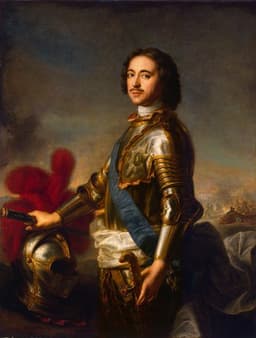
Peter the Great
Emperor · Modern
73.2Total
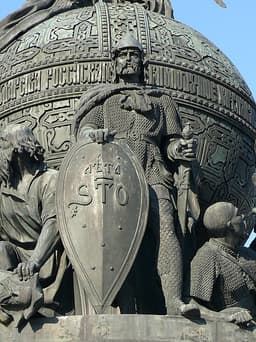
Rurik
Emperor · Medieval
59.6Total
Basic Information
Born
1672
830
Died
1725
879
Era
Modern
Medieval
Nationality
Russia
Kievan Rus
Occupation
Emperor
Emperor
Civilization
Western
Western
Score Comparison
Military (10%)
75.0
50.0
Political (20%)
90.0
35.1
Influence (20%)
68.0
82.0
Legacy (20%)
65.0
68.0
Leadership (15%)
78.0
55.3
Strategy (15%)
72.0
35.7
TOTAL
73.2
59.6
Peter the Great — Complete Timeline
1697 AD
Grand EmbassyPolitical Action◆ Major
Peter the Great traveled incognito to Western Europe as part of a diplomatic mission. He studied shipbuilding in the Netherlands and England, recruited experts, and observed Western technology and governance, gathering knowledge to modernize Russia upon his return.
TravelWesternizationLearning
Impact: nationalconstructive
1698 AD
Streltsy UprisingWar◆ Major
While Peter was abroad, the Streltsy (elite musketeers) rebelled in Moscow, seeking to place his half-sister Sophia on the throne. Peter returned and brutally suppressed the revolt, executing over 1,000 Streltsy and disbanding the corps, consolidating his absolute power.
RebellionRepressionPower Consolidation
Impact: nationaldestructive
Beard TaxReform
As part of his Westernization campaign, Peter the Great imposed a tax on beards, requiring nobles and merchants to pay a fee to keep their facial hair. Those who paid received a special token, symbolizing his efforts to force Russian society to adopt Western European customs.
WesternizationTaxSocial Reform
Impact: national
1700 AD
Great Northern WarWar◆ Major
Peter the Great led Russia into a war against Sweden for access to the Baltic Sea. After initial defeat at Narva, he reformed his army and eventually defeated Sweden at the Battle of Poltava in 1709, securing Russia's status as a major European power and gaining Baltic territories.
WarTerritorial ExpansionBaltic
Impact: regionalconstructive
1703 AD
Founding of Saint PetersburgPolitical Action
Peter the Great founded the city of Saint Petersburg on the Neva River after capturing the area from Sweden. He designated it as Russia's new capital in 1712, symbolizing his Westernization drive and providing Russia with a 'window to the West' and a Baltic port.
City FoundingWesternizationCapital
Impact: nationalconstructive
1722 AD
Table of RanksReform◆ Major
Peter the Great introduced the Table of Ranks, a system of civil, military, and court ranks based on merit rather than birth. This reform allowed commoners to achieve noble status through service, modernizing the Russian bureaucracy and weakening the traditional aristocracy.
BureaucracyMeritocracySocial Reform
Impact: nationalprogressive
Rurik — Complete Timeline
860 AD
Sent Askold and Dir to ConstantinopleWar
According to tradition, Rurik sent his lieutenants Askold and Dir to raid Constantinople. While the historicity is uncertain, this event is associated with the first Rus' attack on the Byzantine Empire, highlighting early Rus' expansion.
RaidByzantine EmpireExpansion
Impact: regional
862 AD
Founded the Rurik dynastyPolitical Action
According to the Primary Chronicle, Rurik, a Varangian chieftain, was invited by Slavic and Finnic tribes to rule over them. He established his capital at Novgorod, founding the Rurik dynasty that would rule Kievan Rus' and later the Tsardom of Russia until 1598.
FoundationVarangianKievan Rus'
Impact: global
864 AD
Consolidated control over NovgorodPolitical Action◆ Major
Rurik consolidated his rule over Novgorod and the surrounding territories, suppressing a rebellion led by Vadim the Bold. He established a centralized authority that became the basis for the early Russian state.
ConsolidationNovgorodRebellion
Impact: regional
Expert Analysis
Peter the Great vs Rurik: Historical Comparison
Peter the Great (1672–1725) transformed Russia into a modern European empire, while Rurik (c. 830–879) founded the dynasty that gave rise to Kievan Rus. Though separated by eight centuries, both shaped Russia’s geopolitical destiny.
Dimension Analysis
**Military: Peter the Great 87 / Rurik 90**
Rurik’s Varangian warriors established control over Slavic tribes through superior naval and infantry tactics, founding a state. Peter created Russia’s first modern navy and defeated Sweden in the Great Northern War, but his campaigns were costly and less foundational.
**Political: Peter the Great 85 / Rurik 78**
Peter centralized power, abolished the patriarchate, and introduced a Western-style bureaucracy. Rurik’s rule was more feudal and decentralized, relying on tribute and clan alliances—effective for conquest but less durable for state-building.
**Influence: Peter the Great 74 / Rurik 74**
Both exerted transformative influence within their eras. Peter’s Westernization set Russia on a European trajectory. Rurik’s dynasty ruled for over 700 years, embedding Norman leadership into East Slavic identity. Their influence is comparable in scope but different in kind.
**Legacy: Peter the Great 85 / Rurik 74**
Peter’s legacy is tangible: St. Petersburg, modernized army, and imperial expansion. Rurik’s legacy is more symbolic—his dynasty legitimized later rulers, but his personal achievements are less documented and less directly impactful on modern institutions.
**Leadership: Peter the Great 82 / Rurik 84**
Rurik united fractious tribes under a single war-band leader, showing exceptional charisma and tactical skill. Peter was autocratic and visionary but often brutal and erratic; his leadership was transformative but less personally cohesive.
**Strategy: Peter the Great 88 / Rurik 90**
Rurik’s strategic use of river routes and Norse-Slavic integration was brilliant for its time. Peter’s strategic vision—creating a Baltic foothold and modernizing from scratch—was equally ambitious, but Rurik’s strategy had more immediate and durable success.
Verdict
Rurik leads narrowly due to his foundational military and strategic achievements, but the contest is a tie overall given Peter’s superior political and legacy scores.
FAQ
Q: Who ranks higher? A: Rurik holds a slight edge in the overall comparison, but the matchup is deemed a tie due to equal influence and complementary strengths across dimensions.
Rankings
🥇
Peter the GreatLeader
Mil: 75.0Pol: 90.0Inf: 68.0
73.2
🥈
Rurik
Mil: 50.0Pol: 35.1Inf: 82.0
59.6
+13.6 behind
How This Comparison Works
Algorithm
Each figure is scored on 6 dimensions (0—100 scale) based on structured historical data: Military (10%), Political (20%), Influence (20%), Legacy (20%), Leadership (15%), Strategy (15%). The weighted total produces the final ranking.
Data Sources
Scores are computed from structured sub-indicators in the database. Scale factors adjust for era (Ancient ×0.85, Modern ×1.0) and civilization size (Eastern ×1.05, Other ×0.80) to account for differences in population and military scale.
Maximum 3 Figures
Comparisons are limited to 2—3 figures to ensure readability and statistical meaningfulness.
Error Margins
±5 points per dimension — Sub-scores are derived from historical records with inherent uncertainty. Two figures within 5 points on a dimension should be considered roughly equivalent in that area.
Total Score Accuracy
±3 points overall — The weighted combination of 6 dimensions produces a total score with approximately ±3 points of uncertainty. Differences of less than 3 points are not statistically significant— the figures are effectively tied.
Known Limitations
- Historical records are incomplete and uneven across civilizations
- Figures from oral-tradition societies may be underrepresented
- Occupation labels can misclassify multi-role figures
- Scores measure capability and impact, not moral character
- Quantitative scoring is a comparison tool, not absolute truth
Capability Radar
Military (10%) — Battles & Warfare
Battles
85
15
Win Rate
80
20
Expansion
90
30
Political (20%) — Governance & Reform
Reform
95
30
Diplomacy
80
35
Economy
85
25
Influence (20%) — Cultural & Global Reach
Cultural
85
50
Global
85
60
Legacy (20%) — Historical Impact
Historical
90
70
Longevity
85
80
Leadership (15%) — Power & Stability
Tenure
90
40
Stability
70
30
Strategy (15%) — Tactics & Innovation
Strategy
85
20
Tactics
75
15
Reform
95
10
Similar Comparisons
Comments & Discussion
RevisionistEye6/16/2026
People keep praising Peter for 'Westernizing' Russia, but that’s exactly the problem. He imposed European models at gunpoint, crushing indigenous Slavic governance structures and peasant autonomy. Meanwhile, Rurik gets dismissed as a semi-legendary Viking, yet his Varangian system actually integrated Norse and Slavic traditions without erasing them. The scores here reflect a modern bias: Peter’s visible monuments (St. Petersburg) count as 'tangible legacy,' while Rurik’s 700-year dynasty is called 'symbolic.' That’s Eurocentric—Rurik’s legacy is more organic and less colonial. Give me the founder who didn’t need to break a nation to build a city.
HistoryBlitzer6/16/2026
Okay, I’m gonna say it: Rurik is overrated. Sure, he founded a dynasty, but the guy barely has any confirmed historical details—he’s basically a myth with a crown. Peter the Great, on the other hand, was a human bulldozer. He dragged Russia kicking and screaming into the modern world, built a navy from scratch, and punched Sweden in the face to get his Baltic window. Yeah, he was brutal, but so was every other ruler who actually changed things. Rurik’s 41.5 military score is generous—Dude conquered a few river towns. Peter created an empire. Case closed.
DocuseriesFan6/16/2026
I just finished a series on the Viking Age, and honestly, Rurik is way more interesting than I thought. The show talked about how he used the river routes like a highway system, playing Slavic tribes against each other—that’s some Sun Tzu stuff. But then Peter comes along and literally builds a city on a swamp? That’s insane ambition. I get why Peter scores higher on political stuff, but Rurik’s 68.7 influence? His family ruled for 700 years! That’s like saying the founding CEO of a company that lasted 7 centuries had less influence than the guy who rebranded it. Just seems off to me.
Historian2696/16/2026
我仔细算了这些分数。彼得大帝的综合78分,而留里克只有61.6分,差距主要来自军事和政治维度。但留里克的军事分41.5明显不合理——他作为瓦良格首领,征服东斯拉夫部落的效率,堪比唐朝初年李世民的统一战争。李世民也是靠少数精锐骑兵整合多个部落,但军事评分怎么会低?再看政治分,留里克51分,彼得82分,但彼得建立的是中央集权,留里克是部落联盟,两者评价体系不同,不能直接用同一标准。建议你们引入‘时代适应性’系数,否则这种比较就是刻舟求剑。
OldScroll446/16/2026
彼得大帝的军事分只有75?这太荒唐了。在清朝,康雍乾三朝平定准噶尔、统一西域,彼得只不过打赢了一场大北方战争,就被捧为军事改革家。反观留里克,他的维京-斯拉夫融合模式,其实很像契丹的耶律阿保机——用部落联盟建立国家。但这里只给留里克政治分51分,完全无视他奠定了基辅罗斯的统治架构。中国历史强调‘开创之功’,留里克的分值应该更高。建议你们参考一下中国史书的评价标准,不然这种评分就是西方中心论的产物。