Loading...
This comparison has not been analyzed yet.
One-time AI generation (~1 minute). Scores and timeline are already available below.
Pelagius of Asturias vs Tizoc
Pelagius of Asturias leads by 9.4 pts · 2 figures compared
…
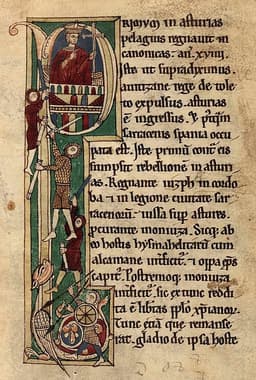
Pelagius of Asturias
Emperor · Medieval
46.0Total

Tizoc
Emperor · Medieval
36.6Total
Basic Information
Born
685
1430
Died
737
1486
Era
Medieval
Medieval
Nationality
Asturias
Aztec Empire
Occupation
Emperor
Emperor
Civilization
Western
Western
Score Comparison
Military (10%)
50.0
21.2
Political (20%)
26.4
30.7
Influence (20%)
55.7
46.3
Legacy (20%)
50.0
36.7
Leadership (15%)
41.5
34.6
Strategy (15%)
43.7
39.6
TOTAL
46.0
36.6
Pelagius of Asturias — Complete Timeline
718 AD
Elected first King of AsturiasPolitical Action◆ Major
Following the Umayyad conquest of the Visigothic Kingdom, Pelagius was elected as the first king of the Asturian kingdom by local nobles. This act formalized the Christian resistance and established a new political entity in northern Iberia.
KingshipAsturiasReconquista
Impact: regionalconstructive
722 AD
Battle of CovadongaWar
Pelagius led a small force of Asturian and Visigothic rebels against an Umayyad army at Covadonga. The Christian victory is traditionally considered the beginning of the Reconquista, establishing the Kingdom of Asturias as a center of resistance against Muslim rule in Iberia.
ReconquistaBattleAsturiasUmayyad
Impact: regionalconstructive
725 AD
Consolidated Asturian control over the Cantabrian regionWar
After Covadonga, Pelagius expanded and consolidated Asturian control over the Cantabrian mountains and adjacent territories. He established a defensive buffer zone against Umayyad raids, securing the survival of the nascent Christian kingdom.
Territorial ExpansionAsturiasReconquista
Impact: regionalconstructive
Tizoc — Complete Timeline
1481 AD
Coronation as Tlatoani of TenochtitlanPolitical Action◆ Major
Tizoc succeeded his brother Axayacatl as the seventh tlatoani of Tenochtitlan. His coronation was marked by a limited military campaign to capture victims for sacrifice, but the campaign yielded few prisoners, signaling weakness.
CoronationTenochtitlanAztec
Impact: national
1482 AD
Unsuccessful Campaign against the MatlatzincaWar◆ Major
Tizoc launched a military campaign against the Matlatzinca people of the Toluca Valley. The campaign resulted in few captives and was considered a failure, damaging Tizoc's reputation and the Aztec military's prestige.
Military FailureMatlatzincaAztec
Impact: regionaldestructive
1484 AD
Construction of the Tizoc StoneCultural
Tizoc commissioned the carving of a large stone monument, known as the Stone of Tizoc, depicting his military victories and those of his predecessors. The stone, now in the National Museum of Anthropology, served as a propaganda tool to bolster his image.
MonumentPropagandaAztec Art
Impact: national
1486 AD
Assassination of TizocPolitical Action◆ Major
Tizoc died under suspicious circumstances, possibly poisoned by his own nobles or by his successor Ahuitzotl. His death ended a short and ineffective reign, and he was succeeded by his brother Ahuitzotl, who restored Aztec military dominance.
AssassinationSuccessionAztec
Impact: nationaltragic
This comparison has not been analyzed yet.
One-time AI generation (~1 minute). Scores and timeline are already available below.
Rankings
🥇
Pelagius of AsturiasLeader
Mil: 50.0Pol: 26.4Inf: 55.7
46.0
🥈
Tizoc
Mil: 21.2Pol: 30.7Inf: 46.3
36.6
+9.4 behind
How This Comparison Works
Algorithm
Each figure is scored on 6 dimensions (0—100 scale) based on structured historical data: Military (10%), Political (20%), Influence (20%), Legacy (20%), Leadership (15%), Strategy (15%). The weighted total produces the final ranking.
Data Sources
Scores are computed from structured sub-indicators in the database. Scale factors adjust for era (Ancient ×0.85, Modern ×1.0) and civilization size (Eastern ×1.05, Other ×0.80) to account for differences in population and military scale.
Maximum 3 Figures
Comparisons are limited to 2—3 figures to ensure readability and statistical meaningfulness.
Error Margins
±5 points per dimension — Sub-scores are derived from historical records with inherent uncertainty. Two figures within 5 points on a dimension should be considered roughly equivalent in that area.
Total Score Accuracy
±3 points overall — The weighted combination of 6 dimensions produces a total score with approximately ±3 points of uncertainty. Differences of less than 3 points are not statistically significant— the figures are effectively tied.
Known Limitations
- Historical records are incomplete and uneven across civilizations
- Figures from oral-tradition societies may be underrepresented
- Occupation labels can misclassify multi-role figures
- Scores measure capability and impact, not moral character
- Quantitative scoring is a comparison tool, not absolute truth
Capability Radar
Military (10%) — Battles & Warfare
Battles
15
15
Win Rate
20
10
Expansion
15
5
Political (20%) — Governance & Reform
Reform
20
10
Diplomacy
25
15
Economy
15
10
Influence (20%) — Cultural & Global Reach
Cultural
40
10
Global
35
5
Legacy (20%) — Historical Impact
Historical
55
10
Longevity
50
10
Leadership (15%) — Power & Stability
Tenure
30
30
Stability
20
10
Strategy (15%) — Tactics & Innovation
Strategy
20
10
Tactics
25
10
Reform
10
5
Similar Comparisons
Comments & Discussion
No comments yet. Be the first to share your thoughts!