Loading...
Pelagius of Asturias vs Philip VI of France
Philip VI of France leads by 4.1 pts · 2 figures compared
…
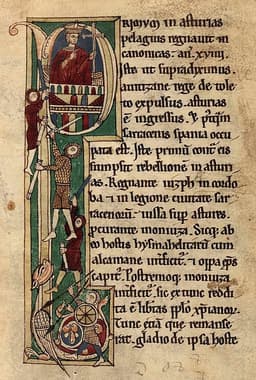
Pelagius of Asturias
Emperor · Medieval
46.0Total

Philip VI of France
Emperor · Medieval
50.1Total
Basic Information
Born
685
1293
Died
737
1350
Era
Medieval
Medieval
Nationality
Asturias
France
Occupation
Emperor
Emperor
Civilization
Western
Western
Score Comparison
Military (10%)
50.0
38.3
Political (20%)
26.4
35.1
Influence (20%)
55.7
55.7
Legacy (20%)
50.0
49.2
Leadership (15%)
41.5
58.8
Strategy (15%)
43.7
60.0
TOTAL
46.0
50.1
Pelagius of Asturias — Complete Timeline
718 AD
Elected first King of AsturiasPolitical Action◆ Major
Following the Umayyad conquest of the Visigothic Kingdom, Pelagius was elected as the first king of the Asturian kingdom by local nobles. This act formalized the Christian resistance and established a new political entity in northern Iberia.
KingshipAsturiasReconquista
Impact: regionalconstructive
722 AD
Battle of CovadongaWar
Pelagius led a small force of Asturian and Visigothic rebels against an Umayyad army at Covadonga. The Christian victory is traditionally considered the beginning of the Reconquista, establishing the Kingdom of Asturias as a center of resistance against Muslim rule in Iberia.
ReconquistaBattleAsturiasUmayyad
Impact: regionalconstructive
725 AD
Consolidated Asturian control over the Cantabrian regionWar
After Covadonga, Pelagius expanded and consolidated Asturian control over the Cantabrian mountains and adjacent territories. He established a defensive buffer zone against Umayyad raids, securing the survival of the nascent Christian kingdom.
Territorial ExpansionAsturiasReconquista
Impact: regionalconstructive
Philip VI of France — Complete Timeline
1328 AD
Accession as First Valois KingPolitical Action◆ Major
Upon the death of Charles IV, Philip VI became king of France as the first of the Valois dynasty. His claim was based on Salic law, which excluded female succession. This accession was contested by Edward III of England, leading to the Hundred Years' War.
DynastySuccessionValois
Impact: regional
1340 AD
Battle of SluysWar◆ Major
Philip VI's French fleet was destroyed by the English navy at Sluys. The English victory gave them control of the English Channel and allowed them to invade France. This naval battle was a major setback for Philip and a key early engagement of the Hundred Years' War.
Naval BattleHundred Years' WarEnglish Channel
Impact: regionaldestructive
1346 AD
Battle of CrécyWar
Philip VI's army was decisively defeated by Edward III at Cr
BattleLongbowHundred Years' War
Impact: regionaldestructive
1348 AD
Black Death Arrives in FranceOther◆ Major
The bubonic plague reached France during Philip VI's reign, causing massive population loss. The pandemic disrupted the economy, weakened the monarchy, and led to social unrest. Philip's government struggled to respond effectively to the crisis.
PlaguePandemicPopulation Loss
Impact: globaltragic
Expert Analysis
Origins
Pelagius of Asturias (c. 685–737) was a Visigothic nobleman, likely of royal blood, who fled the Umayyad conquest of Hispania. His early life is obscure, but he was probably from the Cantabrian region and had served under King Roderic. After the Muslim invasion, he retreated to the mountains of Asturias. Philip VI of France (1293–1350) was born into the Capetian dynasty's cadet branch, the House of Valois. His father was Charles of Valois, a younger son of Philip III. Philip VI inherited the French throne in 1328 upon the death of his cousin Charles IV, under the Salic law that excluded Edward III of England.
Rise to Power
Pelagius rose to prominence as a leader of resistance against Umayyad rule. In 718 or 722, he was elected king by local Asturian nobles, formalizing the rebellion. His pivotal moment came at the Battle of Covadonga (c. 722), where his small force of about 300 men ambushed and defeated a much larger Umayyad army in a narrow valley. This victory is traditionally considered the start of the Reconquista. Philip VI's accession was smoother but contested. He became regent for the pregnant queen of Charles IV, and when she gave birth to a daughter, he claimed the throne under Salic law. Edward III of England, as a grandson of Philip IV, initially paid homage but later challenged Philip's legitimacy, triggering the Hundred Years War in 1337.
Leadership & Governance
Pelagius ruled a small, mountainous kingdom with a military focus. He established a defensive buffer zone, consolidating control over the Cantabrian region through alliances with local chieftains. His governance was rudimentary, relying on personal authority and tribal support. Philip VI governed a large, centralized monarchy. He expanded royal administration, increased taxation for war, and relied on the nobility. His leadership was tested by the Hundred Years War, where he scored 38.3 in military compared to Pelagius's 50.0. Philip's political score of 35.1 reflects his struggles, while Pelagius's 26.4 shows his limited political structure.
Triumph & Tragedy
Pelagius's greatest triumph was the victory at Covadonga, which secured the independence of Asturias and inspired future Christian kingdoms. His failure was the inability to expand significantly; he died with his realm still confined to the mountains. Philip VI's triumph was establishing the Valois dynasty, which ruled France for centuries. His tragedies include the devastating defeat at Crécy (1346) and the loss of the French fleet at Sluys (1340). The Black Death arrived in 1348, exacerbating his reign's turmoil. His legacy score of 49.2 is close to Pelagius's 50.0, but Philip's total score of 50.1 slightly edges Pelagius's 46.0.
Character & Destiny
Pelagius was determined and strategic, using terrain to his advantage. His leadership score of 41.5 reflects his ability to inspire loyalty in harsh conditions. His destiny was to be a symbol of resistance. Philip VI was cautious but prone to tactical errors, as shown at Crécy where he attacked without proper reconnaissance. His strategy score of 60.0 is higher than Pelagius's 43.7, but his leadership score of 58.8 contrasts with his military failures. Historians view Philip as a competent administrator but a poor commander.
Legacy
Pelagius is revered as the founder of the Reconquista and the first king of Asturias. His legacy is commemorated in Spanish nationalism and the origin of the Christian reconquest. Philip VI's legacy is mixed: he began the Hundred Years War and established the Valois dynasty, but his reign saw military defeats and the Black Death. Both scored 55.7 in influence, but Pelagius's symbolic impact on Spanish history is profound. Philip's political and military scores (35.1 and 38.3) are lower than Pelagius's military (50.0) but higher in leadership (58.8 vs 41.5).
Conclusion
While Philip VI has a higher total score (50.1 vs 46.0), Pelagius's impact on the course of history is arguably greater. His victory at Covadonga initiated a centuries-long reconquest that reshaped Europe. Philip's reign, despite founding a dynasty, was marked by disasters that weakened France. Pelagius's legacy as a founder of a nation and a symbol of resistance gives him a more enduring influence. Therefore, Pelagius deserves the edge in historical impact.
Rankings
🥇
Philip VI of FranceLeader
Mil: 38.3Pol: 35.1Inf: 55.7
50.1
🥈
Pelagius of Asturias
Mil: 50.0Pol: 26.4Inf: 55.7
46.0
+4.1 behind
How This Comparison Works
Algorithm
Each figure is scored on 6 dimensions (0—100 scale) based on structured historical data: Military (10%), Political (20%), Influence (20%), Legacy (20%), Leadership (15%), Strategy (15%). The weighted total produces the final ranking.
Data Sources
Scores are computed from structured sub-indicators in the database. Scale factors adjust for era (Ancient ×0.85, Modern ×1.0) and civilization size (Eastern ×1.05, Other ×0.80) to account for differences in population and military scale.
Maximum 3 Figures
Comparisons are limited to 2—3 figures to ensure readability and statistical meaningfulness.
Error Margins
±5 points per dimension — Sub-scores are derived from historical records with inherent uncertainty. Two figures within 5 points on a dimension should be considered roughly equivalent in that area.
Total Score Accuracy
±3 points overall — The weighted combination of 6 dimensions produces a total score with approximately ±3 points of uncertainty. Differences of less than 3 points are not statistically significant— the figures are effectively tied.
Known Limitations
- Historical records are incomplete and uneven across civilizations
- Figures from oral-tradition societies may be underrepresented
- Occupation labels can misclassify multi-role figures
- Scores measure capability and impact, not moral character
- Quantitative scoring is a comparison tool, not absolute truth
Capability Radar
Military (10%) — Battles & Warfare
Battles
15
45
Win Rate
20
30
Expansion
15
25
Political (20%) — Governance & Reform
Reform
20
30
Diplomacy
25
35
Economy
15
25
Influence (20%) — Cultural & Global Reach
Cultural
40
30
Global
35
35
Legacy (20%) — Historical Impact
Historical
55
55
Longevity
50
40
Leadership (15%) — Power & Stability
Tenure
30
55
Stability
20
20
Strategy (15%) — Tactics & Innovation
Strategy
20
40
Tactics
25
35
Reform
10
20
Similar Comparisons
Comments & Discussion
No comments yet. Be the first to share your thoughts!