Loading...
Oscar Berger vs Ramiz Alia
Oscar Berger leads by 2.5 pts · 2 figures compared
…
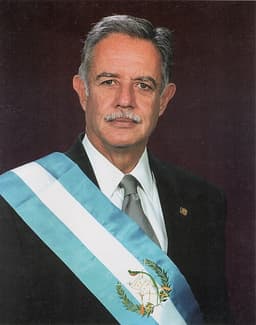
Oscar Berger
Politician · Modern
43.7Total

Ramiz Alia
Politician · Modern
41.2Total
Basic Information
Born
1946
1925
Died
—
—
Era
Modern
Modern
Nationality
Guatemala
Albania
Occupation
Politician
Politician
Civilization
Western
Western
Score Comparison
Military (10%)
49.6
24.9
Political (20%)
36.5
30.8
Influence (20%)
47.1
47.1
Legacy (20%)
36.7
38.3
Leadership (15%)
55.3
58.8
Strategy (15%)
40.3
38.9
TOTAL
43.7
41.2
Oscar Berger — Complete Timeline
2003 AD
Elected President of GuatemalaPolitical Action◆ Major
Berger won the 2003 presidential election as the candidate of the Grand National Alliance, a center-right coalition. He campaigned on anti-corruption and economic development.
ElectionGrand National AllianceGuatemala
Impact: nationalconstructive
2004 AD
Post-war reconstruction and social spendingReform
Berger increased social spending on health and education, and launched programs to rebuild infrastructure damaged during the civil war. However, poverty and inequality remained high.
Social PolicyReconstructionPoverty
Impact: nationalconstructive
2005 AD
Implementation of CAFTA-DRPolitical Action◆ Major
Berger's government ratified and implemented the Dominican Republic-Central America Free Trade Agreement (CAFTA-DR) with the United States, aiming to boost trade and investment.
Trade AgreementCAFTA-DREconomic Policy
Impact: regionalconstructive
Ramiz Alia — Complete Timeline
1985 AD
Became First Secretary of the Party of Labour of AlbaniaPolitical Action◆ Major
Ramiz Alia succeeded Enver Hoxha as First Secretary of the Party of Labour of Albania after Hoxha's death. He inherited a highly isolated and impoverished country with a rigid Stalinist system.
SuccessionCommunist LeadershipAlbania
Impact: national
1990 AD
Initiated Limited ReformsReform◆ Major
Under pressure from economic collapse and student protests, Alia's government introduced limited political and economic reforms, including allowing some private enterprise and ending the ban on religious practice. These were insufficient to prevent the regime's collapse.
ReformLiberalizationCommunist Regime
Impact: national
1992 AD
Resigned as PresidentPolitical Action◆ Major
Following the fall of communism and the victory of the Democratic Party in elections, Ramiz Alia resigned as President. He was later arrested and tried for abuse of power, but was eventually acquitted.
ResignationEnd of CommunismTrial
Impact: national
Expert Analysis
Origins
Oscar Berger was born on August 11, 1946, in Guatemala City into a wealthy family of German descent. His father owned a sugar plantation, providing Berger with a privileged upbringing. He studied law at the Universidad de San Carlos de Guatemala and later managed the family's sugar business, becoming a prominent sugar magnate. This background gave him a strong foothold in the country's economic elite, but limited exposure to grassroots politics.
Ramiz Alia was born on October 18, 1925, in Shkodër, Albania, into a poor Muslim family. Orphaned at a young age, he was raised in a state orphanage. He joined the Communist Party at 16 and studied at the Lenin Institute in Moscow, becoming a devoted follower of Enver Hoxha. His early life was shaped by war and ideology, contrasting sharply with Berger's capitalist upbringing.
Rise to Power
Berger entered politics in the 1990s after Guatemala's civil war ended. He served as mayor of Guatemala City from 1991 to 1999, where he gained a reputation for efficiency and anti-corruption efforts. In 2003, he won the presidency as the candidate of the Grand National Alliance, a center-right coalition, defeating former dictator Efraín Ríos Montt. His rise was facilitated by post-war fatigue and a desire for stability.
Alia rose through the ranks of the Party of Labour of Albania under Hoxha's patronage. He became a member of the Politburo in 1961 and served as President of the People's Assembly. Upon Hoxha's death in 1985, Alia succeeded him as First Secretary, inheriting a crumbling Stalinist state. Unlike Berger, Alia's ascent was within a closed, authoritarian system.
Leadership & Governance
Berger's leadership style was technocratic and business-oriented. He focused on economic liberalization, signing CAFTA-DR in 2005 to boost trade with the US. He increased social spending on health and education, but poverty and inequality remained high. His governance was marked by efforts to consolidate democracy after 36 years of civil war, though his administration faced accusations of corruption.
Alia's leadership was cautious and reactive. He attempted limited reforms to stave off collapse, allowing some private enterprise and political pluralism in 1990-1991. However, he maintained the single-party system until forced by protests to call elections. His governance was constrained by Hoxha's legacy and the isolationist policies that had crippled Albania's economy.
Triumph & Tragedy
Berger's greatest success was stabilizing Guatemala's economy and integrating it into global markets through CAFTA-DR. His social programs reduced extreme poverty from 30% to 26% during his term. However, his failure to address crime and corruption, including scandals in his own party, eroded public trust. The 2005 hurricane Stan exposed infrastructure weaknesses, and his response was criticized.
Alia's major achievement was overseeing a relatively peaceful transition from communism to multi-party democracy, avoiding the violent collapse seen elsewhere. He allowed the first free elections in 1991, which he lost. His tragedy was his inability to reform fast enough; his limited changes only accelerated the system's demise. He was later arrested and tried for abuse of power, serving time until 1995.
Character & Destiny
Berger was pragmatic and cautious, but his elite background made him out of touch with the poor. His decision-making favored business interests, leading to accusations of cronyism. His destiny was to be a transitional figure, remembered more for his economic policies than for transformative leadership.
Alia was dogmatic yet pragmatic in crisis. He believed in socialism but recognized the need for change. His character was shaped by a lifetime in a repressive system, making him indecisive. His destiny was to preside over the collapse of the regime he served, becoming a symbol of its failure.
Legacy
Berger's legacy is mixed. CAFTA-DR boosted exports but increased inequality. His anti-corruption efforts were superficial, and crime worsened after his term. He scored 36.7 in legacy, reflecting limited enduring impact. His governance model was overshadowed by successors.
Alia's legacy is that of a caretaker who ended Stalinism in Albania. He scored 38.3 in legacy, slightly higher due to the historical significance of the transition. However, his reputation is tainted by his role in the previous regime. Both left behind fragile democracies.
Conclusion
While Berger's political score (36.5) is higher than Alia's (30.8), Alia's influence (47.1) matches Berger's, and his leadership score (58.8) exceeds Berger's (55.3). However, Berger's total score (43.7) edges Alia's (41.2). Yet, impact must consider context: Alia oversaw the end of a dictatorship, while Berger managed a post-war transition. Alia's actions had greater historical weight, but Berger's policies had more direct economic impact. Ultimately, Alia's role in dismantling communism gives him a slight edge in historical significance. Therefore, Ramiz Alia had a greater impact on his nation's trajectory.
Rankings
🥇
Oscar BergerLeader
Mil: 49.6Pol: 36.5Inf: 47.1
43.7
🥈
Ramiz Alia
Mil: 24.9Pol: 30.8Inf: 47.1
41.2
+2.5 behind
How This Comparison Works
Algorithm
Each figure is scored on 6 dimensions (0—100 scale) based on structured historical data: Military (10%), Political (20%), Influence (20%), Legacy (20%), Leadership (15%), Strategy (15%). The weighted total produces the final ranking.
Data Sources
Scores are computed from structured sub-indicators in the database. Scale factors adjust for era (Ancient ×0.85, Modern ×1.0) and civilization size (Eastern ×1.05, Other ×0.80) to account for differences in population and military scale.
Maximum 3 Figures
Comparisons are limited to 2—3 figures to ensure readability and statistical meaningfulness.
Error Margins
±5 points per dimension — Sub-scores are derived from historical records with inherent uncertainty. Two figures within 5 points on a dimension should be considered roughly equivalent in that area.
Total Score Accuracy
±3 points overall — The weighted combination of 6 dimensions produces a total score with approximately ±3 points of uncertainty. Differences of less than 3 points are not statistically significant— the figures are effectively tied.
Known Limitations
- Historical records are incomplete and uneven across civilizations
- Figures from oral-tradition societies may be underrepresented
- Occupation labels can misclassify multi-role figures
- Scores measure capability and impact, not moral character
- Quantitative scoring is a comparison tool, not absolute truth
Capability Radar
Military (10%) — Battles & Warfare
Battles
27
25
Win Rate
34
27
Expansion
35
30
Political (20%) — Governance & Reform
Reform
20
20
Diplomacy
25
25
Economy
35
15
Influence (20%) — Cultural & Global Reach
Cultural
10
10
Global
10
10
Legacy (20%) — Historical Impact
Historical
10
20
Longevity
10
10
Leadership (15%) — Power & Stability
Tenure
30
40
Stability
20
15
Strategy (15%) — Tactics & Innovation
Strategy
36
34
Tactics
39
36
Reform
41
35
Similar Comparisons
Comments & Discussion
No comments yet. Be the first to share your thoughts!