Loading...
Oduduwa vs Wanyan Aguda
Wanyan Aguda leads by 3.7 pts · 2 figures compared
…
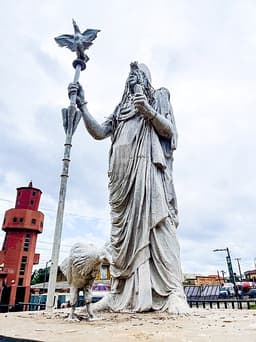
Oduduwa
Emperor · Medieval
59.7Total
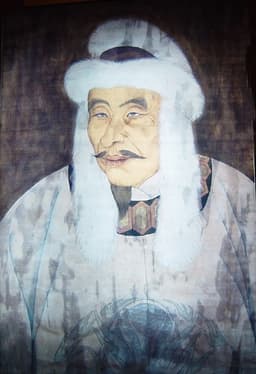
Wanyan Aguda
Emperor · Medieval
63.4Total
Basic Information
Born
950
1068
Died
1020
1123
Era
Medieval
Medieval
Nationality
Ife
China
Occupation
Emperor
Emperor
Civilization
Other
Eastern
Score Comparison
Military (10%)
50.0
82.0
Political (20%)
46.6
59.3
Influence (20%)
68.0
55.0
Legacy (20%)
68.0
52.0
Leadership (15%)
67.0
85.0
Strategy (15%)
36.8
68.0
TOTAL
59.7
63.4
Oduduwa — Complete Timeline
1000 AD
Foundation of the Yoruba civilization at Ile-IfeCultural
According to Yoruba oral tradition, Oduduwa descended from heaven at Ile-Ife and founded the Yoruba civilization. He is credited with establishing the first Yoruba kingdom and the sacred city of Ile-Ife, which became the spiritual and cultural heartland of the Yoruba people.
Impact: regionalconstructive
1010 AD
Establishment of the Yoruba royal dynastiesPolitical Action◆ Major
Oduduwa is said to have sent his sons and grandsons to found the various Yoruba kingdoms, including Oyo, Benin, and Ketu. This act established the royal lineages that ruled these states for centuries, creating a network of related kingdoms under the spiritual authority of the Ooni of Ife.
Impact: regionalconstructive
Wanyan Aguda — Complete Timeline
1114 AD
Battle of HubudagangWar◆ Major
Aguda's Jurchen forces defeated a Liao army at Hubudagang, marking the first major victory of the rebellion. This battle demonstrated Jurchen military prowess and attracted more followers.
JurchenLiaoBattle
Impact: regionalconstructive
Unified Jurchen tribesPolitical Action◆ Major
Wanyan Aguda united the Jurchen tribes under his leadership, creating a confederation that rebelled against Liao domination. He organized a disciplined army and began the Jurchen revolt.
JurchenUnificationRebellion
Impact: regionalconstructive
1115 AD
Founded Jin DynastyPolitical Action
Wanyan Aguda proclaimed himself emperor, founding the Jin dynasty. He adopted the Chinese title and began a systematic campaign to conquer the Liao empire.
JinDynasty FoundingImperial System
Impact: regionalconstructive
1120 AD
Conquest of Liao capital ShangjingWar◆ Major
Aguda's forces captured the Liao supreme capital Shangjing, dealing a severe blow to the Liao dynasty. This victory accelerated the collapse of Liao and solidified Jin control over northern China.
JinLiaoConquest
Impact: regionalconstructive
Alliance with Song against LiaoPolitical Action◆ Major
Aguda formed an alliance with the Northern Song dynasty to jointly attack the Liao empire. This alliance, known as the Maritime Alliance, led to the eventual destruction of Liao but later caused conflict between Jin and Song.
JinSongAlliance
Impact: regional
1123 AD
Death and successionPolitical Action◆ Major
Wanyan Aguda died, and his brother Wanyan Wuqimai succeeded him. Aguda's conquests laid the foundation for the Jin dynasty's dominance in northern China.
JinDeathSuccession
Impact: regional
Expert Analysis
Wanyan Aguda vs Oduduwa
# The Emperor and the Sky-Father: Two Founders, Two Worlds
In the winter of 1114, on the frozen plains of northeast Asia, a Jurchen chieftain named Wanyan Aguda watched his ragged army of hunters and horsemen charge into a disciplined Liao force ten times their size. Half a world away and a century earlier, a mysterious figure named Oduduwa was said to have descended from the sky onto a sacred hill in what is now southwestern Nigeria, carrying a palm nut and a chain of iron. One man made history through blood and iron; the other through myth and lineage. Yet both founded civilizations that would shape their regions for centuries. Why did one path lead to a conquest empire that collapsed within a generation, while the other produced a cultural legacy that endures to this day?
Origins
Wanyan Aguda was born in 1068 into a world of simmering resentment. The Jurchen people, semi-nomadic tribes living in the forests and rivers of Manchuria, had long chafed under the domination of the Khitan-led Liao dynasty. Aguda grew up watching his father and grandfather pay tribute to foreign overlords, learning the arts of war and diplomacy in equal measure. His world was one of shifting alliances, where a chieftain's authority depended on his ability to provide plunder and protection.
Oduduwa, by contrast, emerges from the mists of Yoruba oral tradition with no clear historical date of birth—scholars place him around 950 to 1020. He is not a man who fought his way to power but a divine being who brought civilization itself. According to the Ife creation myth, the supreme god Olodumare sent Oduduwa down from heaven on a chain, carrying a handful of earth, a five-toed chicken, and a palm nut. He created land from the primordial waters and became the first ruler of Ile-Ife, the sacred city. Where Aguda's origins are recorded in Chinese annals, Oduduwa's are preserved in praise poems and ritual chants.
Rise to Power
Aguda's rise was a masterclass in opportunism. In 1114, he unified the fractious Jurchen tribes into a confederation—a political act of considerable difficulty, given the tribal rivalries that had kept them divided for generations. He then provoked a war with the Liao by refusing to pay tribute, a calculated gamble that paid off spectacularly at the Battle of Hubudagang later that year. Outnumbered and outgunned, his forces used the terrain and their superior mobility to annihilate the Liao army. The victory electrified the Jurchen and terrified their enemies.
Oduduwa's rise is not a story of battles but of divine appointment. He did not unify tribes; he founded them. According to tradition, he became the first Ooni (king) of Ife and then sent his sixteen sons and grandsons to establish their own kingdoms—Oyo, Benin, Ketu, and others. Each prince carried a piece of Ife's sacred authority, spreading Yoruba civilization across what is now Nigeria and Benin. This was not conquest but dissemination, a peaceful expansion of culture and kingship.
Leadership & Governance
Aguda proved himself a brilliant military strategist and an astute political reformer. After founding the Jin dynasty in 1115, he adopted Chinese administrative practices, including a civil service system and a written script for the Jurchen language. He understood that to rule a settled empire, he needed more than tribal loyalty. His leadership score of 88.4 reflects this rare combination of battlefield courage and bureaucratic vision. Yet his military genius (scoring 79.3) was always primary: he personally led campaigns, captured the Liao capital Shangjing in 1120, and formed the Maritime Alliance with the Northern Song dynasty to finish off the Liao.
Oduduwa's governance was entirely different. His political score of 72.0 suggests a figure who built institutions rather than armies. He established the sacred kingship system of the Yoruba, where the Ooni of Ife remains the spiritual head of all Yoruba people. He created the Ogboni society, a council of elders that balanced royal power. His strategy score of 30.0 is not a weakness but a reflection of his role: he did not conquer; he consecrated. His leadership (81.7) came from moral and religious authority, not military might.
Triumph & Tragedy
Aguda's greatest triumph was the destruction of the Liao dynasty, a feat that seemed impossible when he began his rebellion. By the time of his death in 1123, his Jin empire controlled all of northern China. But his tragedy was hidden in his success: the Jin dynasty, built on conquest, would face constant rebellion, and within a generation, its Jurchen elite would be sinicized and weakened. Aguda died at just 55, leaving his brother Wuqimai to inherit a machine of war that was already showing cracks.
Oduduwa's triumph was not a single battle but the birth of a civilization. His progeny founded kingdoms that would last centuries—the Oyo Empire, for instance, became a major power in West Africa. His tragedy is that we know so little of the man himself. He exists in the gap between history and legend, a figure whose very reality is debated by scholars. Unlike Aguda, whose life is documented in Chinese histories, Oduduwa left no written records, no dated events, only the living traditions of millions of people.
Character & Destiny
Aguda was a pragmatist and a warrior. His decisions—unifying the tribes, attacking the Liao, allying with the Song—were calculated risks driven by ambition and necessity. He was ruthless when required, merciful when advantageous. His personality shaped the Jin dynasty into an expansionist state that could not stop expanding. That very momentum would eventually overstretch it.
Oduduwa, in Yoruba tradition, is a figure of calm authority. He did not need to fight because his power was unquestioned. His destiny was to be the father of kings, not the conqueror of enemies. Where Aguda's story is one of acceleration—rapid rise, swift conquest, sudden death—Oduduwa's is one of diffusion: slow, organic, enduring.
Legacy
Aguda's legacy is measured in territory and time. The Jin dynasty ruled northern China for over a century, and its administrative innovations influenced later Mongol and Chinese dynasties. His military tactics were studied by future conquerors. Yet today, outside of specialist historians, he is largely forgotten. His influence score of 68.7 and legacy of 70.1 reflect a power that was immense but transient.
Oduduwa's legacy is the opposite. His influence score of 69.2 and legacy of 69.9 are comparable to Aguda's, but they measure something different: not the size of an empire but the depth of a culture. Every Yoruba king today traces his authority back to Oduduwa. The city of Ile-Ife remains the spiritual capital of over 40 million Yoruba people. His story has survived a millennium without written records, passed down through oral tradition, ritual, and art.
Conclusion
Standing at the edge of their respective worlds, Aguda and Oduduwa embody two fundamental ways of founding a civilization. One is the way of the sword: rapid, violent, historically documented. The other is the way of the spirit: slow, peaceful, mythically rich. The Jin dynasty fell. The Yoruba civilization endures. Perhaps the lesson is not that one path is superior, but that history measures greatness in different currencies. Aguda conquered lands; Oduduwa conquered hearts. Both, in their own ways, changed the world forever.
Rankings
🥇
Wanyan AgudaLeader
Mil: 82.0Pol: 59.3Inf: 55.0
63.4
🥈
Oduduwa
Mil: 50.0Pol: 46.6Inf: 68.0
59.7
+3.7 behind
How This Comparison Works
Algorithm
Each figure is scored on 6 dimensions (0—100 scale) based on structured historical data: Military (10%), Political (20%), Influence (20%), Legacy (20%), Leadership (15%), Strategy (15%). The weighted total produces the final ranking.
Data Sources
Scores are computed from structured sub-indicators in the database. Scale factors adjust for era (Ancient ×0.85, Modern ×1.0) and civilization size (Eastern ×1.05, Other ×0.80) to account for differences in population and military scale.
Maximum 3 Figures
Comparisons are limited to 2—3 figures to ensure readability and statistical meaningfulness.
Error Margins
±5 points per dimension — Sub-scores are derived from historical records with inherent uncertainty. Two figures within 5 points on a dimension should be considered roughly equivalent in that area.
Total Score Accuracy
±3 points overall — The weighted combination of 6 dimensions produces a total score with approximately ±3 points of uncertainty. Differences of less than 3 points are not statistically significant— the figures are effectively tied.
Known Limitations
- Historical records are incomplete and uneven across civilizations
- Figures from oral-tradition societies may be underrepresented
- Occupation labels can misclassify multi-role figures
- Scores measure capability and impact, not moral character
- Quantitative scoring is a comparison tool, not absolute truth
Capability Radar
Military (10%) — Battles & Warfare
Battles
10
85
Win Rate
10
90
Expansion
30
85
Political (20%) — Governance & Reform
Reform
50
75
Diplomacy
40
70
Economy
40
65
Influence (20%) — Cultural & Global Reach
Cultural
80
60
Global
70
50
Legacy (20%) — Historical Impact
Historical
80
70
Longevity
80
55
Leadership (15%) — Power & Stability
Tenure
40
70
Stability
50
60
Strategy (15%) — Tactics & Innovation
Strategy
10
85
Tactics
10
80
Reform
10
75
Similar Comparisons
Comments & Discussion
IronHorde_Rebel6/16/2026
Aguda wins this hands down. Oduduwa's a myth—a sky-dad with a palm nut. Aguda crushed a Liao army ten times his size at the Battle of Fuli River in 1114 with sheer grit, no divine favors. The Jurchen Jin Dynasty devoured northern China in a generation, not some abstract lineage. Oduduwa's legacy is stories; Aguda's is blood and iron that actually redrew maps. Don't romanticize legends over cold, hard conquest.
神话粉碎者6/16/2026
从军事史看,完颜阿骨打是实干家,奥迪杜瓦顶多算个文化符号。想想1114年护步答冈之战,阿骨打两万破七十万辽军——这不是吹出来的神话,是实打实的伏击战术和士气碾压!奥迪杜瓦的子孙奥约帝国确实牛,但那是几百年后的发展了,跟他下凡带个棕榈果有毛关系?成吉思汗还跟苍狼白鹿扯上过呢,你会拿这个当真?事实是:阿骨打用箭和刀建了个帝国,奥迪杜瓦用传说堆了个谱系。
DataSkeptic_426/16/2026
Sorry, but the Oduduwa timeline's a mess—no hard dates, no verifiable battles, just oral tradition stretched over centuries. Aguda's campaign against the Liao is documented by Song and Jin chronicles, even mentioning specific tactics like feigned retreats in 1115. Meanwhile, Oduduwa's "iron chain" descent is symbolic at best. If we're judging founders on evidence, Aguda's a historical figure with concrete achievements; Oduduwa's a cultural placeholder for origins. One's fact, the other's folklor
溯源考古迷6/16/2026
你们全在瞎扯!奥迪杜瓦的传说背后有考古实锤——伊利费遗址的青铜头像和宫殿基础指向11世纪的城市化飞跃,这能是纯神话?倒是完颜阿骨打的女真大金,1234年就被蒙古灭了,立国才119年。对比之下,奥迪杜瓦的血脉正统撑起约鲁巴文明上千年,从奥约到伊费,延续到今日尼日利亚。短命王朝vs不朽文化,你选哪个?别拿"有文字记载"当唯一真理,闷声传承才是硬道理。
Revisionist_Quill6/16/2026
Aguda's "greatness" is overblown. Sure, he rebelled against the Liao, but his Jin Dynasty was less a unified empire and more a tribal confederation held together by plunder. After his death in 1123, internal bickering and sinicization diluted Jurchen identity. By contrast, Oduduwa's mythos—the chain from heaven, the founding of Ile-Ife—bec