Loading...
Oba Ewuare I vs Richard I
Oba Ewuare I leads by 16.2 pts · 2 figures compared
…
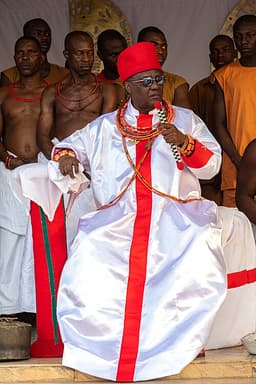
Oba Ewuare I
Emperor · Medieval
70.6Total

Richard I
Emperor · Medieval
54.4Total
Basic Information
Born
1400
1157
Died
1473
1199
Era
Medieval
Medieval
Nationality
Benin Kingdom
England
Occupation
Emperor
Emperor
Civilization
Other
Western
Score Comparison
Military (10%)
80.0
70.0
Political (20%)
62.7
37.9
Influence (20%)
65.0
55.0
Legacy (20%)
72.0
52.0
Leadership (15%)
78.0
55.3
Strategy (15%)
72.0
66.3
TOTAL
70.6
54.4
Oba Ewuare I — Complete Timeline
1440 AD
Transformation of Benin CityReform◆ Major
Oba Ewuare I rebuilt Benin City after a civil war, constructing massive earthwork walls and a new palace complex. He reorganized the city's layout with broad streets and fortified gates, establishing the urban plan that persisted for centuries.
Urban PlanningFortificationBenin Empire
Impact: regionalconstructive
1450 AD
Establishment of the Iyoba titleReform◆ Major
Ewuare I created the title of Iyoba (Queen Mother) for his mother, granting her a separate palace outside Benin City. This institutionalized a new political role for royal women in the Benin Kingdom's governance structure.
Political ReformGender RolesBenin Kingdom
Impact: nationalconstructive
1455 AD
Expansion of Benin territoryWar◆ Major
Ewuare I led military campaigns that expanded Benin's control over the Niger Delta and Yoruba-speaking areas to the west. He conquered over 200 towns and villages, incorporating them into the Benin Empire through tribute systems.
ConquestEmpire BuildingBenin
Impact: regional
1460 AD
Introduction of coral bead regaliaCultural
Ewuare I introduced the use of red coral beads as royal regalia, including the coral crown and beaded garments. This established a distinctive visual identity for the Oba and became a symbol of divine kingship in Benin art.
Royal RegaliaArtBenin Culture
Impact: nationalconstructive
Richard I — Complete Timeline
1189 AD
Third CrusadeWar◆ Major
Richard I led the Third Crusade to reclaim Jerusalem from Saladin. He captured Cyprus and Acre, but failed to take Jerusalem. He negotiated the Treaty of Jaffa, securing safe passage for Christian pilgrims.
CrusadeHoly LandSaladin
Impact: global
1191 AD
Battle of ArsufWar◆ Major
Richard I defeated Saladin's forces at the Battle of Arsuf, a key engagement during the Third Crusade. This victory allowed the Crusaders to secure the coast and march toward Jaffa.
CrusadeBattleSaladin
Impact: regional
Conquest of CyprusWar◆ Major
Richard I conquered the island of Cyprus en route to the Holy Land, defeating the Byzantine ruler Isaac Komnenos. He later sold the island to the Knights Templar, establishing a Crusader base.
ConquestCrusadeCyprus
Impact: regional
1192 AD
Capture and RansomPolitical Action◆ Major
On his return from the Crusade, Richard was captured by Duke Leopold V of Austria and handed over to Emperor Henry VI. He was held for ransom, which was paid by England in 1194, totaling 150,000 marks.
ImprisonmentRansom
Impact: regionaltragic
1199 AD
Death at ChâlusWar◆ Major
Richard I was fatally wounded by a crossbow bolt while besieging the castle of Ch
DeathSiege
Impact: nationaltragic
Expert Analysis
Origins
Oba Ewuare I, born around 1440, was the son of Oba Ohen in the Kingdom of Benin (modern-day Nigeria). His early life was marked by civil war; he fled into exile after his father was assassinated. He spent years in the Niger Delta, gathering support. Richard I, born 1157 in Oxford, was the son of King Henry II of England and Eleanor of Aquitaine. He was raised in the French court and became Duke of Aquitaine in 1172. While Ewuare's youth was shaped by political instability and exile, Richard's upbringing was immersed in the chivalric culture of medieval Europe, with early exposure to military campaigns against his father's rebels.
Rise to Power
Ewuare I seized power in a coup around 1440, killing his brother Uwaifiokun, who had usurped the throne. He then crushed a rebellion led by his other brother, Prince Okpame. By 1450, he had consolidated control. Richard I became king in 1189 after the death of Henry II. He had already rebelled against his father twice, allying with Philip II of France. His coronation was marked by anti-Jewish riots. Ewuare's rise was through military force and political maneuvering within Benin, while Richard's ascent involved dynastic conflict and foreign alliances.
Leadership & Governance
Ewuare I transformed Benin City by constructing massive earthwork walls—the Benin Moat, a series of ramparts and ditches spanning over 16,000 kilometers. He reorganized the city into wards and established a palace complex with courtyards. He created the Iyoba title (Queen Mother), granting his mother a separate palace and political role, which institutionalized a new power center. He also introduced coral bead regalia to symbolize royal authority. Richard I governed England largely through deputies, spending only six months of his reign in the country. He raised funds through heavy taxation and sale of offices to finance his crusade. His governance was absentee, focusing on military campaigns rather than administrative reform. Ewuare scored 78.0 in leadership, Richard 55.3.
Triumph & Tragedy
Ewuare's greatest triumph was the physical and political transformation of Benin City. He expanded the empire to over 200 towns and villages, controlling trade routes to the Niger Delta. His tragedy was the destruction of Benin's earlier history: he ordered the burning of previous royal artifacts and records, erasing much of the kingdom's pre-1440 history. Richard's triumph was his military success in the Third Crusade, notably the capture of Acre and victory at Arsuf (1191). He negotiated the Treaty of Jaffa, allowing Christian pilgrims access to Jerusalem. His tragedy was his capture on the way home, imprisonment by Henry VI, and the exorbitant ransom that burdened England. He died from a gangrenous wound at Châlus in 1199.
Character & Destiny
Ewuare was a decisive and ruthless reformer. His destruction of historical records shows a desire to control narrative. He was also a builder, creating enduring institutions like the Iyoba. Richard was a charismatic warrior, known for personal bravery but also for greed and cruelty. He alienated allies like Philip II and was indifferent to English welfare. His character led to his captivity and early death. Ewuare's destiny was to shape Benin's golden age; Richard's was to become a romanticized but ineffective king. Historical assessments note Ewuare's scores: military 80.0, strategy 72.0; Richard's military 70.0, strategy 66.3.
Legacy
Ewuare's legacy endures in Benin's cultural identity: the coral bead regalia, the Iyoba title, and the Benin Moat (a UNESCO World Heritage site). His reforms centralized power and influenced subsequent Obas. Richard's legacy is as a crusader icon, but his actual impact on England was minimal. He left a depleted treasury and no heir. His legend grew through later literature, but his governance was a failure. Ewuare's overall score of 70.6 versus Richard's 54.4 reflects a more substantial and lasting impact.
Conclusion
Oba Ewuare I had a greater impact on his kingdom and the world than Richard I. While Richard's military exploits captured the medieval imagination, Ewuare's systemic changes—urban planning, political institutions, and cultural symbols—transformed Benin into a powerful empire. Richard's scores are consistently lower across all categories except military, where Ewuare still leads 80.0 to 70.0. Ewuare's legacy is tangible and enduring; Richard's is mythologized but historically shallow. The data supports Ewuare as the more significant historical figure.
Rankings
🥇
Oba Ewuare ILeader
Mil: 80.0Pol: 62.7Inf: 65.0
70.6
🥈
Richard I
Mil: 70.0Pol: 37.9Inf: 55.0
54.4
+16.2 behind
How This Comparison Works
Algorithm
Each figure is scored on 6 dimensions (0—100 scale) based on structured historical data: Military (10%), Political (20%), Influence (20%), Legacy (20%), Leadership (15%), Strategy (15%). The weighted total produces the final ranking.
Data Sources
Scores are computed from structured sub-indicators in the database. Scale factors adjust for era (Ancient ×0.85, Modern ×1.0) and civilization size (Eastern ×1.05, Other ×0.80) to account for differences in population and military scale.
Maximum 3 Figures
Comparisons are limited to 2—3 figures to ensure readability and statistical meaningfulness.
Error Margins
±5 points per dimension — Sub-scores are derived from historical records with inherent uncertainty. Two figures within 5 points on a dimension should be considered roughly equivalent in that area.
Total Score Accuracy
±3 points overall — The weighted combination of 6 dimensions produces a total score with approximately ±3 points of uncertainty. Differences of less than 3 points are not statistically significant— the figures are effectively tied.
Known Limitations
- Historical records are incomplete and uneven across civilizations
- Figures from oral-tradition societies may be underrepresented
- Occupation labels can misclassify multi-role figures
- Scores measure capability and impact, not moral character
- Quantitative scoring is a comparison tool, not absolute truth
Capability Radar
Military (10%) — Battles & Warfare
Battles
70
75
Win Rate
75
70
Expansion
85
40
Political (20%) — Governance & Reform
Reform
90
20
Diplomacy
75
55
Economy
85
25
Influence (20%) — Cultural & Global Reach
Cultural
85
65
Global
65
55
Legacy (20%) — Historical Impact
Historical
80
70
Longevity
70
60
Leadership (15%) — Power & Stability
Tenure
80
40
Stability
80
30
Strategy (15%) — Tactics & Innovation
Strategy
85
65
Tactics
80
80
Reform
90
30
Similar Comparisons
Comments & Discussion
No comments yet. Be the first to share your thoughts!