Loading...
Harold Godwinson vs Richard I
Richard I leads by 8.6 pts · 2 figures compared
…
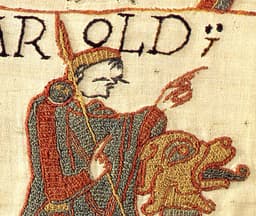
Harold Godwinson
Emperor · Medieval
45.8Total

Richard I
Emperor · Medieval
54.4Total
Basic Information
Born
1022
1157
Died
1066
1199
Era
Medieval
Medieval
Nationality
England
England
Occupation
Emperor
Emperor
Civilization
Western
Western
Score Comparison
Military (10%)
47.5
70.0
Political (20%)
35.1
37.9
Influence (20%)
54.1
55.0
Legacy (20%)
49.2
52.0
Leadership (15%)
31.2
55.3
Strategy (15%)
52.5
66.3
TOTAL
45.8
54.4
Harold Godwinson — Complete Timeline
1066 AD
Battle of Stamford BridgeWar◆ Major
Harold defeated an invading Norwegian army under King Harald Hardrada at Stamford Bridge in Yorkshire. The victory was decisive, but Harold's army was weakened and exhausted.
BattleVictoryViking Invasion
Impact: national
Battle of HastingsWar
Harold's army was defeated by William of Normandy at Hastings on October 14. Harold was killed in the battle, traditionally by an arrow in the eye, ending Anglo-Saxon rule in England.
BattleDefeatNorman Conquest
Impact: globaltragic
Coronation of Harold GodwinsonPolitical Action◆ Major
Harold was crowned king of England on January 6, 1066, the day after Edward the Confessor's death. His claim was contested by William of Normandy and Harald Hardrada of Norway.
CoronationSuccessionContested Claim
Impact: national
Richard I — Complete Timeline
1189 AD
Third CrusadeWar◆ Major
Richard I led the Third Crusade to reclaim Jerusalem from Saladin. He captured Cyprus and Acre, but failed to take Jerusalem. He negotiated the Treaty of Jaffa, securing safe passage for Christian pilgrims.
CrusadeHoly LandSaladin
Impact: global
1191 AD
Battle of ArsufWar◆ Major
Richard I defeated Saladin's forces at the Battle of Arsuf, a key engagement during the Third Crusade. This victory allowed the Crusaders to secure the coast and march toward Jaffa.
CrusadeBattleSaladin
Impact: regional
Conquest of CyprusWar◆ Major
Richard I conquered the island of Cyprus en route to the Holy Land, defeating the Byzantine ruler Isaac Komnenos. He later sold the island to the Knights Templar, establishing a Crusader base.
ConquestCrusadeCyprus
Impact: regional
1192 AD
Capture and RansomPolitical Action◆ Major
On his return from the Crusade, Richard was captured by Duke Leopold V of Austria and handed over to Emperor Henry VI. He was held for ransom, which was paid by England in 1194, totaling 150,000 marks.
ImprisonmentRansom
Impact: regionaltragic
1199 AD
Death at ChâlusWar◆ Major
Richard I was fatally wounded by a crossbow bolt while besieging the castle of Ch
DeathSiege
Impact: nationaltragic
Expert Analysis
Origins
Harold Godwinson was born around 1022 into the powerful Godwin family, the most influential noble house in England. His father, Earl Godwin, was a key advisor to King Edward the Confessor. Harold grew up in the heart of Anglo-Saxon politics, gaining experience as an earl and military commander. He had no formal education but learned statecraft and warfare through family connections.
Richard I was born on September 8, 1157, in Oxford, England, as the third son of King Henry II and Eleanor of Aquitaine. He was raised in a sophisticated court, educated in Latin, French, and the arts of war. His mother's influence and his father's vast Angevin Empire provided a backdrop of constant political maneuvering.
Rise to Power
Harold rose to prominence after his father's exile and death. By 1053, he succeeded as Earl of Wessex, becoming the most powerful magnate in England. He led successful campaigns against the Welsh (1063) and became the king's right hand. Upon Edward the Confessor's death on January 5, 1066, Harold claimed the throne, supported by the Witenagemot. He was crowned the next day, but faced immediate challenges from William of Normandy and Harald Hardrada.
Richard's rise was more turbulent. He rebelled against his father Henry II alongside his brothers in 1173-74. After becoming heir apparent, he consolidated power in Aquitaine. Following Henry II's death in 1189, Richard inherited the throne and immediately began preparations for the Third Crusade, having already taken the cross in 1187.
Leadership & Governance
Harold's leadership was tested in 1066. He mobilized a large army and fleet to defend against invasions. At Stamford Bridge on September 25, he defeated Harald Hardrada with a forced march and surprise attack, showing tactical skill. However, he then rushed south to face William, leaving his army exhausted. His governance was brief; he issued coins and charters but had no time for reforms. He relied on the fyrd system and personal loyalty.
Richard I spent only six months of his ten-year reign in England. He viewed the kingdom primarily as a source of funds for his crusade. He sold offices, lands, and even the crown of Scotland to raise money. He left the governance to regents, notably William Longchamp and later Hubert Walter. His military leadership was exceptional: at the Battle of Arsuf on September 7, 1191, he defeated Saladin's forces through disciplined cavalry charges. He scored 70.0 in military compared to Harold's 47.5.
Triumph & Tragedy
Harold's greatest triumph was Stamford Bridge, where he crushed a formidable Norwegian army. His tragedy was Hastings: after a forced march, his tired troops faced William's fresh forces. Harold died on the battlefield, traditionally by an arrow in the eye. His death ended Anglo-Saxon rule and led to Norman conquest.
Richard's triumphs include capturing Cyprus and Acre during the Third Crusade. His victory at Arsuf demonstrated his tactical brilliance. However, he failed to capture Jerusalem. His tragedy was his capture on the way home: in December 1192, he was imprisoned by Duke Leopold V, and a ransom of 150,000 marks (about three times England's annual revenue) was demanded. He was released in 1194 but died in 1199 from a crossbow wound at Châlus, a minor siege.
Character & Destiny
Harold was pragmatic and loyal to his oath? He had allegedly sworn to support William's claim to the English throne in 1064, but later broke it. His decision to engage William immediately after Stamford Bridge was risky. His character was shaped by duty to his kingdom and family. His destiny was sealed by the convergence of two invasions and his own exhaustion.
Richard was chivalric and martial, earning the nickname "Lionheart" for his bravery. He was also ruthless and greedy for glory. His character made him a great crusader but a poor king of England. He neglected his realm and treated it as a cash cow. His fate—capture and early death—stemmed from his overconfidence and lack of diplomacy.
Legacy
Harold's legacy is as the last Anglo-Saxon king, a symbol of English resistance before the Norman Conquest. His death at Hastings became a defining moment. He scored 49.2 in legacy. The Battle of Hastings is one of the most famous in English history, and Harold's story is retold in the Bayeux Tapestry.
Richard I's legacy is more romanticized: he is remembered as a crusader king, though he spent little time in England. His military reputation endures, scoring 55.0 in influence and 52.0 in legacy. However, his reign was financially draining and left England without strong central governance. The Robin Hood legend contrasts his absence with the tyranny of his brother John.
Conclusion
Richard I scores higher overall (54.4 vs 45.8), but his impact on England was less direct. Harold's brief reign had monumental consequences: his defeat led to a complete transformation of English society, language, and culture. Richard's crusades, while famous, had limited lasting effect. Therefore, Harold's impact on history was greater due to the fundamental change his death wrought. Richard was a better general (70.0 vs 47.5 military score), but Harold's defeat changed the course of a nation.
Rankings
🥇
Richard ILeader
Mil: 70.0Pol: 37.9Inf: 55.0
54.4
🥈
Harold Godwinson
Mil: 47.5Pol: 35.1Inf: 54.1
45.8
+8.6 behind
How This Comparison Works
Algorithm
Each figure is scored on 6 dimensions (0—100 scale) based on structured historical data: Military (10%), Political (20%), Influence (20%), Legacy (20%), Leadership (15%), Strategy (15%). The weighted total produces the final ranking.
Data Sources
Scores are computed from structured sub-indicators in the database. Scale factors adjust for era (Ancient ×0.85, Modern ×1.0) and civilization size (Eastern ×1.05, Other ×0.80) to account for differences in population and military scale.
Maximum 3 Figures
Comparisons are limited to 2—3 figures to ensure readability and statistical meaningfulness.
Error Margins
±5 points per dimension — Sub-scores are derived from historical records with inherent uncertainty. Two figures within 5 points on a dimension should be considered roughly equivalent in that area.
Total Score Accuracy
±3 points overall — The weighted combination of 6 dimensions produces a total score with approximately ±3 points of uncertainty. Differences of less than 3 points are not statistically significant— the figures are effectively tied.
Known Limitations
- Historical records are incomplete and uneven across civilizations
- Figures from oral-tradition societies may be underrepresented
- Occupation labels can misclassify multi-role figures
- Scores measure capability and impact, not moral character
- Quantitative scoring is a comparison tool, not absolute truth
Capability Radar
Military (10%) — Battles & Warfare
Battles
60
75
Win Rate
55
70
Expansion
40
40
Political (20%) — Governance & Reform
Reform
20
20
Diplomacy
40
55
Economy
30
25
Influence (20%) — Cultural & Global Reach
Cultural
35
65
Global
30
55
Legacy (20%) — Historical Impact
Historical
55
70
Longevity
40
60
Leadership (15%) — Power & Stability
Tenure
15
40
Stability
20
30
Strategy (15%) — Tactics & Innovation
Strategy
60
65
Tactics
65
80
Reform
30
30
Similar Comparisons
Comments & Discussion
No comments yet. Be the first to share your thoughts!