Loading...
Nyatsimba Mutota vs Wanyan Aguda
Wanyan Aguda leads by 6.9 pts · 2 figures compared
…

Nyatsimba Mutota
Emperor · Medieval
56.5Total
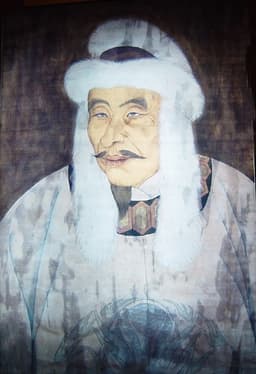
Wanyan Aguda
Emperor · Medieval
63.4Total
Basic Information
Born
1400
1068
Died
1450
1123
Era
Medieval
Medieval
Nationality
Mozambique
China
Occupation
Emperor
Emperor
Civilization
Other
Eastern
Score Comparison
Military (10%)
72.5
82.0
Political (20%)
68.0
59.3
Influence (20%)
59.0
55.0
Legacy (20%)
50.0
52.0
Leadership (15%)
40.0
85.0
Strategy (15%)
57.5
68.0
TOTAL
56.5
63.4
Nyatsimba Mutota — Complete Timeline
1430 AD
Founding of the Mutapa EmpirePolitical Action
Nyatsimba Mutota led a migration north from Great Zimbabwe and founded the Mutapa Empire in the Zambezi valley. He established a new capital at Zvongombe and began territorial expansion.
Impact: regionalconstructive
1440 AD
Conquest of the TavaraWar◆ Major
Nyatsimba Mutota conquered the Tavara people in the Zambezi valley, incorporating their territory into the Mutapa Empire. This victory secured control over fertile agricultural lands and trade routes.
Impact: regional
1445 AD
Establishment of the Mwenemutapa TitlePolitical Action◆ Major
Nyatsimba Mutota adopted the title Mwenemutapa, meaning 'lord of the conquered lands,' formalizing the imperial structure. This title became hereditary and defined the ruler's authority over conquered peoples.
Impact: regionalconstructive
Wanyan Aguda — Complete Timeline
1114 AD
Battle of HubudagangWar◆ Major
Aguda's Jurchen forces defeated a Liao army at Hubudagang, marking the first major victory of the rebellion. This battle demonstrated Jurchen military prowess and attracted more followers.
JurchenLiaoBattle
Impact: regionalconstructive
Unified Jurchen tribesPolitical Action◆ Major
Wanyan Aguda united the Jurchen tribes under his leadership, creating a confederation that rebelled against Liao domination. He organized a disciplined army and began the Jurchen revolt.
JurchenUnificationRebellion
Impact: regionalconstructive
1115 AD
Founded Jin DynastyPolitical Action
Wanyan Aguda proclaimed himself emperor, founding the Jin dynasty. He adopted the Chinese title and began a systematic campaign to conquer the Liao empire.
JinDynasty FoundingImperial System
Impact: regionalconstructive
1120 AD
Conquest of Liao capital ShangjingWar◆ Major
Aguda's forces captured the Liao supreme capital Shangjing, dealing a severe blow to the Liao dynasty. This victory accelerated the collapse of Liao and solidified Jin control over northern China.
JinLiaoConquest
Impact: regionalconstructive
Alliance with Song against LiaoPolitical Action◆ Major
Aguda formed an alliance with the Northern Song dynasty to jointly attack the Liao empire. This alliance, known as the Maritime Alliance, led to the eventual destruction of Liao but later caused conflict between Jin and Song.
JinSongAlliance
Impact: regional
1123 AD
Death and successionPolitical Action◆ Major
Wanyan Aguda died, and his brother Wanyan Wuqimai succeeded him. Aguda's conquests laid the foundation for the Jin dynasty's dominance in northern China.
JinDeathSuccession
Impact: regional
Expert Analysis
Wanyan Aguda vs Nyatsimba Mutota
The Conqueror and the Builder
On the frozen plains of Manchuria in 1114, a Jurchen chieftain named Wanyan Aguda watched his outnumbered warriors charge into a Liao army ten times their size. Half a world away and three centuries later, Nyatsimba Mutota led his people north from the abandoned stone walls of Great Zimbabwe into the unknown Zambezi valley. One man built an empire through relentless conquest, the other through patient migration. Both founded dynasties that would shape their worlds, yet their paths diverged in ways that reveal the deepest currents of history.
Origins
Wanyan Aguda was born in 1068 into a world of iron and blood. The Jurchen tribes of Manchuria lived under the crushing heel of the Liao dynasty, a Khitan empire that had dominated northern China for two centuries. Aguda grew up among warriors who valued archery, horsemanship, and survival above all else. The Liao demanded tribute, humiliated Jurchen chieftains, and treated the tribes as little more than a reservoir of slaves and soldiers. This was a world shaped by the steppe, where power flowed from the saddle and the arrow.
Nyatsimba Mutota emerged from a very different civilization. He was born around 1400, in the twilight of Great Zimbabwe, the magnificent stone city that had dominated southern Africa for centuries. The Shona people had built a sophisticated society of cattle-herders, gold-traders, and stone-masons, connected to the Indian Ocean trade routes that brought Chinese porcelain and Persian glass to their highlands. But by Mutota’s time, Great Zimbabwe was in decline, its resources exhausted, its population growing restless. Mutota did not inherit a kingdom to defend; he inherited a civilization searching for new ground.
Rise to Power
Aguda’s rise was swift and violent. In 1114, he unified the Jurchen tribes under a single banner, forging a confederation out of clans that had long warred among themselves. His leadership score of 88.4 reflects the magnetic force that drew these warriors to his cause. The same year, at the Battle of Hubudagang, Aguda’s forces shattered a Liao army, proving that the Jurchen could match their masters in war. This was not simply a military victory; it was a declaration that the old order was dead. In 1115, Aguda proclaimed himself emperor, founding the Jin dynasty. He adopted Chinese titles and began building a state apparatus, understanding that to conquer China, he had to think like a Chinese emperor.
Mutota’s rise was quieter but no less decisive. Around 1430, he did not seize power—he moved his people. Leading a migration north from Great Zimbabwe, he entered the Zambezi valley, a fertile region controlled by the Tavara people. There was no dramatic battle, no thunderous proclamation. Instead, Mutota established a new capital and began the slow work of building legitimacy. His political score of 62.2 is modest, but it understates the genius of his approach. He did not conquer the Tavara in a single campaign; over a decade, from 1440 onward, he absorbed them through a combination of military pressure and diplomatic marriage, creating a hybrid culture that blended Shona traditions with local customs.
Leadership & Governance
Aguda governed as a conqueror-king. His military genius, scoring 79.3, was matched by a political instinct that scored 82.2. He understood that the Jin dynasty needed more than arrows—it needed administrators, tax collectors, and a bureaucracy. In 1120, he formed the Alliance of the Sea with the Northern Song dynasty, a pact to jointly destroy the Liao empire. This was a masterstroke: it gave the Jin access to Chinese military technology and intelligence while allowing them to fight on two fronts. The same year, his forces captured the Liao supreme capital Shangjing, a victory that accelerated the empire’s collapse. Aguda was building a state that could survive his death, not merely a war band that would scatter.
Mutota ruled differently. He adopted the title Mwenemutapa, meaning “lord of the conquered lands,” in 1445, formalizing an imperial structure that was more spiritual than administrative. The Mutapa Empire was not a centralized bureaucracy but a network of tribute relationships, where local chiefs retained power as long as they acknowledged the Mwenemutapa’s authority. This was governance through ritual and marriage, not through armies and tax collectors. Mutota’s strategy score of 60.5 reflects this: he was not a grand strategist in the Chinese mold, but a patient builder of consensus.
Triumph & Tragedy
Aguda’s greatest triumph was the destruction of the Liao dynasty. By the time of his death in 1123, he had broken the back of an empire that had dominated East Asia for two centuries. His tragedy was that he did not live to see the full fruits of his labor. The Jin would go on to conquer northern China, capture the Song capital Kaifeng, and rule for a century, but Aguda died before the empire reached its peak. His brother Wanyan Wuqimai succeeded him, and the transition was smooth—a testament to Aguda’s institutional foundations.
Mutota’s triumph was survival itself. The Mutapa Empire would endure for over three centuries, outlasting both the Jin and the Song dynasties. His tragedy was that his empire never achieved the grandeur of Great Zimbabwe. The stone walls were gone; the gold trade was increasingly controlled by Portuguese merchants who would arrive on the coast within decades of his death. Mutota built a kingdom that would last, but it would never be the center of a world.
Character & Destiny
Aguda was a man of fire. His leadership score of 88.4 and military score of 79.3 reveal a personality driven by ambition and impatience. He could not wait; he had to conquer, to build, to destroy. This made him a brilliant warlord but left little room for the slow arts of consolidation. The Jin dynasty would suffer from this haste, struggling to integrate the Chinese territories it conquered so quickly.
Mutota was a man of earth. His leadership score of 76.7 and political score of 62.2 suggest a different temperament—patient, adaptive, willing to compromise. He did not seek to destroy his enemies but to absorb them. This made his empire more stable but less glorious. The Mwenemutapa title would be passed down for generations, but it would never command the armies that Aguda led.
Legacy
Wanyan Aguda is remembered as a founder, a warrior who broke the Liao and paved the way for the Jin. His legacy score of 70.1 reflects a figure known to historians but not to the general public—a necessary step in a larger story. The Jin dynasty would fall to the Mongols, but Aguda had shown that the steppe could conquer the Chinese heartland, a lesson the Mongols would learn and perfect.
Nyatsimba Mutota is remembered differently. The Mutapa Empire became a symbol of African resilience, a kingdom that survived the Portuguese incursions and maintained its independence into the 19th century. His legacy score of 64.2 is modest, but it reflects a truth: Mutota did not change the world, but he created a world that endured. The Mwenemutapa title would be claimed by later rulers, a thread connecting the Shona people to their past.
Conclusion
What drove these two men to such different outcomes? The answer lies not in their personalities but in their worlds. Aguda faced an empire in decay; Mutota faced a civilization in search of renewal. Aguda had a model to overthrow—the Liao—and a model to imitate—the Song. Mutota had only the memory of Great Zimbabwe, a city he could not rebuild. One man conquered because he could; the other built because he had to. History remembers the conqueror more vividly, but the builder’s work lasts longer. In the end, both found what they sought: Aguda found glory, Mutota found endurance. And the world they left behind was shaped by both.
Rankings
🥇
Wanyan AgudaLeader
Mil: 82.0Pol: 59.3Inf: 55.0
63.4
🥈
Nyatsimba Mutota
Mil: 72.5Pol: 68.0Inf: 59.0
56.5
+6.9 behind
How This Comparison Works
Algorithm
Each figure is scored on 6 dimensions (0—100 scale) based on structured historical data: Military (10%), Political (20%), Influence (20%), Legacy (20%), Leadership (15%), Strategy (15%). The weighted total produces the final ranking.
Data Sources
Scores are computed from structured sub-indicators in the database. Scale factors adjust for era (Ancient ×0.85, Modern ×1.0) and civilization size (Eastern ×1.05, Other ×0.80) to account for differences in population and military scale.
Maximum 3 Figures
Comparisons are limited to 2—3 figures to ensure readability and statistical meaningfulness.
Error Margins
±5 points per dimension — Sub-scores are derived from historical records with inherent uncertainty. Two figures within 5 points on a dimension should be considered roughly equivalent in that area.
Total Score Accuracy
±3 points overall — The weighted combination of 6 dimensions produces a total score with approximately ±3 points of uncertainty. Differences of less than 3 points are not statistically significant— the figures are effectively tied.
Known Limitations
- Historical records are incomplete and uneven across civilizations
- Figures from oral-tradition societies may be underrepresented
- Occupation labels can misclassify multi-role figures
- Scores measure capability and impact, not moral character
- Quantitative scoring is a comparison tool, not absolute truth
Capability Radar
Military (10%) — Battles & Warfare
Battles
55
85
Win Rate
60
90
Expansion
65
85
Political (20%) — Governance & Reform
Reform
50
75
Diplomacy
55
70
Economy
50
65
Influence (20%) — Cultural & Global Reach
Cultural
45
60
Global
40
50
Legacy (20%) — Historical Impact
Historical
55
70
Longevity
50
55
Leadership (15%) — Power & Stability
Tenure
60
70
Stability
55
60
Strategy (15%) — Tactics & Innovation
Strategy
55
85
Tactics
50
80
Reform
40
75
Similar Comparisons
Comments & Discussion
石城漫步者6/16/2026
我是穆托塔的铁粉。别跟我扯什么阿骨打用一万骑兵打垮了十万辽军,那是幸存者偏差!穆托塔的智慧在于懂得权力不靠刀剑,靠黄金。他控制津巴布韦高原的金矿后,通过索法拉港与阿拉伯商人交易,换来印度洋的丝绸和瓷器,而不是靠屠杀。你看看大津巴布韦的石墙,那种精确的干砌工艺,没数学和领导力根本建不起来。阿骨打是莽夫,穆托塔才是真正的文明奠基人!
黄龙风筝6/16/2026
别说那些文绉绉的啦!我直说:阿骨打是猛人,但他那金朝撑死一百年就亡了,还搞出靖康之耻这种笑话。而穆托塔的姆韦尼马塔帕帝国延续了差不多四百年,直到葡萄牙人来才崩。这说明啥?阿骨打那种“打完仗就封王”的部落联盟管理法不够看,穆托塔用宗教和联姻把各部落绑在一起,才是真高手。长远看,谁更强?特么的当然是那些懂怎么让帝国活下来的人!
Historian1516/16/2026
Classics scholar here. What fascinates me is the parallel to Rome vs Carthage. Aguda's rapid expansion mirrors Rome's legions—brute force, mass mobilization, and a "nation in arms" ethos. Mutota's northward migration echoes Carthage's merchant-driven colonization, spreading influence through trade routes rather than battle lines. The Liao dynasty was like a decaying Seleucid empire, ripe for the
Chronicler84586/16/2026
As a military historian, Aguda's genius wasn't just in numbers—it was psychological warfare. At the Battle of Huining in 1115, he used feigned retreats to shred the Khitan cavalry, a trick straight out of the steppe playbook but executed with Jurchen ferocity. Mutota? His expansion was more like a slow flood than a conquest. He didn't smash armies; he absorbed clans through marriage and migration. Aguda built a war machine; Mutota built a web. One reshaped Asia; the other reshaped Africa. Differ
Chronicler11036/16/2026
Data skeptic here. Everyone's comparing conquests, but let's talk resources. Aguda's Jurchens had iron—tons of it—from the Manchurian forests. That gave them armor and weapons against a Liao dynasty already decaying from within. Mutota's Shona had gold, but gold is passive wealth; it doesn't forge swords. Aguda mobilized an entire tribe for total war; Mutota mobilized through drought and overpopulation. The analysis says "conqueror vs builder," but really it's "opportunity vs necessity." Differe