Loading...
This comparison has not been analyzed yet.
One-time AI generation (~1 minute). Scores and timeline are already available below.
Numa Pompilius vs Ptolemy I Soter
Ptolemy I Soter leads by 19.1 pts · 2 figures compared
…

Numa Pompilius
Emperor · Ancient
47.1Total
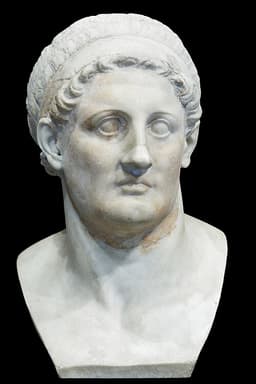
Ptolemy I Soter
Emperor · Ancient
66.2Total
Basic Information
Born
-753
-367
Died
-673
-283
Era
Ancient
Ancient
Nationality
Roman Kingdom
Egypt
Occupation
Emperor
Emperor
Civilization
Western
Middle Eastern
Score Comparison
Military (10%)
11.4
76.0
Political (20%)
45.0
75.0
Influence (20%)
55.0
40.0
Legacy (20%)
55.0
80.0
Leadership (15%)
47.9
75.0
Strategy (15%)
44.9
61.2
TOTAL
47.1
66.2
Numa Pompilius — Complete Timeline
715 BC
Foundation of Roman Religious InstitutionsReform
Numa Pompilius established the major Roman religious offices, including the Pontifex Maximus, the Vestal Virgins, and the Flamines. He created a structured state religion, building temples to Vesta and Janus, and codified rituals to secure divine favor for Rome.
Roman ReligionPontifex MaximusVestal Virgins
Impact: nationalconstructive
Establishment of the Temple of JanusCultural
Numa built the Temple of Janus in Rome, whose doors were open in times of war and closed in times of peace. During his entire reign, the doors remained closed, symbolizing the peace and stability he brought to Rome.
Temple of JanusPeaceRoman Architecture
Impact: nationalconstructive
713 BC
Creation of the Roman CalendarReform◆ Major
Numa reformed the Roman calendar, adding the months of January and February to the original 10-month system. This created a 12-month lunar calendar of 355 days, which remained the basis of Roman timekeeping until the Julian reform.
Calendar ReformRoman CalendarTimekeeping
Impact: nationalconstructive
Codification of the Laws of NumaReform◆ Major
Numa issued a set of laws covering religious rites, property rights, and social customs. These laws, later recorded as the 'Leges Numae,' regulated everything from burial practices to the treatment of slaves, forming an early legal foundation for Rome.
Roman LawLeges NumaeLegal Reform
Impact: nationalconstructive
Ptolemy I Soter — Complete Timeline
321 BC
Capture of Alexander's BodyPolitical Action◆ Major
Ptolemy I intercepted the funeral cortege of Alexander the Great and brought his body to Memphis, later to Alexandria. This act legitimized his rule over Egypt and made Alexandria a pilgrimage site, enhancing his prestige among the Diadochi.
DiadochiAlexanderEgypt
Impact: regionalconstructive
312 BC
Battle of GazaWar
Ptolemy I defeated Demetrius Poliorcetes, son of Antigonus I, at Gaza. This victory secured Ptolemy's control over Syria and Palestine temporarily, though he later lost these territories. The battle was part of the ongoing Wars of the Diadochi.
DiadochiBattleEgypt
Impact: regional
305 BC
Foundation of the Ptolemaic DynastyPolitical Action
Ptolemy I Soter declared himself king of Egypt, founding the Ptolemaic dynasty. He established a Greek-speaking monarchy that ruled Egypt for nearly 300 years, blending Greek and Egyptian cultures. His reign began the Hellenistic period in Egypt.
DiadochiEgyptHellenistic
Impact: regionalconstructive
295 BC
Founding of the Library of AlexandriaCultural◆ Major
Ptolemy I established the Library of Alexandria as part of the Musaeum, a center of learning. The library aimed to collect all known Greek works and became the largest and most famous library of the ancient world, fostering scholarship.
EgyptLibraryHellenistic
Impact: globalconstructive
This comparison has not been analyzed yet.
One-time AI generation (~1 minute). Scores and timeline are already available below.
Rankings
🥇
Ptolemy I SoterLeader
Mil: 76.0Pol: 75.0Inf: 40.0
66.2
🥈
Numa Pompilius
Mil: 11.4Pol: 45.0Inf: 55.0
47.1
+19.1 behind
How This Comparison Works
Algorithm
Each figure is scored on 6 dimensions (0—100 scale) based on structured historical data: Military (10%), Political (20%), Influence (20%), Legacy (20%), Leadership (15%), Strategy (15%). The weighted total produces the final ranking.
Data Sources
Scores are computed from structured sub-indicators in the database. Scale factors adjust for era (Ancient ×0.85, Modern ×1.0) and civilization size (Eastern ×1.05, Other ×0.80) to account for differences in population and military scale.
Maximum 3 Figures
Comparisons are limited to 2—3 figures to ensure readability and statistical meaningfulness.
Error Margins
±5 points per dimension — Sub-scores are derived from historical records with inherent uncertainty. Two figures within 5 points on a dimension should be considered roughly equivalent in that area.
Total Score Accuracy
±3 points overall — The weighted combination of 6 dimensions produces a total score with approximately ±3 points of uncertainty. Differences of less than 3 points are not statistically significant— the figures are effectively tied.
Known Limitations
- Historical records are incomplete and uneven across civilizations
- Figures from oral-tradition societies may be underrepresented
- Occupation labels can misclassify multi-role figures
- Scores measure capability and impact, not moral character
- Quantitative scoring is a comparison tool, not absolute truth
Capability Radar
Military (10%) — Battles & Warfare
Battles
6
75
Win Rate
8
70
Expansion
13
85
Political (20%) — Governance & Reform
Reform
70
80
Diplomacy
65
85
Economy
60
90
Influence (20%) — Cultural & Global Reach
Cultural
75
85
Global
55
80
Legacy (20%) — Historical Impact
Historical
70
90
Longevity
80
85
Leadership (15%) — Power & Stability
Tenure
43
85
Stability
75
80
Strategy (15%) — Tactics & Innovation
Strategy
15
80
Tactics
19
65
Reform
20
60
Similar Comparisons
Comments & Discussion
No comments yet. Be the first to share your thoughts!