Loading...
This comparison has not been analyzed yet.
One-time AI generation (~1 minute). Scores and timeline are already available below.
Norman Schwarzkopf Jr. vs Petar Bojovic
Norman Schwarzkopf Jr. leads by 11.6 pts · 2 figures compared
…
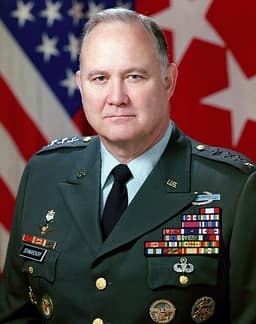
Norman Schwarzkopf Jr.
General · Modern
61.9Total

Petar Bojovic
General · Modern
50.3Total
Basic Information
Born
1934
1858
Died
—
1945
Era
Modern
Modern
Nationality
United States
Serbia
Occupation
General
General
Civilization
Western
Western
Score Comparison
Military (10%)
76.0
70.0
Political (20%)
68.0
35.1
Influence (20%)
56.7
54.9
Legacy (20%)
50.0
46.7
Leadership (15%)
71.0
50.7
Strategy (15%)
68.1
50.0
TOTAL
61.9
50.3
Norman Schwarzkopf Jr. — Complete Timeline
1983 AD
Command of the 24th Mechanized Infantry Division in Grenada (Operation Urgent Fury)War◆ Major
Schwarzkopf commanded the 24th Mechanized Infantry Division during the US invasion of Grenada. The operation successfully overthrew the Marxist government and evacuated US citizens, though it faced criticism for coordination issues.
Cold WarGrenadaInvasion
Impact: regionalconstructive
1988 AD
Appointment as Commander of US Central Command (CENTCOM)Political Action◆ Major
Schwarzkopf was appointed commander of US Central Command, responsible for US military operations in the Middle East. This position placed him in charge of planning and executing the response to Iraq's invasion of Kuwait.
Middle EastCommandCENTCOM
Impact: globalconstructive
1991 AD
Command of Operation Desert StormWar
Schwarzkopf commanded the coalition forces in the Gulf War, executing a 100-hour ground campaign that liberated Kuwait from Iraqi occupation. The operation involved a massive air campaign followed by a rapid armored thrust that destroyed the Iraqi army.
Gulf WarDesert StormVictory
Impact: globalconstructive
Negotiation of the Ceasefire at SafwanPolitical Action◆ Major
Schwarzkopf negotiated the ceasefire agreement with Iraqi military commanders at Safwan airfield on March 3, 1991. The agreement ended the Gulf War and established terms for the withdrawal of Iraqi forces from Kuwait.
Gulf WarCeasefireDiplomacy
Impact: regionalconstructive
Petar Bojovic — Complete Timeline
1912 AD
Command during the Balkan WarsWar◆ Major
Bojovic commanded the Serbian 1st Army during the First Balkan War, leading the capture of the Ottoman city of Skopje. He also fought in the Second Balkan War against Bulgaria.
Balkan WarsVictoryTerritorial Expansion
Impact: regionalconstructive
1915 AD
Command during the Retreat through AlbaniaWar◆ Major
Bojovic commanded the Serbian 1st Army during the retreat through Albania. He maintained discipline and led his troops to the Adriatic coast, where they were evacuated to Corfu by Allied ships.
World War IRetreatSurvival
Impact: regionaltragic
1918 AD
Breakthrough of the Salonika FrontWar
Bojovic commanded the Serbian 1st Army during the Allied offensive that broke the Salonika Front. His forces captured the Bulgarian city of Kyustendil, cutting off Bulgarian supply lines and forcing Bulgaria to surrender.
World War ISalonika FrontLiberation
Impact: globalconstructive
1921 AD
Appointment as Chief of General StaffPolitical Action
Bojovic was appointed Chief of the General Staff of the Yugoslav Army. He served in this position until 1922, overseeing the integration of the Serbian, Croatian, and Slovenian armies into a unified force.
Military CommandYugoslaviaUnification
Impact: nationalconstructive
This comparison has not been analyzed yet.
One-time AI generation (~1 minute). Scores and timeline are already available below.
Rankings
🥇
Norman Schwarzkopf Jr.Leader
Mil: 76.0Pol: 68.0Inf: 56.7
61.9
🥈
Petar Bojovic
Mil: 70.0Pol: 35.1Inf: 54.9
50.3
+11.6 behind
How This Comparison Works
Algorithm
Each figure is scored on 6 dimensions (0—100 scale) based on structured historical data: Military (10%), Political (20%), Influence (20%), Legacy (20%), Leadership (15%), Strategy (15%). The weighted total produces the final ranking.
Data Sources
Scores are computed from structured sub-indicators in the database. Scale factors adjust for era (Ancient ×0.85, Modern ×1.0) and civilization size (Eastern ×1.05, Other ×0.80) to account for differences in population and military scale.
Maximum 3 Figures
Comparisons are limited to 2—3 figures to ensure readability and statistical meaningfulness.
Error Margins
±5 points per dimension — Sub-scores are derived from historical records with inherent uncertainty. Two figures within 5 points on a dimension should be considered roughly equivalent in that area.
Total Score Accuracy
±3 points overall — The weighted combination of 6 dimensions produces a total score with approximately ±3 points of uncertainty. Differences of less than 3 points are not statistically significant— the figures are effectively tied.
Known Limitations
- Historical records are incomplete and uneven across civilizations
- Figures from oral-tradition societies may be underrepresented
- Occupation labels can misclassify multi-role figures
- Scores measure capability and impact, not moral character
- Quantitative scoring is a comparison tool, not absolute truth
Capability Radar
Military (10%) — Battles & Warfare
Battles
75
70
Win Rate
85
65
Expansion
70
30
Political (20%) — Governance & Reform
Reform
30
20
Diplomacy
60
25
Economy
30
15
Influence (20%) — Cultural & Global Reach
Cultural
55
30
Global
60
30
Legacy (20%) — Historical Impact
Historical
65
45
Longevity
40
35
Leadership (15%) — Power & Stability
Tenure
40
30
Stability
50
20
Strategy (15%) — Tactics & Innovation
Strategy
85
65
Tactics
80
60
Reform
60
40
Similar Comparisons
Comments & Discussion
No comments yet. Be the first to share your thoughts!