Loading...
Muhammad Shah I Bahmani vs Richard of Cornwall
Muhammad Shah I Bahmani leads by 8.9 pts · 2 figures compared
…
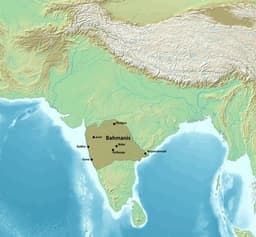
Muhammad Shah I Bahmani
Emperor · Medieval
54.3Total

Richard of Cornwall
Emperor · Medieval
45.4Total
Basic Information
Born
1358
1209
Died
1375
1272
Era
Medieval
Medieval
Nationality
India
Holy Roman Empire
Occupation
Emperor
Emperor
Civilization
Indian
Western
Score Comparison
Military (10%)
25.0
50.0
Political (20%)
62.7
40.8
Influence (20%)
60.0
51.8
Legacy (20%)
49.2
40.0
Leadership (15%)
66.0
55.3
Strategy (15%)
51.7
30.3
TOTAL
54.3
45.4
Muhammad Shah I Bahmani — Complete Timeline
1360 AD
Reorganization of Bahmani administrationReform◆ Major
Muhammad Shah I Bahmani restructured the Bahmani administration by dividing the sultanate into four provinces (tarafs), each governed by a tarafdar. This system improved tax collection and military organization.
Administrative ReformProvincial System
Impact: regionalconstructive
1365 AD
War with Vijayanagara over Raichur DoabWar◆ Major
Muhammad Shah I Bahmani fought a war against the Vijayanagara Empire for control of the Raichur Doab. The conflict ended with a treaty that temporarily ceded the region to Vijayanagara.
WarVijayanagaraTerritorial Dispute
Impact: regional
1367 AD
Construction of the Jami Masjid at GulbargaCultural
Muhammad Shah I Bahmani commissioned the construction of the Jami Masjid in Gulbarga, a large congregational mosque. The mosque became a center for Islamic worship and learning in the Bahmani capital.
ArchitectureReligion
constructive
1370 AD
Suppression of the rebellion of Bahram KhanPolitical Action
Muhammad Shah I Bahmani crushed a rebellion led by the noble Bahram Khan, who had challenged his authority. The revolt was put down with force, and Bahram Khan was executed.
RebellionInternal Conflict
Impact: nationaldestructive
Richard of Cornwall — Complete Timeline
1257 AD
Elected King of GermanyPolitical Action◆ Major
Richard of Cornwall was elected King of Germany by a faction of prince-electors, opposing Alfonso X of Castile. This election was part of the Great Interregnum, with Richard receiving support from the English crown and the Papacy.
ElectionGreat InterregnumEnglish Influence
Impact: regional
Crowned King of GermanyPolitical Action◆ Major
Richard of Cornwall was crowned King of Germany in Aachen by the Archbishop of Cologne. His coronation was contested by Alfonso X, and Richard's authority was largely confined to the Rhineland and parts of southern Germany.
CoronationGreat InterregnumRival Claimant
Impact: regional
1262 AD
Returned to EnglandPolitical Action
Richard of Cornwall returned to England after spending several years in Germany. His departure weakened his influence in the Holy Roman Empire, and he never returned, leaving the German throne contested until the end of the Great Interregnum.
ReturnEnglandGreat Interregnum
Impact: regional
1272 AD
Died in EnglandOther◆ Major
Richard of Cornwall died at Berkhamsted Castle in England. His death ended his claim to the German throne, and he was succeeded by Rudolf of Habsburg, who ended the Great Interregnum.
DeathGreat InterregnumEnd of Claim
Impact: regional
Expert Analysis
Origins
Muhammad Shah I Bahmani was born around 1338 into the Bahmani dynasty, founded by his father Ala-ud-Din Bahman Shah in 1347. He grew up in the nascent sultanate centered at Gulbarga, receiving training in administration and warfare. His early life was shaped by the ongoing conflicts with the Vijayanagara Empire and internal noble factions.
Richard of Cornwall was born on 5 January 1209 at Winchester Castle, the second son of King John of England and Isabella of Angoulême. As a younger prince, he was not expected to inherit the throne but accumulated vast wealth through his marriage to Sanchia of Provence and his role as Earl of Cornwall. His education focused on governance and diplomacy, preparing him for a career in English politics.
Rise to Power
Muhammad Shah I ascended the throne in 1358 after the death of his father. His rise was smooth due to his father's establishment of the dynasty. He immediately faced challenges from powerful nobles, including Bahram Khan, whom he suppressed in 1360. His major test came with the war against Vijayanagara over the Raichur Doab (1367-1368). The conflict ended with a treaty that temporarily secured the disputed territory, bolstering his reputation.
Richard of Cornwall's path to power was unconventional. During the Great Interregnum in the Holy Roman Empire, he was elected King of Germany on 13 January 1257 by a faction of prince-electors, opposing Alfonso X of Castile. Richard spent money to secure votes, leveraging his wealth. He was crowned in Aachen on 17 May 1257 by the Archbishop of Cologne, but his authority was never fully recognized outside his supporters. He made only four brief visits to Germany, spending most of his time in England.
Leadership & Governance
Muhammad Shah I reorganized the Bahmani administration by dividing the sultanate into four provinces (tarafs), each governed by a tarafdar. This decentralized system improved tax collection and military recruitment. He also commissioned the Jami Masjid at Gulbarga, fostering Islamic culture. His leadership score of 66.0 reflects his effective governance, though his military score of 25.0 indicates limited direct military innovation.
Richard of Cornwall's governance was limited. As king, he issued charters and acted as a mediator, but his absence from Germany meant he had little impact on local administration. He focused on securing revenues from his English estates, scoring 40.8 in political and 30.3 in strategy. His leadership score of 55.3 stems from his diplomatic efforts, but he failed to consolidate power in the empire.
Triumph & Tragedy
Muhammad Shah I's greatest success was the administrative reorganization that stabilized the Bahmani Sultanate, earning him a political score of 62.7. His war with Vijayanagara ended in a stalemate but secured the Raichur Doab temporarily. However, his failure to expand territory significantly and the eventual resumption of conflict with Vijayanagara after his death were drawbacks. His legacy score of 49.2 reflects enduring structures but limited personal fame.
Richard of Cornwall's triumph was his election and coronation as German king, a rare achievement for an English prince. He also accumulated immense wealth, becoming one of the richest men in England. His tragedy was his inability to exert real authority in Germany; he spent only a few years there and returned to England in 1262, where he died in 1272. His influence score of 51.8 and legacy score of 40.0 indicate a fleeting impact.
Character & Destiny
Muhammad Shah I was pragmatic and administrative, focusing on building state institutions. His suppression of rebellions shows a firm hand, but his relatively peaceful reign allowed the sultanate to consolidate. His total score of 54.3 reflects a balanced but unspectacular rule.
Richard of Cornwall was ambitious and wealthy, but his character led him to overreach. He sought a crown without the commitment to rule effectively. His decision to return to England sealed his fate as a titular king. His total score of 45.4 underscores his limited success.
Legacy
Muhammad Shah I's administrative divisions influenced later Deccan sultanates, and the Jami Masjid remains a historical monument. His reforms laid the groundwork for the Bahmani Sultanate's longevity until its fragmentation in 1518.
Richard of Cornwall's legacy is minimal. His election contributed to the Great Interregnum's complexity, but he is remembered primarily as a footnote in German history. His wealth and English titles have more lasting recognition.
Conclusion
Muhammad Shah I Bahmani had a greater impact than Richard of Cornwall. With a total score of 54.3 against 45.4, his administrative reforms shaped a sultanate that lasted over a century, while Richard's kingship was ephemeral. Muhammad Shah's political and leadership scores (62.7 and 66.0) contrast sharply with Richard's 40.8 and 55.3. Though neither was a transformative figure, Muhammad Shah's concrete contributions to governance outweigh Richard's symbolic reign. Therefore, Muhammad Shah I Bahmani is the more significant historical figure.
Rankings
🥇
Muhammad Shah I BahmaniLeader
Mil: 25.0Pol: 62.7Inf: 60.0
54.3
🥈
Richard of Cornwall
Mil: 50.0Pol: 40.8Inf: 51.8
45.4
+8.9 behind
How This Comparison Works
Algorithm
Each figure is scored on 6 dimensions (0—100 scale) based on structured historical data: Military (10%), Political (20%), Influence (20%), Legacy (20%), Leadership (15%), Strategy (15%). The weighted total produces the final ranking.
Data Sources
Scores are computed from structured sub-indicators in the database. Scale factors adjust for era (Ancient ×0.85, Modern ×1.0) and civilization size (Eastern ×1.05, Other ×0.80) to account for differences in population and military scale.
Maximum 3 Figures
Comparisons are limited to 2—3 figures to ensure readability and statistical meaningfulness.
Error Margins
±5 points per dimension — Sub-scores are derived from historical records with inherent uncertainty. Two figures within 5 points on a dimension should be considered roughly equivalent in that area.
Total Score Accuracy
±3 points overall — The weighted combination of 6 dimensions produces a total score with approximately ±3 points of uncertainty. Differences of less than 3 points are not statistically significant— the figures are effectively tied.
Known Limitations
- Historical records are incomplete and uneven across civilizations
- Figures from oral-tradition societies may be underrepresented
- Occupation labels can misclassify multi-role figures
- Scores measure capability and impact, not moral character
- Quantitative scoring is a comparison tool, not absolute truth
Capability Radar
Military (10%) — Battles & Warfare
Battles
45
20
Win Rate
50
25
Expansion
40
10
Political (20%) — Governance & Reform
Reform
65
15
Diplomacy
55
45
Economy
50
50
Influence (20%) — Cultural & Global Reach
Cultural
40
20
Global
30
20
Legacy (20%) — Historical Impact
Historical
45
25
Longevity
40
15
Leadership (15%) — Power & Stability
Tenure
60
40
Stability
55
30
Strategy (15%) — Tactics & Innovation
Strategy
45
20
Tactics
40
15
Reform
55
5
Similar Comparisons
Comments & Discussion
No comments yet. Be the first to share your thoughts!