Loading...
Moeletsi Mbeki vs Zhao Ziyang
Zhao Ziyang leads by 5.3 pts · 2 figures compared
…

Moeletsi Mbeki
Politician · Modern
42.4Total
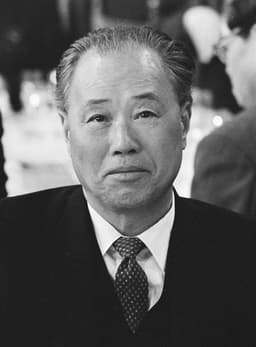
Zhao Ziyang
Politician · Modern
47.7Total
Basic Information
Born
1945
1919
Died
—
2005
Era
Modern
Modern
Nationality
South Africa
China
Occupation
Politician
Politician
Civilization
Other
Eastern
Score Comparison
Military (10%)
46.1
13.4
Political (20%)
26.4
45.0
Influence (20%)
48.6
56.4
Legacy (20%)
35.8
46.7
Leadership (15%)
58.8
74.0
Strategy (15%)
39.2
27.5
TOTAL
42.4
47.7
Zhao Ziyang — Complete Timeline
1980 AD
Appointed Premier of the People's Republic of ChinaPolitical Action◆ Major
Zhao Ziyang succeeded Hua Guofeng as Premier. He implemented Deng Xiaoping's economic reforms, including the household responsibility system and the opening of Special Economic Zones.
Economic ReformPremiership
Impact: nationalconstructive
1987 AD
Appointed General Secretary of the Communist PartyPolitical Action◆ Major
Zhao Ziyang became General Secretary after Hu Yaobang's resignation. He continued economic reforms but faced growing pressure from conservative factions within the party.
Party LeadershipReform Era
Impact: national
1989 AD
Sympathized with Tiananmen Square ProtestersPolitical Action
During the Tiananmen Square protests, Zhao Ziyang visited the protesters and expressed sympathy, opposing the use of force. This led to his purge and house arrest for the rest of his life.
Tiananmen SquarePurge
Impact: globaltragic
Purged and Placed Under House ArrestPolitical Action◆ Major
Zhao Ziyang was removed from all posts and placed under house arrest after the Tiananmen Square crackdown. He was replaced by Jiang Zemin and lived in seclusion until his death in 2005.
PurgeHouse Arrest
Impact: nationaltragic
Expert Analysis
Origins
Moeletsi Mbeki, born in 1945 in South Africa, is the younger brother of former President Thabo Mbeki. He grew up in a politically active family; his father, Govan Mbeki, was a prominent anti-apartheid activist and member of the African National Congress (ANC). Moeletsi was educated at the University of Sussex and later worked as an economist and political analyst. His formative experiences were shaped by the anti-apartheid struggle and his family's involvement in the ANC, though he remained more of an intellectual commentator rather than a frontline politician.
Zhao Ziyang, born in 1919 in Huaxian, Henan, China, came from a modest farming family. He joined the Chinese Communist Party (CCP) in 1938 and fought in the Chinese Civil War. He rose through the ranks as a party official in Guangdong and Sichuan, gaining a reputation for pragmatic economic management. His early experiences in rural China and his role in implementing land reforms shaped his later advocacy for agricultural decollectivization.
Rise to Power
Moeletsi Mbeki never held high political office. His influence came as a deputy chairman of the South African Institute of International Affairs and as a commentator on African affairs. He was a critic of ANC policies, particularly on economic issues, but his platform remained limited to academic and policy circles. His rise was more about intellectual influence than political power.
Zhao Ziyang rose rapidly after the Cultural Revolution. He became Premier in 1980, succeeding Hua Guofeng, and later General Secretary of the CCP in 1987. His rise was propelled by his successful implementation of Deng Xiaoping's economic reforms in Sichuan, where he introduced the household responsibility system that boosted agricultural output. He was a key figure in China's transition from Maoist planning to market-oriented reforms.
Leadership & Governance
Moeletsi Mbeki's leadership style is that of a critical analyst. He has written extensively on Africa's development challenges, arguing that the continent's elites have failed to foster inclusive growth. He scores 58.8 in leadership, reflecting his role as a thought leader rather than a decision-maker. His governance approach is indirect, influencing policy through publications and media appearances.
Zhao Ziyang scored 74.0 in leadership, indicating strong performance within the CCP structure. He was a reformist leader who pushed for political liberalization alongside economic changes. He advocated for "socialist democracy" and opposed the use of force against Tiananmen Square protesters. However, his governance was constrained by conservative factions within the party, leading to his purge in 1989. His leadership was characterized by a willingness to engage with dissenting voices, as seen when he visited the hunger strikers in Tiananmen Square.
Triumph & Tragedy
Moeletsi Mbeki's greatest success is his intellectual contribution to African economic discourse, particularly his critique of neopatrimonialism and the failure of post-colonial states. His book "Advocates for Change" is a notable work. However, his lack of political power limits his impact; he has not enacted any policies or held executive office. His failure lies in being unable to translate his ideas into concrete change, scoring only 26.4 in political power.
Zhao Ziyang's triumph was his role in China's economic reform. He championed the household responsibility system that lifted millions out of poverty and oversaw the opening of special economic zones. His tragedy is his purge after Tiananmen. He opposed the crackdown, visited protesters, and was placed under house arrest for 15 years until his death in 2005. His legacy is overshadowed by his downfall, yet his reforms endured.
Character & Destiny
Moeletsi Mbeki is a cautious intellectual, often critical of his brother's government but loyal to the ANC. His character is that of an insider critic, which has allowed him to remain relevant but not powerful. His destiny is to be a respected but marginal figure in South African history.
Zhao Ziyang was a principled reformer who believed in gradual political change. His decision to side with the protesters sealed his fate. He could have survived politically by staying silent, but his character drove him to act. His destiny was to be a martyr for Chinese democracy, though his reforms were continued by successors like Jiang Zemin.
Legacy
Moeletsi Mbeki's legacy is limited. He is known among Africanists for his critiques, but his influence scores 48.6, reflecting moderate recognition. He will be remembered as an analyst, not a shaper of events.
Zhao Ziyang's legacy is complex. In China, his name is still taboo, but his economic reforms are credited with laying the groundwork for China's growth. Globally, he is seen as a tragic figure who stood for peaceful protest. His legacy score of 46.7 is depressed by official suppression, but his impact on China's trajectory is immense. He scored 56.4 in influence, higher than Mbeki's 48.6.
Conclusion
Zhao Ziyang had greater impact than Moeletsi Mbeki. His TOTAL score of 47.7 exceeds Mbeki's 42.4, and his leadership score of 74.0 dwarfs Mbeki's 58.8. While Mbeki is an insightful analyst, Zhao Ziyang's decisions reshaped the lives of hundreds of millions. His economic reforms transformed China, and his stand at Tiananmen Square remains a defining moment in modern history. Moeletsi Mbeki, despite being well-intentioned, never held power and his ideas have not translated into policy. Thus, Zhao Ziyang is the more consequential figure.
Rankings
🥇
Zhao ZiyangLeader
Mil: 13.4Pol: 45.0Inf: 56.4
47.7
🥈
Moeletsi Mbeki
Mil: 46.1Pol: 26.4Inf: 48.6
42.4
+5.3 behind
How This Comparison Works
Algorithm
Each figure is scored on 6 dimensions (0—100 scale) based on structured historical data: Military (10%), Political (20%), Influence (20%), Legacy (20%), Leadership (15%), Strategy (15%). The weighted total produces the final ranking.
Data Sources
Scores are computed from structured sub-indicators in the database. Scale factors adjust for era (Ancient ×0.85, Modern ×1.0) and civilization size (Eastern ×1.05, Other ×0.80) to account for differences in population and military scale.
Maximum 3 Figures
Comparisons are limited to 2—3 figures to ensure readability and statistical meaningfulness.
Error Margins
±5 points per dimension — Sub-scores are derived from historical records with inherent uncertainty. Two figures within 5 points on a dimension should be considered roughly equivalent in that area.
Total Score Accuracy
±3 points overall — The weighted combination of 6 dimensions produces a total score with approximately ±3 points of uncertainty. Differences of less than 3 points are not statistically significant— the figures are effectively tied.
Known Limitations
- Historical records are incomplete and uneven across civilizations
- Figures from oral-tradition societies may be underrepresented
- Occupation labels can misclassify multi-role figures
- Scores measure capability and impact, not moral character
- Quantitative scoring is a comparison tool, not absolute truth
Capability Radar
Military (10%) — Battles & Warfare
Battles
21
17
Win Rate
25
16
Expansion
28
19
Political (20%) — Governance & Reform
Reform
10
65
Diplomacy
20
55
Economy
15
60
Influence (20%) — Cultural & Global Reach
Cultural
10
30
Global
10
40
Legacy (20%) — Historical Impact
Historical
10
45
Longevity
5
35
Leadership (15%) — Power & Stability
Tenure
0
60
Stability
5
30
Strategy (15%) — Tactics & Innovation
Strategy
33
25
Tactics
35
28
Reform
37
30
Similar Comparisons
Comments & Discussion
No comments yet. Be the first to share your thoughts!