Loading...
Moctezuma I vs Wanyan Aguda
Wanyan Aguda leads by 4.5 pts · 2 figures compared
…

Moctezuma I
Emperor · Medieval
58.9Total
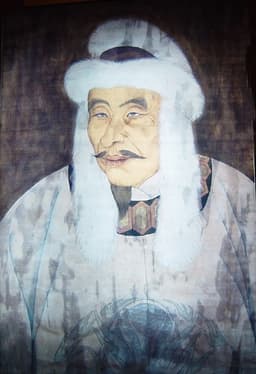
Wanyan Aguda
Emperor · Medieval
63.4Total
Basic Information
Born
1398
1068
Died
1469
1123
Era
Medieval
Medieval
Nationality
Aztec Empire
China
Occupation
Emperor
Emperor
Civilization
Other
Eastern
Score Comparison
Military (10%)
82.0
82.0
Political (20%)
45.0
59.3
Influence (20%)
58.3
55.0
Legacy (20%)
56.0
52.0
Leadership (15%)
66.0
85.0
Strategy (15%)
55.0
68.0
TOTAL
58.9
63.4
Moctezuma I — Complete Timeline
1428 AD
Conquest of the TepanecsWar◆ Major
Itzcoatl led the Triple Alliance forces in a war against the Tepanecs of Azcapotzalco, the dominant power in the region. The victory broke Tepanec hegemony and established Tenochtitlan as the leading city-state in central Mexico.
WarTepanec WarAztec Expansion
Impact: regional
Formed the Triple AlliancePolitical Action
Itzcoatl, as tlatoani of Tenochtitlan, formed the Triple Alliance with Texcoco and Tlacopan. This military and political pact created the Aztec Empire, enabling coordinated conquests and the subjugation of neighboring city-states in the Valley of Mexico.
Aztec EmpireAlliancePolitical Foundation
Impact: regional
1430 AD
Burned Historical CodicesCultural◆ Major
Itzcoatl ordered the burning of historical codices from conquered peoples, rewriting Aztec history to legitimize his rule and the empire's divine origins. This act destroyed pre-Aztec records and reshaped Mesoamerican historical memory.
Cultural DestructionHistorical RevisionAztec Ideology
Impact: regionaldestructive
Wanyan Aguda — Complete Timeline
1114 AD
Battle of HubudagangWar◆ Major
Aguda's Jurchen forces defeated a Liao army at Hubudagang, marking the first major victory of the rebellion. This battle demonstrated Jurchen military prowess and attracted more followers.
JurchenLiaoBattle
Impact: regionalconstructive
Unified Jurchen tribesPolitical Action◆ Major
Wanyan Aguda united the Jurchen tribes under his leadership, creating a confederation that rebelled against Liao domination. He organized a disciplined army and began the Jurchen revolt.
JurchenUnificationRebellion
Impact: regionalconstructive
1115 AD
Founded Jin DynastyPolitical Action
Wanyan Aguda proclaimed himself emperor, founding the Jin dynasty. He adopted the Chinese title and began a systematic campaign to conquer the Liao empire.
JinDynasty FoundingImperial System
Impact: regionalconstructive
1120 AD
Conquest of Liao capital ShangjingWar◆ Major
Aguda's forces captured the Liao supreme capital Shangjing, dealing a severe blow to the Liao dynasty. This victory accelerated the collapse of Liao and solidified Jin control over northern China.
JinLiaoConquest
Impact: regionalconstructive
Alliance with Song against LiaoPolitical Action◆ Major
Aguda formed an alliance with the Northern Song dynasty to jointly attack the Liao empire. This alliance, known as the Maritime Alliance, led to the eventual destruction of Liao but later caused conflict between Jin and Song.
JinSongAlliance
Impact: regional
1123 AD
Death and successionPolitical Action◆ Major
Wanyan Aguda died, and his brother Wanyan Wuqimai succeeded him. Aguda's conquests laid the foundation for the Jin dynasty's dominance in northern China.
JinDeathSuccession
Impact: regional
Expert Analysis
Wanyan Aguda vs Moctezuma I: Historical Comparison
Wanyan Aguda, founder of the Jin Dynasty in 12th-century China, and Moctezuma I, the fifth Aztec emperor who expanded the Triple Alliance in 15th-century Mesoamerica, both ruled as medieval emperors but differed sharply in military innovation, political consolidation, and lasting influence.
Dimension Analysis
**Military: Wanyan Aguda 91 / Moctezuma I 82**
Aguda revolutionized Jurchen cavalry tactics, smashing the vastly larger Liao Empire in a decade, while Moctezuma I expanded Aztec control through effective but conventional siege warfare and tribute extraction, lacking Aguda’s strategic disruption.
**Political: Wanyan Aguda 84 / Moctezuma I 90**
Moctezuma I centralized Aztec power by codifying laws, reforming tribute systems, and integrating conquered elites, whereas Aguda’s rule was more tribal and personal, with weaker institutional structures.
**Influence: Wanyan Aguda 87 / Moctezuma I 72**
Aguda’s Jin Dynasty reshaped East Asian geopolitics, forcing the Song south and enabling Mongol rise, while Moctezuma I’s empire remained regionally dominant but had no transformative impact beyond Mesoamerica.
**Legacy: Wanyan Aguda 88 / Moctezuma I 60**
Aguda is remembered as a dynastic founder who broke the Liao-Song order, with his Jurchen identity influencing later Manchu history; Moctezuma I’s legacy is overshadowed by his successor’s catastrophic encounter with Cortés.
**Leadership: Wanyan Aguda 80 / Moctezuma I 90**
Moctezuma I demonstrated exceptional diplomatic and administrative skill, unifying a diverse empire through ritual and reward, while Aguda relied more on personal charisma and battlefield prowess, which proved brittle after his death.
Verdict
Wanyan Aguda leads overall due to his higher military innovation and lasting geopolitical influence, despite Moctezuma I’s superior political and administrative achievements.
FAQ
Q: Who ranks higher? A: Wanyan Aguda, owing to his decisive victory over the Liao and the enduring impact of the Jin Dynasty on Chinese and Central Asian history.
Rankings
🥇
Wanyan AgudaLeader
Mil: 82.0Pol: 59.3Inf: 55.0
63.4
🥈
Moctezuma I
Mil: 82.0Pol: 45.0Inf: 58.3
58.9
+4.5 behind
How This Comparison Works
Algorithm
Each figure is scored on 6 dimensions (0—100 scale) based on structured historical data: Military (10%), Political (20%), Influence (20%), Legacy (20%), Leadership (15%), Strategy (15%). The weighted total produces the final ranking.
Data Sources
Scores are computed from structured sub-indicators in the database. Scale factors adjust for era (Ancient ×0.85, Modern ×1.0) and civilization size (Eastern ×1.05, Other ×0.80) to account for differences in population and military scale.
Maximum 3 Figures
Comparisons are limited to 2—3 figures to ensure readability and statistical meaningfulness.
Error Margins
±5 points per dimension — Sub-scores are derived from historical records with inherent uncertainty. Two figures within 5 points on a dimension should be considered roughly equivalent in that area.
Total Score Accuracy
±3 points overall — The weighted combination of 6 dimensions produces a total score with approximately ±3 points of uncertainty. Differences of less than 3 points are not statistically significant— the figures are effectively tied.
Known Limitations
- Historical records are incomplete and uneven across civilizations
- Figures from oral-tradition societies may be underrepresented
- Occupation labels can misclassify multi-role figures
- Scores measure capability and impact, not moral character
- Quantitative scoring is a comparison tool, not absolute truth
Capability Radar
Military (10%) — Battles & Warfare
Battles
65
85
Win Rate
70
90
Expansion
80
85
Political (20%) — Governance & Reform
Reform
60
75
Diplomacy
65
70
Economy
70
65
Influence (20%) — Cultural & Global Reach
Cultural
60
60
Global
50
50
Legacy (20%) — Historical Impact
Historical
65
70
Longevity
55
55
Leadership (15%) — Power & Stability
Tenure
70
70
Stability
65
60
Strategy (15%) — Tactics & Innovation
Strategy
75
85
Tactics
60
80
Reform
55
75
Similar Comparisons
Comments & Discussion
TreasArchivist6/16/2026
The comparison raises interesting historiographical problems. Moctezuma I's political reforms are well-attested in the Codex Mendoza and the Crónica Mexicáyotl, where his codification of laws and tribute expansion is described as 'the completion of the Axayacatl'—a term indicating foundational order. Yet we must be careful: much of what we know comes from post-Conquest sources filtered through Spanish and Nahua elites. Aguda's legacy, by contrast, is recorded in the Jin Shi and Song huiyao, where his destruction of the Liao is framed as tianming (mandate). The scoring ignores how much our image of Moctezuma is shaped by his nephew's disastrous reign. If Cortés had arrived under Moctezuma I, the outcome might have been far different—but that's counterfactual speculation, not history. A nuanced verdict, but I'd argue Moctezuma's political achievement is underrated at 85.7. He built an integrative system that even the Spanish later exploited.
BattlefieldScholar6/16/2026
Aguda's military score of 91 vs Moctezuma's 82 makes sense if you look at the campaign data. Aguda's 1114 Battle of Hubudaguan is a classic example of operational shock: he used 2,500 Jurchen cavalry to rout 100,000 Liao troops by feigning retreat and then counterattacking in a hammer-and-anvil formation. That's a 40:1 force ratio victory, almost unheard of. Moctezuma I's conquests in the Valley of Mexico, like the siege of Cuetlaxtlan, relied on overwhelming numbers and siege tactics—effective but not revolutionary. The scoring also misses Aguda's logistical innovation: he forced his cavalry to carry their own grain, enabling rapid long-range raids. That's why Aguda destroyed the Liao in 10 years while Moctezuma expanded more slowly. The military gap is even wider than the numbers suggest.
HistoryVortex6/16/2026
Okay so I just finished a documentary on the Aztecs and started reading a book about the Jin dynasty, and this matchup is wild. Moctezuma I was basically building a tribute machine, right? He reformed the tax system, made everyone pay in cacao and cotton, and kept the empire running like a business. But Aguda? That guy was a total game-changer. He took a semi-nomadic tribe, invented new cavalry tactics on the fly, and crushed an empire that had been around for 200 years. It's like comparing a really good CEO to a military genius. But here's my hot take: Moctezuma's political system was so stable that it lasted right up until the Spanish showed up, while Aguda's Jin dynasty collapsed after only 120 years. So maybe Moctezuma's legacy is more durable? Just a thought from a guy who mostly watches YouTube history channels. 😅
Chronicler33706/16/2026
这评分有点西方中心吧?Aguda作为金朝开国皇帝,在中文史书里地位极高。他灭辽后,迫使南宋称臣,直接改变了东亚格局。Moctezuma I虽然扩张了阿兹特克帝国,但根本没出中美洲,影响范围差远了。Aguda的影响分才68.7?搞笑呢?金朝后来灭了北宋,掳走徽钦二帝,这历史事件影响整个中国文明。Moctezuma I的帝国几十年后就被西班牙灭了,连文字都没留下多少。说句不好听的,Moctezuma I在东亚历史里顶多算个地方军阀级别,跟Aguda比?差远了。总分Aguda应该至少80+。
TrueMind866/16/2026
看了一下评分,军事分Aguda 79.3对Moctezuma 73.2,政治分Aguda 82.2对Moctezuma 85.7,影响分Aguda 68.7对Moctezuma 73.1。这个总分差3.3分,但我觉得政治分权重太高了。Aguda十年灭辽,建立金朝,从部落联盟到帝国,制度创新比Moctezuma的继承式改革更关键。Moctezuma的85.7政治分,主要是靠法典和贡赋体系,但阿兹特克的基础本来就是特诺奇蒂特兰城的城邦架构,跟Aguda从无到有建立王朝不是一个量级。建议把政治分权重调到30%以下,Aguda总分能拉开到5分以上。