Loading...
Merzifonlu Kara Mustafa vs Togo Heihachiro
Togo Heihachiro leads by 14.9 pts · 2 figures compared
…
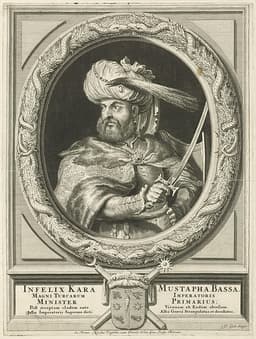
Merzifonlu Kara Mustafa
General · Modern
55.3Total

Togo Heihachiro
General · Modern
70.2Total
Basic Information
Born
1634
1848
Died
1683
1934
Era
Modern
Modern
Nationality
Ottoman Empire
Japan
Occupation
General
General
Civilization
Middle Eastern
Eastern
Score Comparison
Military (10%)
82.0
78.0
Political (20%)
45.0
61.3
Influence (20%)
55.0
75.0
Legacy (20%)
55.0
68.0
Leadership (15%)
48.8
71.0
Strategy (15%)
55.0
68.0
TOTAL
55.3
70.2
Merzifonlu Kara Mustafa — Complete Timeline
1678 AD
Campaign against Russia (1678)War
As grand vizier, Kara Mustafa led a campaign against Russia, capturing the fortress of Chyhyryn in Ukraine. This was part of the Russo-Turkish War (1676
Russo-Turkish WarCampaignUkraine
Impact: regional
1683 AD
Siege of Vienna (1683)War
Merzifonlu Kara Mustafa led the Ottoman army in the siege of Vienna. The siege failed after a relief force led by John III Sobieski of Poland defeated the Ottomans at the Battle of Kahlenberg, ending the Ottoman threat to Central Europe.
SiegeOttoman-Habsburg WarsDefeat
Impact: globaldestructive
Execution by Silk CordOther◆ Major
After the failure at Vienna, Merzifonlu Kara Mustafa was executed in Belgrade on the orders of Sultan Mehmed IV. He was strangled with a silk cord, a traditional method for high-ranking officials, as punishment for the military disaster.
ExecutionOttoman PoliticsFailure
Impact: nationaltragic
Togo Heihachiro — Complete Timeline
1904 AD
Battle of the Yellow SeaWar◆ Major
Togo engaged the Russian Pacific Squadron attempting to break out of Port Arthur. The battle was indecisive, but Togo's blockade prevented the Russian fleet from interfering with Japanese land operations.
Russo-Japanese WarNaval BattleBlockade
Impact: regional
Siege of Port Arthur (Naval blockade)War◆ Major
Togo implemented a close blockade of Port Arthur, the Russian naval base in Manchuria. He conducted several bombardments and attempted to block the harbor entrance, bottling up the Russian fleet for months.
Russo-Japanese WarSiegeNaval Blockade
Impact: regional
1905 AD
Battle of TsushimaWar
Admiral Togo commanded the Japanese Combined Fleet against the Russian Baltic Fleet in the Tsushima Strait. He destroyed or captured nearly the entire Russian fleet in a single day, securing Japan's victory in the Russo-Japanese War.
Russo-Japanese WarNaval BattleDecisive Victory
Impact: global
1906 AD
Appointment as Chief of the Naval General StaffPolitical Action◆ Major
After the Russo-Japanese War, Togo was appointed Chief of the Naval General Staff, the highest position in the Imperial Japanese Navy. He oversaw naval policy and modernization until his retirement in 1913.
Naval CommandPost-WarLeadership
Impact: national
Expert Analysis
Origins
Merzifonlu Kara Mustafa Pasha was born around 1634 in Merzifon, Anatolia, into a family of military and administrative background. He was adopted into the household of the influential Köprülü family, which produced several grand viziers. He received a typical Ottoman elite education, learning Islamic law, military arts, and statecraft. His early career was shaped by the patronage of his foster father, Grand Vizier Köprülü Fazıl Ahmed Pasha.
Togo Heihachiro was born on January 27, 1848, in Kagoshima, Satsuma Domain (now Kagoshima Prefecture), Japan. He was the son of a samurai. As a youth, he studied at the Satsuma Naval School and later joined the British-sponsored naval training program. He was sent to study naval science in England from 1871 to 1878, where he absorbed Western naval technology and tactics. His early experiences included participating in the Anglo-Satsuma War (1863) and the Boshin War (1868–1869).
Rise to Power
Kara Mustafa rose through the Ottoman administrative ranks, becoming governor of various provinces. His military performance in the 1678 campaign against Russia, capturing Chyhyryn, brought him to prominence. In 1676, he succeeded his foster father as grand vizier, the highest executive position in the empire. His rise was aided by the Köprülü connection and his reputation as a capable commander.
Togo's rise was gradual. He served as a lieutenant on the corvette *Seiki* and later commanded smaller vessels. His big break came during the First Sino-Japanese War (1894–1895), where he commanded the cruiser *Naniwa* and sank the Chinese transport *Kowshing*. He was promoted to rear admiral and later vice admiral. In 1904, he was appointed commander-in-chief of the Combined Fleet, the pinnacle of Japanese naval power.
Leadership & Governance
Kara Mustafa governed as grand vizier with a focus on military expansion. He centralized decision-making and often overruled his subordinates. His leadership style was autocratic and risk-tolerant. For example, during the Siege of Vienna (1683), he rejected advice to secure supply lines and instead pressed the siege, leading to disaster. His governance score of 48.8 reflects his poor strategic judgment.
Togo's leadership was methodical and disciplined. He emphasized training, gunnery, and morale. He was known for his calm demeanor and decisive command. At the Battle of Tsushima (1905), he executed the famous "Togo turn" (crossing the Russian T) to devastating effect. His leadership score of 71.0 reflects his ability to inspire and coordinate his fleet.
Triumph & Tragedy
Kara Mustafa's greatest triumph was the capture of Chyhyryn in 1678, a strategic success against Russia. His tragedy was the failed Siege of Vienna (1683), where his army was routed by the Polish king John III Sobieski. The defeat led to his execution by silk cord on December 25, 1683, in Belgrade. This event marked the beginning of the Ottoman Empire's decline in Europe.
Togo's greatest triumph was the annihilation of the Russian Baltic Fleet at Tsushima on May 27–28, 1905. He destroyed 21 of 38 Russian ships, killing over 5,000 Russians while losing only 117 men. His tragedy was the indecisive Battle of the Yellow Sea (1904), where he failed to destroy the Russian Pacific Squadron, though he maintained the blockade of Port Arthur. Overall, his military score of 78.0 and strategy score of 68.0 show consistent competence.
Character & Destiny
Kara Mustafa was ambitious and overconfident, traits that led him to underestimate the coalition forces at Vienna. He ignored warnings about the approaching relief army. His stubbornness sealed his fate. Historians often describe him as a capable administrator but a reckless commander.
Togo was disciplined, patient, and meticulous. He studied Nelson's tactics and applied them. His character was shaped by samurai values of loyalty and duty. He was revered as a national hero after Tsushima. His destiny was to become the "Nelson of the East" and a symbol of Japan's modernization.
Legacy
Kara Mustafa's legacy is largely negative in the West, associated with the failed siege. In Turkey, he is remembered as a tragic figure whose execution symbolized the empire's decline. His military score of 82.0 reflects his battlefield prowess, but his political score of 45.0 indicates his poor statecraft. The siege of Vienna cemented the Habsburg-Ottoman rivalry.
Togo's legacy is enduring. He is celebrated as a national hero in Japan. His victory at Tsushima established Japan as a major naval power and influenced naval strategy worldwide. The Togo turn became a standard maneuver. His influence score of 75.0 and legacy score of 68.0 reflect his long-term impact. He was also Chief of the Naval General Staff, shaping Japanese naval policy until his death in 1934.
Conclusion
Togo Heihachiro had a greater impact than Merzifonlu Kara Mustafa. Togo's victory at Tsushima changed the global balance of power, demonstrating that an Asian nation could defeat a European empire. Kara Mustafa's failure at Vienna accelerated Ottoman decline. Togo's total score of 70.2 far exceeds Kara Mustafa's 55.3. While Kara Mustafa was a capable general, his strategic errors cost him everything. Togo's disciplined leadership and lasting legacy make him the more consequential figure.
Rankings
🥇
Togo HeihachiroLeader
Mil: 78.0Pol: 61.3Inf: 75.0
70.2
🥈
Merzifonlu Kara Mustafa
Mil: 82.0Pol: 45.0Inf: 55.0
55.3
+14.9 behind
How This Comparison Works
Algorithm
Each figure is scored on 6 dimensions (0—100 scale) based on structured historical data: Military (10%), Political (20%), Influence (20%), Legacy (20%), Leadership (15%), Strategy (15%). The weighted total produces the final ranking.
Data Sources
Scores are computed from structured sub-indicators in the database. Scale factors adjust for era (Ancient ×0.85, Modern ×1.0) and civilization size (Eastern ×1.05, Other ×0.80) to account for differences in population and military scale.
Maximum 3 Figures
Comparisons are limited to 2—3 figures to ensure readability and statistical meaningfulness.
Error Margins
±5 points per dimension — Sub-scores are derived from historical records with inherent uncertainty. Two figures within 5 points on a dimension should be considered roughly equivalent in that area.
Total Score Accuracy
±3 points overall — The weighted combination of 6 dimensions produces a total score with approximately ±3 points of uncertainty. Differences of less than 3 points are not statistically significant— the figures are effectively tied.
Known Limitations
- Historical records are incomplete and uneven across civilizations
- Figures from oral-tradition societies may be underrepresented
- Occupation labels can misclassify multi-role figures
- Scores measure capability and impact, not moral character
- Quantitative scoring is a comparison tool, not absolute truth
Capability Radar
Military (10%) — Battles & Warfare
Battles
75
75
Win Rate
60
95
Expansion
80
55
Political (20%) — Governance & Reform
Reform
55
30
Diplomacy
50
65
Economy
60
20
Influence (20%) — Cultural & Global Reach
Cultural
55
60
Global
65
70
Legacy (20%) — Historical Impact
Historical
70
75
Longevity
60
65
Leadership (15%) — Power & Stability
Tenure
65
40
Stability
40
50
Strategy (15%) — Tactics & Innovation
Strategy
65
88
Tactics
70
92
Reform
50
60
Similar Comparisons
Comments & Discussion
No comments yet. Be the first to share your thoughts!