Loading...
Mehmed II vs Taejong of Joseon
Mehmed II leads by 3.7 pts · 2 figures compared
…
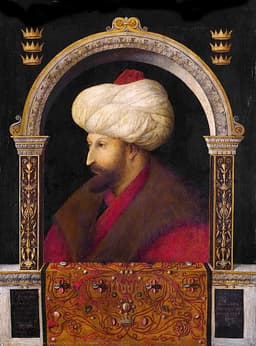
Mehmed II
Emperor · Medieval
66.8Total
Taejong of Joseon
Emperor · Medieval
63.1Total
Basic Information
Born
1432
1367
Died
1481
1422
Era
Medieval
Medieval
Nationality
Ottoman Empire
Korea
Occupation
Emperor
Emperor
Civilization
Middle Eastern
Eastern
Score Comparison
Military (10%)
77.5
67.5
Political (20%)
70.3
70.0
Influence (20%)
40.0
55.0
Legacy (20%)
75.0
55.0
Leadership (15%)
78.0
78.0
Strategy (15%)
80.3
66.3
TOTAL
66.8
63.1
Mehmed II — Complete Timeline
1453 AD
Siege of ConstantinopleWar
Mehmed II led the Ottoman army in a 53-day siege of Constantinople, the capital of the Byzantine Empire. The city fell on May 29, 1453, after Ottoman forces breached the walls. This conquest ended the Byzantine Empire and established Constantinople as the Ottoman capital, later renamed Istanbul.
ConquestByzantine EmpireOttoman Expansion
Impact: global
1456 AD
Siege of BelgradeWar◆ Major
Mehmed II led a large Ottoman army to besiege Belgrade, a key Hungarian fortress. The siege was broken by a Christian relief force led by John Hunyadi. The Ottoman army suffered heavy losses and was forced to retreat. This defeat halted Ottoman expansion into Hungary for decades.
SiegeDefeatHungary
Impact: regional
1461 AD
Conquest of the Empire of TrebizondWar◆ Major
Mehmed II led a military campaign against the Empire of Trebizond, the last major Byzantine Greek successor state. After a siege of the capital, Emperor David Megas Komnenos surrendered. This conquest eliminated the final remnant of Byzantine authority in Anatolia.
ConquestAnatoliaByzantine Successor
Impact: regional
1478 AD
Codification of Ottoman Law (Kanunname)Reform◆ Major
Mehmed II issued the Kanunname, a comprehensive legal code that systematized Ottoman criminal, administrative, and land law. This code defined the powers of the sultan, the structure of the bureaucracy, and the rights of subjects. It provided a legal framework for the expanding empire.
Legal ReformOttoman LawAdministration
Impact: nationalconstructive
1480 AD
Invasion of OtrantoWar
Mehmed II ordered an Ottoman fleet to invade the Italian city of Otranto. Ottoman forces captured the city and massacred many inhabitants. This invasion established a temporary Ottoman foothold in Italy, causing alarm among Italian states. The occupation ended after Mehmed's death.
InvasionItalyOttoman Expansion
Impact: regionaldestructive
Taejong of Joseon — Complete Timeline
1392 AD
Participation in the Founding of JoseonPolitical Action◆ Major
Taejong, as Prince Yi Bang-won, played a key role in helping his father Yi Seong-gye establish the Joseon dynasty. He led military campaigns and eliminated rivals, including the assassination of Jeong Mong-ju.
Dynasty FoundingPower StrugglePolitical Violence
Impact: national
1398 AD
First Prince's RebellionPolitical Action◆ Major
Taejong led a coup against his own brothers and the prime minister Jeong Do-jeon, killing them to secure his position as heir. This rebellion consolidated his power but caused a bloody succession crisis.
CoupSuccession CrisisPolitical Purge
Impact: nationaldestructive
1401 AD
Reform of Government and MilitaryReform◆ Major
Taejong implemented administrative reforms, including the establishment of the Uijeongbu (State Council) and a centralized military system. These reforms strengthened royal authority and reduced the power of aristocratic families.
Government ReformCentralizationMilitary Reform
Impact: nationalconstructive
1402 AD
Purge of Scholar-OfficialsPolitical Action◆ Major
Taejong purged hundreds of scholar-officials who opposed his rule, executing or exiling them. This eliminated dissent but created a climate of fear, solidifying his authoritarian control.
PurgeRepressionAuthoritarianism
Impact: nationaldestructive
1418 AD
Abdication in Favor of SejongPolitical Action◆ Major
Taejong abdicated the throne to his son Sejong the Great, but continued to influence state affairs as a retired king. This transition ensured a stable succession and allowed Sejong to implement his own reforms.
AbdicationSuccessionSejong the Great
Impact: nationalconstructive
Expert Analysis
Origins
Mehmed II was born on March 30, 1432, in Edirne, the Ottoman capital. He was the fourth son of Sultan Murad II and a slave concubine, Hüma Hatun. Mehmed received a rigorous education in Islamic sciences, history, and military tactics, studying under prominent scholars like Molla Gürani. His early exposure to the imperial court and military campaigns shaped his ambition. In contrast, Taejong of Joseon was born on June 13, 1367, as Yi Bang-won, the fifth son of Yi Seong-gye (later King Taejo) and Queen Sinui. He grew up in a turbulent period of late Goryeo, witnessing his father's rise through military prowess. Yi Bang-won was educated in Confucian classics and martial arts, passing the civil service examination in 1382 at age 15. His family background as a military commander's son instilled a pragmatic and ruthless political instinct.
Rise to Power
Mehmed II first ascended the throne in 1444 at age 12 after his father Murad II abdicated. However, due to external threats and internal instability, Murad returned to power, and Mehmed was sidelined. Mehmed regained the throne in 1451 upon Murad's death. His first major act was preparing for the conquest of Constantinople. He built the fortress Rumeli Hisarı on the Bosporus in 1452, blockaded the city, and assembled a massive army and fleet. The 53-day siege culminated on May 29, 1453, when Ottoman forces breached the walls. This victory cemented his authority and earned him the title "the Conqueror." Taejong's rise was marked by a bloody coup. He helped his father found the Joseon dynasty in 1392, but when Taejo favored his youngest son, Yi Bang-seok, as heir, Yi Bang-won launched the First Prince's Rebellion in 1398. He killed his half-brothers and the prime minister Jeong Do-jeon, seizing de facto power. He formally became king in 1400 after his elder brother abdicated. His path to power involved fratricide and purges, contrasting with Mehmed's military conquest.
Leadership & Governance
Mehmed II ruled as an absolute monarch, centralizing authority through legal codification. He issued the Kanunname, a comprehensive legal code that systematized criminal, administrative, and land law, defining the sultan's powers and state structure. He also practiced religious tolerance, allowing the Greek Orthodox Church to operate under Patriarch Gennadius II, whom he appointed. Militarily, he expanded the empire into Serbia, Bosnia, and the Empire of Trebizond. His leadership style was hands-on, personally leading campaigns. Taejong, in contrast, focused on institutional consolidation. He established the Uijeongbu (State Council) to streamline governance and reformed the military into a centralized system under the king's control. He purged scholar-officials who opposed him, executing hundreds to eliminate dissent. However, he also promoted Confucian ideals, supporting the compilation of historical records and agricultural improvements. While Mehmed built an empire through conquest, Taejong built a stable dynasty through ruthless internal reform.
Triumph & Tragedy
Mehmed II's greatest triumph was the conquest of Constantinople, which ended the Byzantine Empire and transformed the Ottoman state into a major power. He also codified laws and fostered cultural patronage, including the construction of the Topkapı Palace and the Fatih Mosque. However, his failures include the failed Siege of Belgrade in 1456, where John Hunyadi repelled his forces, and the costly invasion of Otranto in 1480, which was eventually reversed. His later campaigns in the east against Uzun Hasan achieved mixed results. Taejong's triumphs include successfully establishing the Joseon dynasty's legitimacy through administrative reforms and a smooth transition to his son Sejong the Great, who became one of Korea's most celebrated rulers. His tragedy lies in his violent purges: he executed many loyalists, including his own in-laws, creating a climate of fear. His legacy is tainted by the bloodshed of his rise and reign, despite his effective governance.
Character & Destiny
Mehmed II was known for his intellectual curiosity, speaking multiple languages including Turkish, Arabic, Persian, Greek, and Latin. He was ambitious, calculating, and ruthless, exemplified by his execution of the Byzantine emperor Constantine XI and the subsequent massacre. His strategic mind scored 80.3, reflecting his ability to plan the Constantinople siege meticulously. Yet his hubris led to overreach at Belgrade and Otranto. Taejong was pragmatic and coldly rational, willing to sacrifice family and officials for political stability. His leadership score of 78.0 matches his decisive actions, but his paranoia and insecurity drove purges. While Mehmed's destiny was shaped by external conquest, Taejong's fate was determined by internal power struggles. Both men shaped their states' trajectories through force of will, but their methods reflected different contexts: Mehmed expanded an empire, Taejong consolidated a dynasty.
Legacy
Mehmed II's legacy is monumental: he ended the medieval Byzantine Empire, opened the Ottoman Golden Age, and influenced European history by spurring the Age of Discovery. His legal code remained influential for centuries. He scored 75.0 in legacy, reflecting his lasting impact on the Ottoman Empire and world history. Taejong's legacy score of 55.0 is lower, but he is remembered as a key architect of Joseon's stability. His reforms enabled Sejong's cultural achievements, including the creation of Hangul. However, his violent methods are often criticized. Mehmed's influence spread across three continents, while Taejong's impact was largely confined to Korea. The total score gap of 3.7 points (66.8 vs 63.1) reflects this broader impact.
Conclusion
Mehmed II had a greater impact on world history than Taejong of Joseon. His conquest of Constantinople was a turning point that reshaped geopolitics, triggered the Renaissance's cultural shift, and established the Ottoman Empire as a dominant power for centuries. While Taejong's internal consolidation was crucial for Korea, it lacked the global repercussions of Mehmed's actions. Mehmed's military score of 77.5 outperforms Taejong's 67.5, and his strategy score of 80.3 exceeds 66.3. Despite Taejong's political acumen (70.0 vs 70.3, nearly equal), Mehmed's innovative governance and expansive vision place him above. Thus, Mehmed II emerges as the more consequential historical figure.
Rankings
🥇
Mehmed IILeader
Mil: 77.5Pol: 70.3Inf: 40.0
66.8
🥈
Taejong of Joseon
Mil: 67.5Pol: 70.0Inf: 55.0
63.1
+3.7 behind
How This Comparison Works
Algorithm
Each figure is scored on 6 dimensions (0—100 scale) based on structured historical data: Military (10%), Political (20%), Influence (20%), Legacy (20%), Leadership (15%), Strategy (15%). The weighted total produces the final ranking.
Data Sources
Scores are computed from structured sub-indicators in the database. Scale factors adjust for era (Ancient ×0.85, Modern ×1.0) and civilization size (Eastern ×1.05, Other ×0.80) to account for differences in population and military scale.
Maximum 3 Figures
Comparisons are limited to 2—3 figures to ensure readability and statistical meaningfulness.
Error Margins
±5 points per dimension — Sub-scores are derived from historical records with inherent uncertainty. Two figures within 5 points on a dimension should be considered roughly equivalent in that area.
Total Score Accuracy
±3 points overall — The weighted combination of 6 dimensions produces a total score with approximately ±3 points of uncertainty. Differences of less than 3 points are not statistically significant— the figures are effectively tied.
Known Limitations
- Historical records are incomplete and uneven across civilizations
- Figures from oral-tradition societies may be underrepresented
- Occupation labels can misclassify multi-role figures
- Scores measure capability and impact, not moral character
- Quantitative scoring is a comparison tool, not absolute truth
Capability Radar
Military (10%) — Battles & Warfare
Battles
95
65
Win Rate
90
70
Expansion
95
55
Political (20%) — Governance & Reform
Reform
90
90
Diplomacy
85
70
Economy
80
75
Influence (20%) — Cultural & Global Reach
Cultural
85
60
Global
90
45
Legacy (20%) — Historical Impact
Historical
95
75
Longevity
90
70
Leadership (15%) — Power & Stability
Tenure
85
85
Stability
75
80
Strategy (15%) — Tactics & Innovation
Strategy
95
75
Tactics
95
60
Reform
85
80
Similar Comparisons
Comments & Discussion
No comments yet. Be the first to share your thoughts!